Buyers of Raw Housing Urge Government for Legal Amendments
Residents Worry About Penalty Fees
Buyers Near Completion Face Final Payment Loan Issues
Sales Difficult, Some with Negative Equity of 100 Million Won
Officetel Use Change Blocked by District Unit Plans
Penalty Fees to Be Imposed from Next Year, Ministry of Land Sticks to Principles
"Banks require registration as lodging businesses to provide loans. Even then, you have to go to tertiary financial institutions to get 20-50%. If registered as lodging businesses, the landlords cannot reside there, so they cannot get loans." (Official from the National Residence Association)
"By the end of this year, enforcement fines will be imposed, and we will be forced onto the streets, which is deplorable. The central government says to change the usage, but local governments say they cannot accept it." (Buyer of Byeollae Saengsuk)
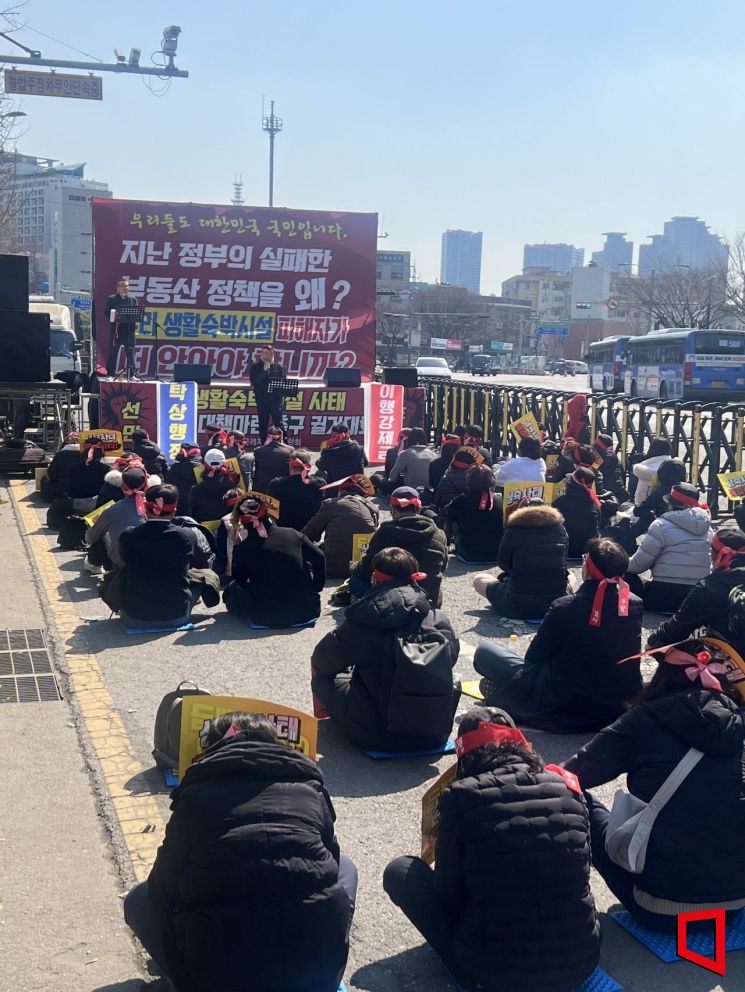 On the 21st, the National Residence Federation held a rally in front of the Samgakji Police Station in Yongsan-gu, Seoul, urging measures for residential lodging facilities.
Buyers of life-type lodging facilities have demanded amendments to related laws so they can reside in these units as residential spaces. In complexes nearing move-in, final payment loans are not properly issued, and if lodging business registration is not done, enforcement fines will be imposed. The Ministry of Land, Infrastructure and Transport (MOLIT) maintains the principle that "there will be no change to quasi-housing," so conflicts are expected to continue.
On the 21st, the National Residence Association held a rally in front of the Samgakji Police Station in Yongsan-gu, Seoul, urging measures for life-type lodging facilities. About 250 buyers, ranging from people in their 30s to middle-aged, attended. They wore red headbands and waved placards with slogans such as "Resolve the Saengsuk Crisis" and "Abolish Enforcement Fines." After the rally, the association submitted a petition to the Presidential Office.
Life-type lodging facilities refer to lodging facilities where cooking is possible. They are non-residential, so they are not counted as housing units, and building standards such as parking lots and corridors are more relaxed than those for residential officetels. They do not require subscription savings accounts and are cheaper than mixed-use residential apartments, making them popular during the real estate market boom. As speculative demand surged, the government specified life-type lodging facilities as lodging business registration targets and amended the Enforcement Decree of the Building Act in 2021 to prohibit their use as housing.
Along with the amendment of the Enforcement Decree, MOLIT granted a special period until last year to allow changing the use of life-type lodging facilities to residential officetels, but only 1,996 units out of 98,000 changed use, accounting for just 2%. The building standards for officetels are stricter than those for life-type lodging facilities, making use changes difficult.
Both Residents and Buyers Awaiting Move-in Are at a Loss
Buyers residing in already completed life-type lodging facilities are troubled because they cannot register as lodging businesses. A man in his 60s living in a life-type lodging facility in Byeollae, Namyangju, said, "When I bought it, I was told residence was possible, but now they say it is not. I have already disposed of my previous home, and since it cannot be sold, I am at a loss."
Kim Min-ho, director of the National Residence Association, lamented, "Residents cannot register as lodging businesses because they cannot live there if they do, and the government has messed up life-type lodging facilities, so even if they put them up for sale, they do not sell. Those who received existing apartments are left stranded, and newlyweds have to buy an additional home."
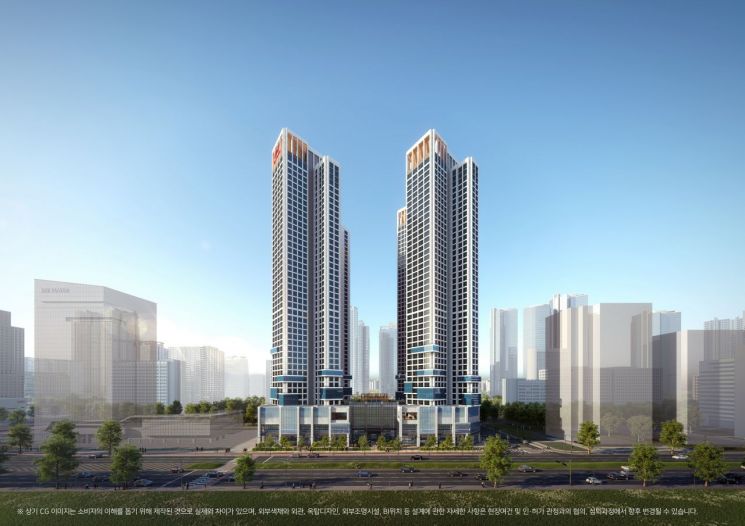
To change the use to residential officetels, consent from all contract holders is required. Even with residents' consent, local governments may not allow use changes depending on the district unit plan of the area where the project is located.
Kim Kyung-jin, vice chairman of the National Residence Association, said, "Even if 100% resident consent is obtained, changes may not be possible depending on the authority of each local government (district unit plan)."
With the final payment loan limit for life-type lodging facilities dropping to less than half, buyers are now worried about securing the final payment. A buyer of Hillstate Songdo Stay Edition said, "I don't even know what the district unit plan is. I bought a life-type lodging facility to live comfortably, but the final payment loan is not coming out. I earnestly ask the government to allow life-type lodging facilities to be converted to officetels."
Refusal to Pay Final Payment... Negative Premium of 1 Billion KRW
Buyers of Magok Lotte Castle Le West, scheduled for completion in August, are resisting by refusing to pay the final payment if residential conversion is not realized. Some buyers are giving up their deposits and listing properties with negative premiums. The price for an 88㎡ unit is 1.4 billion KRW, but a negative premium exceeding 1.55 billion KRW is attached. A 49㎡ unit is priced at 856.8 million KRW with a negative premium of 95 million KRW.
The situation is no different at Hanwha Forena Cheonan Asan Station, a 70-story building under construction near Asan Station in Chungnam. A 117㎡ unit is priced at 876 million KRW with a negative premium of 85 million KRW. A 99㎡ unit is priced at 740 million KRW with a negative premium of 57 million KRW.
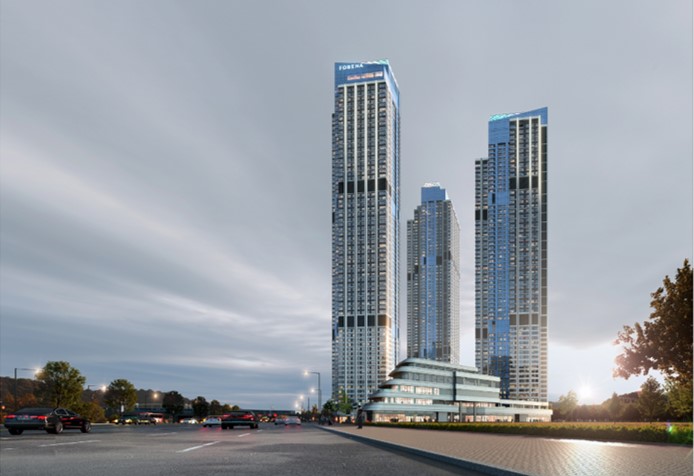
Hillstate Songdo Stay Edition, scheduled for completion in June, also has a negative premium exceeding 1 billion KRW. A 96㎡ unit is listed at 633 million KRW with a negative premium of 1 billion KRW, and an 83㎡ unit is priced at 537 million KRW with a negative premium of 70 million KRW.
Buyers of Foreena The Island in Yeosu Ungcheon are pursuing use changes by purchasing additional land to build an attached parking lot. The parking space standard for residential officetels is one space per household, but for life-type lodging facilities, it is one space per 200㎡, which is about one space per three households.
Enforcement Fine Grace Period Ends This Year, MOLIT Says "No Further Extension"
Buyers will be subject to enforcement fines starting next year. The enforcement fine is 10% of the building's standard market value. MOLIT strengthened related regulations in 2021 to impose enforcement fines if life-type lodging facilities are not used as lodging facilities. The imposition of enforcement fines was deferred until the end of this year, but no further extensions are being considered.
An MOLIT official explained, "If something not designated as housing is used as housing, enforcement fines must be paid, so time was given to register as lodging businesses. We will not impose fines immediately from January next year, but there will be no additional extensions."
MOLIT holds the position that blanket use changes or legal amendments are difficult considering residential conditions and fairness with housing owners. An MOLIT official said, "It is hard to accept calling life-type lodging facilities quasi-housing when the standards for residential officetels have not even been met. Allowing life-type lodging facilities as residential would cause complex issues such as parking, schools, and fairness for contract holders who remodeled in compliance with the law. We cannot create more victims."
Lee Eun-hyung, a research fellow at the Korea Institute of Construction Policy, said, "Even if the paperwork changes to officetels, it will be difficult to convert in areas with district unit plans where residential officetels are not planned. Life-type lodging facilities were created to allow lodging business in officetel form, and they do not fit officetel standards from the start. There could be controversy over preferential treatment regarding use changes, so leaving it to the market is best."
© The Asia Business Daily(www.asiae.co.kr). All rights reserved.



















