Fines Imposed on Unlicensed Massage Therapists
80,000 Establishments, 300,000 Workers
Legislative Improvements Needed to Reflect Social Changes
Recently, as the number of massage establishments such as sports and Thai massage shops has been increasing, fines have been consecutively imposed on unqualified masseurs. It is estimated that there are about 80,000 massage establishments and 300,000 workers in South Korea, but under current law, only visually impaired individuals are allowed to provide massage services.
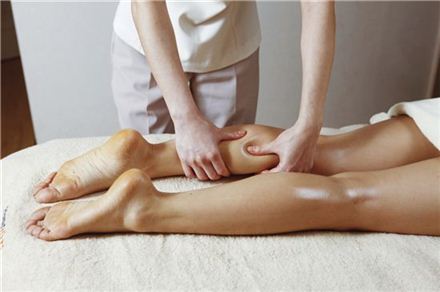 Massage image. [Photo by Asia Economy DB]
According to the legal community on the 21st, Judge Jo Aram of the Seoul Eastern District Court Criminal Division 7 sentenced A (59) to a fine of 2 million won on the 8th for violating the Medical Service Act. A was indicted for operating a massage parlor in Songpa-gu, Seoul, last June without a masseur license. A established two businesses, hired employees, and charged customers between 50,000 and 130,000 won per session. Judge Lee Minji of the Seoul Eastern District Court Criminal Division 4 also sentenced B (43), the owner of a massage business in Gangdong-gu, Seoul, to a fine of 3 million won last December. The B business was effectively operated by someone without a masseur license and employed Thai nationals.
According to the current Medical Service Act, masseur qualifications are granted only to visually impaired persons, and those who provide massage services for profit without qualifications face imprisonment of up to three years or fines of up to 30 million won. The scope of a masseur’s duties, as defined by the Ministry of Health and Welfare, includes “various manual therapies such as massage, shiatsu, use of electrical devices, and other stimulation therapies involving physical treatment of the human body.” This effectively covers all types of massage, leading to ongoing criticism that it infringes on freedom of occupation.
However, since 2008, the Constitutional Court has ruled constitutionally valid four times to guarantee the livelihood rights of the visually impaired. In December 2021, the court acknowledged that “the qualification clause monopolizing massage work for the visually impaired does restrict the general public’s freedom to choose their occupation,” but stated that “since massage is almost the only occupation that visually impaired people can normally pursue, it must be seen as an unavoidable choice to guarantee their right to livelihood.” The constitutional petitions at that time were filed by non-visually impaired operators of massage parlors and massage centers.
Experts point out the need for system improvement regarding the current law, which faces the contradictory situation of being a ‘legalized illegality.’ Professor Han Sanghee of Konkuk University Law School said, “When professional occupations were legislated in South Korea, they were defined too broadly and abstractly. This has revealed legislative flaws, and in the case of masseurs, the law has not kept pace with changes in modern society.” He added, “In the past, when welfare systems were underdeveloped, it was a concept to protect the livelihood of the visually impaired, but now it should be entrusted to the free market economy.”
© The Asia Business Daily(www.asiae.co.kr). All rights reserved.
![Clutching a Stolen Dior Bag, Saying "I Hate Being Poor but Real"... The Grotesque Con of a "Human Knockoff" [Slate]](https://cwcontent.asiae.co.kr/asiaresize/183/2026021902243444107_1771435474.jpg)















