Jang Ye-chan's Harsh Remarks, Independent Candidacy Splits Conservative Votes
Lee Jun-seok Struggles, Trailing Gong Young-woon by Twice the Support
Cheon A-yong's Minimal Presence, Criticizes Yong Hye-in's Self-Nomination
With just over 20 days remaining until the April 10 general election, young politicians are failing to stand out. Although the public's desire for young and fresh figures for the future is growing, there is an increasing fatigue toward the political behavior of young politicians who imitate established politicians.
According to political circles on the 20th, controversy surrounding Jang Ye-chan, former Youth Supreme Council member of the People Power Party whose nomination for Busan Suyeong District was canceled due to inappropriate remarks in the past, is not easily subsiding. Although he bowed his head at a press conference, calling his past harsh remarks "a slip of the tongue in his 20s," he is pushing ahead with an independent candidacy, saying, "When will the killing of Jang Ye-chan, who is being accused of suspicions not even present in private SNS posts from 10 years ago, end?" This passage reads as expressing grievance over what he perceives as a politically motivated attack rather than genuine remorse. A People Power Party official expressed concern, saying, "Since he declared his independent candidacy, the vote among the ruling party's supporters is likely to be split, making it difficult to guarantee victory in the general election."
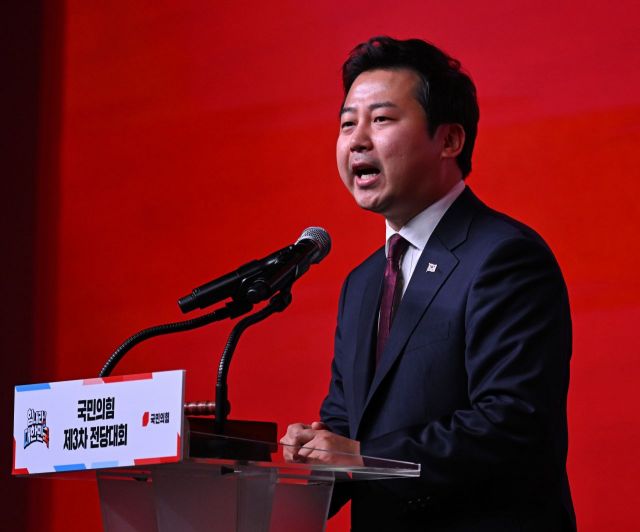 Jang Ye-chan, the newly appointed Youth Supreme Committee member of the People Power Party, is delivering an acceptance speech at the 3rd Party Convention of the People Power Party held on the 8th at KINTEX in Ilsan, Gyeonggi Province. Photo by Kim Hyun-min kimhyun81@
Lee Jun-seok, leader of the Reform New Party and a young politician mentioned as a potential next presidential candidate, is also facing a tough battle for victory in the general election. In a poll conducted in Hwaseong, Gyeonggi Province, where Lee is running, he trails by a twofold margin behind Gong Young-woon, a former Hyundai Motor executive and candidate from the Democratic Party of Korea. According to a survey conducted by Hangil Research on the 15th and 16th, commissioned by Gyeongin Broadcasting and Incheon Ilbo, targeting 503 men and women aged 18 and over residing in Hwaseong (response rate 6.3%, margin of error ±4.4% at 95% confidence level), Gong received 46.2%, Lee 23.1%, and Han Jeong-min of the People Power Party 20.1%.
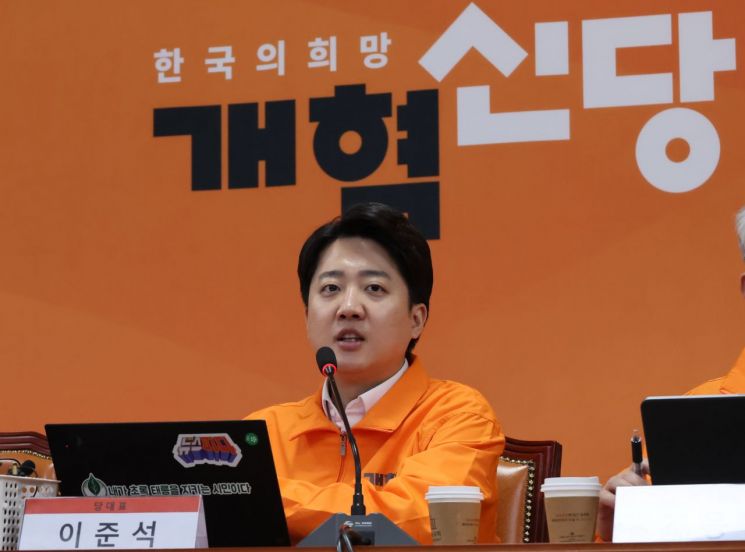
The Reform New Party’s stagnant single-digit support rate is also an obstacle. Although it initially gained momentum among male voters in their 20s, the party’s support has struggled to rebound after the merger with Lee Nak-yeon’s New Future Party fell through just 11 days later. Some critics argue that Lee’s label of 'rudeness theory' ('ssagajiron') shows no difference from established politicians. In response to this on a recent radio show, Lee said, "If the criticism is 'How can the party leader act like that?' I would accept it, but 'How can a young person act like that?' is a bit off."
Contrary to expectations, the Lee Jun-seok faction known as 'Cheon-A-Yong-In' (Cheon Ha-ram, Heo Eun-ah, Kim Yong-tae, Lee Gi-in) also has a minimal presence. Kim Yong-tae, former Youth Supreme Council member who remains in the People Power Party, has secured his nomination and is raising expectations, but the other members face difficulties winning the general election and entering the National Assembly due to the Reform New Party’s weak support. The 'self-nomination' of Yong Hye-in, a member of the Democratic United Party, is also controversial. The Democratic United Party, a satellite party of the Democratic Party, placed Yong sixth on its proportional representation list, making her re-election via proportional representation likely. Yong previously entered the National Assembly as a proportional representative of the Democratic Citizens Party in the last general election.
© The Asia Business Daily(www.asiae.co.kr). All rights reserved.
!["The Woman Who Threw Herself into the Water Clutching a Stolen Dior Bag"...A Grotesque Success Story That Shakes the Korean Psyche [Slate]](https://cwcontent.asiae.co.kr/asiaresize/183/2026021902243444107_1771435474.jpg)

















