62% Say "Global Economy Will Achieve Soft Landing Next Year"
Wall Street's optimism about the stock market has reached its highest level in the past two years.
On the 19th (local time), CNBC reported this citing a Bank of America (BoA) survey of 226 fund managers.
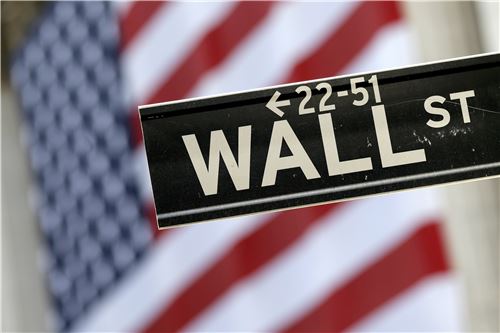 Wall Street Sign (Asia Economy = Yonhap News)
In this survey, the BoA sentiment index, based on recent cash holdings, economic outlook, and equity allocations, recorded 4.6. This is a 0.3-point increase from 4.3 in February, marking the highest level since January 2022.
Fund managers slightly increased the cash proportion in their managed assets to 4.4%, up from 4.2% in February. This indicates a growing risk-averse sentiment, although it is lower than January's 4.8%. Michael Hartnett, BoA's Chief Investment Strategist, said, "It is optimistic but not extremely optimistic." While excessive optimism in the market can signal a good time to sell assets, maintaining cash balances above 4% suggests there is still room for further gains.
Risk appetite, which shows how much risk investors are willing to take, also reached its highest level since November 2021. Preference for low-dividend stocks is at its highest since December 2021. Respondents to the survey predicted that small-cap stocks will outperform large-cap stocks in the future.
The outlook for global growth also showed the highest level since January 2022. Chief Investment Strategist Hartnett said, "Stock price increases are leading (economic growth expectations)." The S&P 500 index, focused on large-cap stocks in the New York Stock Exchange, rose 24% last year and has increased about 8% this year, surpassing the 5100 mark for the first time ever. Amid the AI boom driving the market, technology, telecommunications, and energy stocks have shown notable gains.
The proportion of those expecting a global recession next year was at its lowest since February 2022. 62% of respondents answered that the economy will experience a soft landing, and 23% expected a no landing scenario with continued growth without recession. Only 11% anticipated a recession. This contrasts with the October 2023 survey, where 30% of respondents expected a recession.
As optimism spreads and risk appetite rises, perspectives on corporate cash usage have also changed. Investors have traditionally preferred debt repayment over shareholder returns. However, in this survey, the preference for companies prioritizing dividends and share buybacks was the highest since July 2015.
CNBC analyzed that the rapid slowdown in U.S. corporate debt, totaling $27.3 trillion (approximately 3,650.3 trillion KRW), supports this trend. Non-financial business debt increased by only 2.2% in 2023, the lowest growth since 2014.
When asked about the biggest tail risk (a low-probability but high-impact risk), 32% pointed to inflation. With recent inflation indicators exceeding expectations being released daily, this response increased by 5 percentage points compared to the previous month's survey. Following inflation, respondents cited geopolitics (21%), hard landing (16%), and the U.S. presidential election (14%).
© The Asia Business Daily(www.asiae.co.kr). All rights reserved.
















