KDI "Fundamental Reform of Labor Market Structure Needed"
Employment insecurity experienced by middle-aged and older workers in Korea was found to be the highest among OECD countries, excluding T?rkiye.
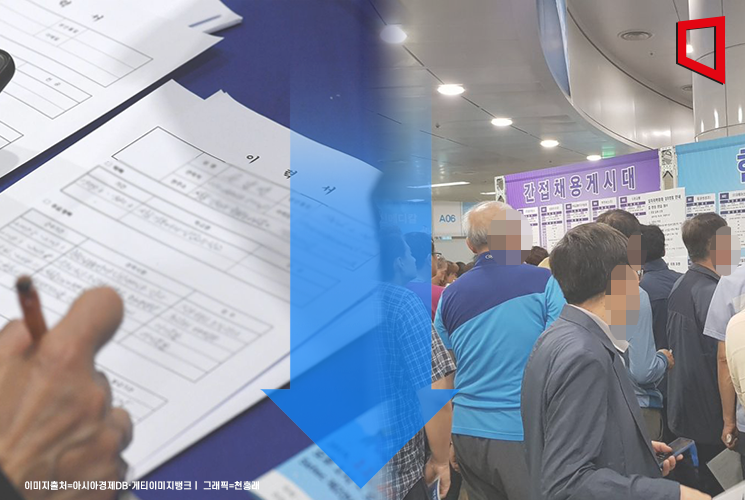
Han Yosep, a research fellow at the Korea Development Institute (KDI), revealed this in the report titled "KDI Focus: Measures to Restore Labor Market Functions to Overcome Employment Insecurity among Middle-Aged and Older Workers," published on the 20th.
According to the study, the proportion of Korean male workers aged 55-59 with less than one year of tenure reached 26.8% (as of 2021). This is the highest figure among OECD countries, except for T?rkiye.
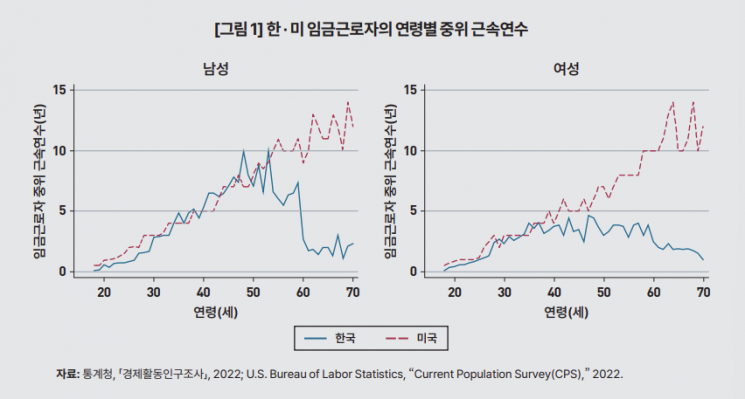
In particular, employment insecurity among middle-aged and older wage workers in Korea was even higher compared to the United States, which is known for its flexible labor market with easy dismissals.
Looking at the median tenure of wage workers by age, for male wage workers, the increase in median tenure stopped in the mid-40s and sharply declined from the 50s. For women, the median tenure did not increase further after the mid-30s.
Han stated, "This difference becomes even more apparent for both men and women after the current institutional minimum retirement age of 60," adding, "It shows that it is much more difficult to remain employed at the same workplace after middle age in Korea compared to the United States."
The rapid increase in employment insecurity after middle age in Korea is due to the fast-growing proportion of non-regular workers among middle-aged and older workers. As of 2022, the proportion of temporary workers among wage workers aged 55-64 was 33.2% for men and 35.9% for women, the highest levels among OECD countries, with a gap of more than 10 percentage points compared to second-ranked Japan. The OECD average is 8.2% for men and 9.0% for women.
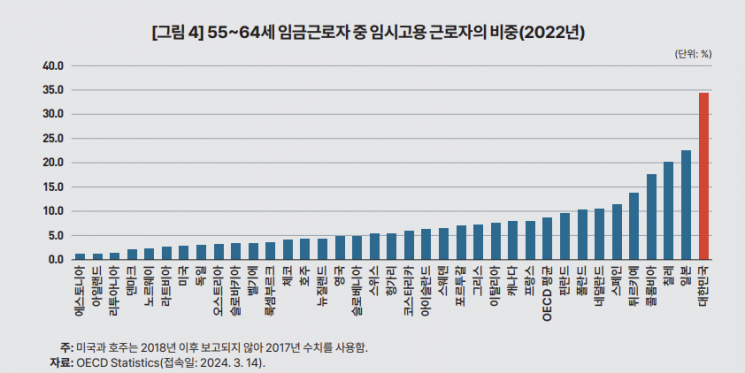
However, the more fundamental cause is the lack of demand for regular employment for middle-aged and older workers themselves. Han pointed out, "There is a shortage of jobs in the middle-aged labor market, and high-wage, high-skilled jobs are very scarce, aside from low-wage, low-skilled jobs."
As of 2019, the proportion of regular employment relative to the population was only 32.2% for men aged 55-64 and 43.1% for women aged 25-54. This is significantly lower than the OECD average (excluding Israel and Mexico) of 47.2% and 50.3%, respectively, during the same period.
Han emphasized, "Low demand for regular employment among middle-aged workers leads to a dual labor market structure," and added, "Since meaningful improvements are difficult under the current labor market conditions, fundamental reforms of the labor market structure are necessary."
To fundamentally reform the labor market structure, Han argued that the seniority-based wage system for regular workers should first be relaxed, especially in large corporations and the public sector. He suggested that wage increases based on seniority should be principally limited after periods of rapid productivity growth in the public sector, and wage increases should be based on job roles and performance.
Regarding employment protection for regular workers, he pointed out the need for changes that increase predictability in the dismissal process compared to the current system. He added that, similar to overseas cases, monetary compensation for unfair dismissal should increase proportionally with tenure but should have certain upper and lower limits.
Finally, he emphasized the need to "eliminate the still widespread blind spots in employment insurance, especially for non-regular workers, and enhance the effectiveness of job search support."
© The Asia Business Daily(www.asiae.co.kr). All rights reserved.
![User Who Sold Erroneously Deposited Bitcoins to Repay Debt and Fund Entertainment... What Did the Supreme Court Decide in 2021? [Legal Issue Check]](https://cwcontent.asiae.co.kr/asiaresize/183/2026020910431234020_1770601391.png)

















