OECD AI Report: Office Workers Use AI to Assist Tasks
High AI Utilization but Concerns Over Job and Wage Reduction
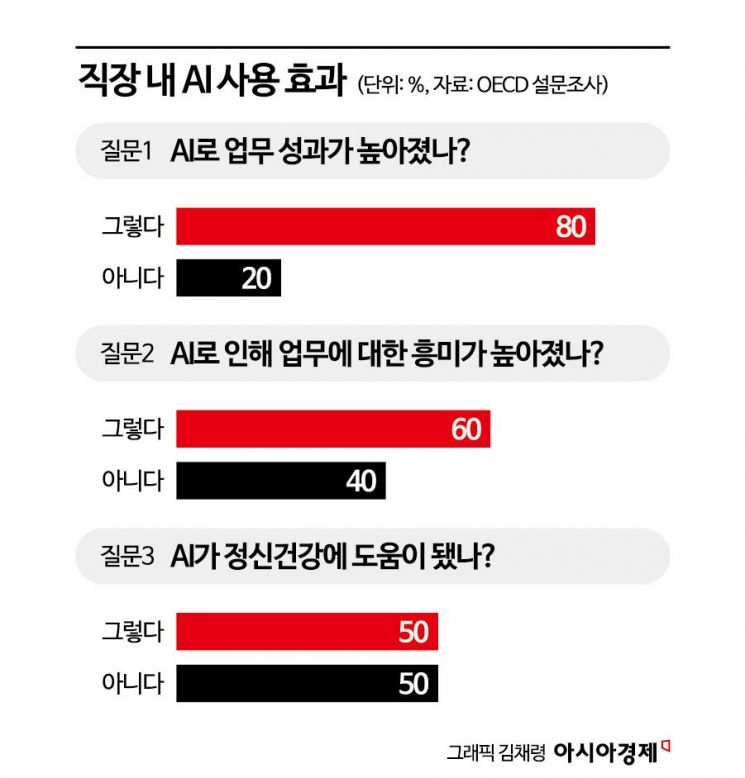
A survey found that 80% of workers in major countries using artificial intelligence (AI) reported that it helps them with their work. It is pointed out that the gap between occupations may widen further depending on the level of AI utilization. There are also warnings that the spread of AI could threaten existing jobs and wages, necessitating government measures to address this issue.
According to the OECD's report "AI Use in the Workplace" released on the 20th, four out of five workers using AI said their work performance improved. Additionally, three out of five said AI helped increase their interest in their work.
The OECD prepared this report based on a survey conducted last year of 5,334 workers and employers in major member countries including the United States, the United Kingdom, France, Germany, and Canada. The survey targeted employees in the finance and manufacturing sectors. Key topics included how AI is used in the workplace, its impact on management and working conditions, as well as on workers' productivity and wages.
The survey results showed that both workers and employers believed AI had a positive effect on workers' productivity and working conditions. Employers especially noted that AI increased employee productivity. In manufacturing, 63% of employers, and in finance, 57%, said AI use helped improve worker productivity.
Gender and education disparities in AI utilization were also observed. Generally, male workers and those with higher education were more positive about AI use. This is likely because men and highly educated individuals are more often in managerial positions with higher AI utilization.
The OECD emphasized that not investing in AI and not adopting AI in the workplace is equivalent to missing opportunities to improve productivity and job quality. It warned that unequal access to and use of AI in the workplace could widen gaps not only between companies and workers but also between countries.
It also projected that AI development could reduce workers' jobs and wages, causing inequality. According to the survey, 60% of workers worried about losing their jobs to AI within the next 10 years, and 40% believed AI could reduce wages in their field. Among finance workers, 19% were very concerned about losing their jobs to AI within two years, while 14% of manufacturing workers feared job loss within two years.
The OECD analyzed that AI is likely to replace jobs with a high automation rate first. It estimated that occupations at highest risk of automation account for 27% of total employment. The OECD advised governments to help workers who lose jobs due to AI transition to new jobs created in other sectors.
Forty percent of surveyed workers believed AI could reduce wages in their sector. They anticipated wage decreases rather than increases as AI replaces parts of their work.
Warnings about economic inequality caused by AI have come not only from the OECD but also from various sources. The Brookings Institution in the United States recently reported that AI development could devalue human labor and worsen economic inequality, which could ultimately threaten democracy. A survey by Deloitte AI Institute earlier this year of 2,800 corporate executives from 16 countries found that more than half of respondents (51%) believed that widespread generative AI would exacerbate economic inequality.
Concerns about privacy violations due to AI were also raised. The OECD diagnosed that as AI use in the workplace increases, data collection and analysis on workers to operate such systems will also increase, potentially leading to privacy infringements. To reduce privacy concerns, it argued that governments need to consider measures to restrict personal data collection.
© The Asia Business Daily(www.asiae.co.kr). All rights reserved.


















