KCCI, Employment Flow Report for Vulnerable Workers in Their 40s
Despite an overall increase in employment last year, the number of employed people in their 40s decreased. There are concerns that the government's employment policies, which have been relatively focused on youth, the elderly, and women, are leaving middle-aged men in a blind spot, threatening their job security.
On the 20th, the Korea Employers Federation released a report analyzing the employment market by age group over the past decade. A notable point is the number of employed people in their 40s. Last year, it was 6.26 million, down by 45,000 from the previous year. This contrasts with the total number of employed people, which increased by more than 320,000 to 28.42 million in 2023 from 28.09 million in 2022. The only age groups with a decrease in employment numbers were those in their 20s and 40s, both of which also saw population declines.
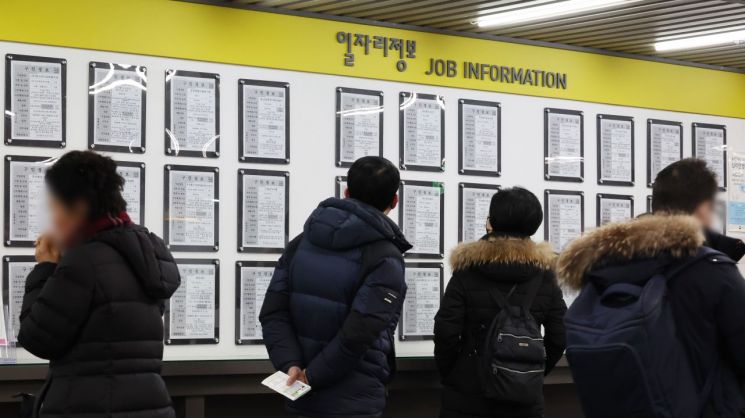 Job seekers visiting the Seoul Western Employment Welfare Plus Center in Mapo-gu, Seoul, are looking over job information.
 [Photo by Yonhap News]
Among employed people in their 40s, 59% were men and 41% were women. The number of employed men decreased every year, while the number of employed women began to increase after 2022. The proportion of wage workers steadily rose, whereas the proportion of non-wage workers such as self-employed individuals steadily declined. Changes in the industrial structure also had an impact. The number of employed people in manufacturing in their 40s decreased by more than 150,000 compared to ten years ago.
Last year, the number of people in their 40s with side jobs was 98,000, showing a steady increase since the COVID-19 pandemic. This indicates that more people have taken on additional work to earn extra income due to worsening business conditions and high interest rates after the pandemic.
The number of economically inactive people in their 40s last year was 1.582 million, down by 85,000 compared to ten years ago. Notably, during this period, the number of women decreased by nearly 160,000, while the number of men increased by more than 70,000. This suggests a larger scale of labor market withdrawal among men. At the time of the survey, 270,000 respondents said they were simply resting. This means that the pool of idle labor in their 40s has increased accordingly.
Last year, the number of women in their 40s who experienced career interruptions was 590,000, surpassing for the first time the number in their 30s (540,000) since related surveys began. This appears to be due to women marrying and having children later than in the past, thus delaying the timing of career breaks.
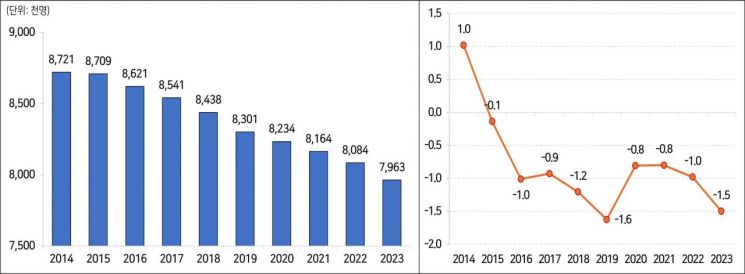 Population Size and Population Growth Rate Trends of People in Their 40s [Source: Korea Employers Federation]
Taking these points into comprehensive consideration, the Korea Employers Federation analyzed that job vulnerability among people in their 40s is intensifying. Since this age group plays a major role in family support as well as consumption and tax payments, employment instability in the 40s inevitably has a greater ripple effect on the national economy. The Federation argued that targeted responses are needed for job transitions due to industrial restructuring and to alleviate job mismatches caused by overeducation among people in their 40s.
They also added that measures should be taken to prevent labor market withdrawal among highly educated men of the same age group and to resolve women's career interruptions. Lim Young-tae, head of the Employment and Social Policy Division at the Korea Employers Federation, said, "So far, government job policies have focused on youth, the elderly, and women, so there is a lack of customized employment policies for people in their 40s, especially middle-aged men. Separate job measures for employment stability in the 40s need to be discussed, and policies to enhance adaptability to new industries for people in their 40s are necessary to ensure that industrial transitions do not shock employment."
© The Asia Business Daily(www.asiae.co.kr). All rights reserved.


















