2022~2032 Mid-to-Long-Term Workforce Supply and Demand Outlook
Labor Supply Constraints Due to Aging Population
The shortage of labor in the labor market due to low birth rates and aging is expected to reach up to 900,000 people over the next eight years. From 2028, both the economically active population and the number of employed persons are predicted to enter a declining trend.
On the 19th, the Korea Employment Information Service announced the 'Mid- to Long-term (2022?2032) Labor Supply and Demand Outlook and Additional Labor Demand Forecast' containing these details. The economically active population aged 15 and over is expected to increase by 316,000 from 2022 to 2032, which is about one-tenth of the increase (3.14 million) in the previous decade (2012?2022). Even this will peak at 29,485,000 in 2027, then turn to a decline from 2028, falling to 29,238,000 by 2032.
Looking specifically at the economically active population aged 15 to 64, the decline is expected to start earlier, with a net decrease of 1,703,000 by 2032. Meanwhile, the economically active population aged 65 and over is projected to increase by 2,019,000 during the same period, raising the proportion of those aged 65 and over in the total economically active population from 11.6% in 2022 to 18.4% in 2032.
The economic activity participation rate is expected to decline from 63.9% in 2022 to 63.1% in 2032, with a particularly noticeable drop among the youth (aged 15?29) from 49.8% to 48.1%.
Amid the decrease in labor supply, the number of employed persons aged 15 and over is also expected to decline from 2028. After peaking at 28,789,000 in 2027, it is projected to fall to 28,399,000 by 2032. Considering the increase until 2027, there will be a net increase of 309,000 from 2022 to 2032, which is again about one-tenth of the increase (3,134,000) in the past decade. The employment rate for those aged 15 and over is also expected to decline from 62.1% in 2022 to 61.3% in 2032, a drop of 0.8 percentage points, starting from 2028, according to the Employment Information Service.
Looking at industries and occupations in detail, with aging, the demand for care and medical services is increasing, and employment in the health and welfare sector is expected to rise sharply by 998,000. Employment in information and communication and professional scientific and technical services is also expected to increase due to digital transformation, leading to an overall increase in employment in the service sector. On the other hand, employment in manufacturing (-145,000), construction (-126,000), and agriculture, forestry, and fisheries (-94,000) is predicted to decline by 2032.
By occupation, due to aging and digital transformation, experts centered in health and welfare, and information and communication industries are expected to increase by 522,000, while sales occupations are expected to see the largest decrease (-322,000) due to the expansion of non-face-to-face transactions. More specifically, occupations such as care and health service workers, computer systems and software experts, nurses, cooks, and health and medical-related workers are among the top occupations with employment growth. Conversely, store sales workers, simple manufacturing workers, automobile drivers, humanities, technical and arts instructors, and crop cultivation workers are expected to decline.
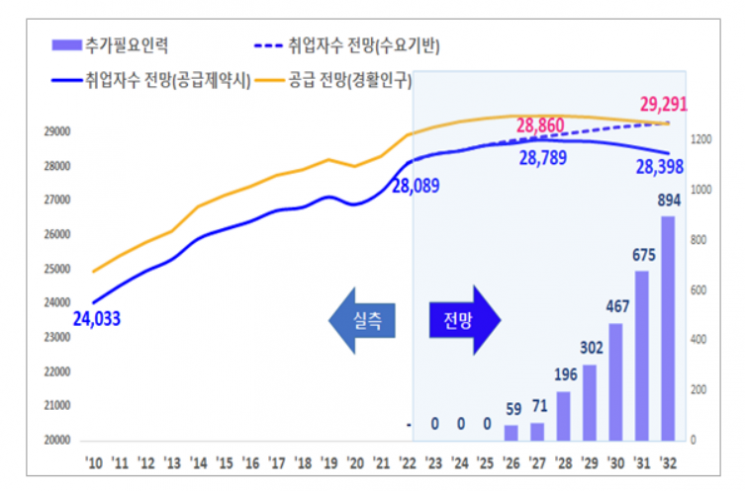
This decrease in labor supply poses a significant obstacle to sustained economic growth. The Employment Information Service has for the first time estimated that to maintain an economic growth rate of 2.1% annually (2022?2027) to 1.9% (2028?2032) over the next decade, an additional approximately 894,000 workers (about 89,000 per year), which is about 3% of the total projected employed population, will be needed.
As of 2032, the largest additional labor demand is expected in the health and welfare services sector, with 138,000 more workers needed. Even in sectors where employment is expected to decline, such as manufacturing and wholesale and retail trade, an additional 137,000 and 118,000 workers respectively are projected to be required.
By occupation, additional labor demand is high among relatively high-skilled occupational groups such as experts, related workers, and office workers. The Employment Information Service stated, "If the necessary workforce is not adequately supplied, achieving an economic growth rate of 1.9?2.1% will be difficult."
In the context of a declining economically active population, it is urgent to promote the entry of potential labor into the labor market to maintain economic growth momentum. The Employment Information Service recommended differentiated policy efforts tailored to each group, such as customized employment support for youth, establishing work and childcare-friendly employment environments for women, and creating a continuous employment foundation for the elderly.
Lee Seong-hee, Vice Minister of Employment and Labor, also shared this outlook from the Employment Information Service at the joint job task force meeting of related ministries on the 15th and stated that support policies will focus on youth, women, and middle-aged and elderly groups.
© The Asia Business Daily(www.asiae.co.kr). All rights reserved.

















