Prime Minister's National Address, Deputy Prime Minister Lee Ju-ho's Announcement
'2,000 Personnel Increase' Distribution Ratio to Be Announced
Non-Capital Region Expected to Account for 80%, Over 3,000 Personnel
Medical Community's Strong Opposition Expected Following 'Resignation Notice on the 25th'
The government will announce the next year's admission quotas for 40 medical schools nationwide on the 20th. Within the previously stated scale of 'an increase of 2,000 students,' it is expected that the increase will be about double the current quotas, mainly at non-metropolitan regional national universities and small-scale medical schools.
According to the Presidential Office and related ministries, the government plans to announce the allocation results of the increased medical school quotas by university this afternoon. Prime Minister Han Duck-soo will appeal to the public about the direction of medical reform and the necessity of increasing medical school quotas through a public address. After the address, Deputy Prime Minister and Minister of Education Lee Ju-ho will announce the distribution results of the 2,000 additional students to be admitted in the 2025 academic year across medical schools nationwide.
The government maintains the scale of increasing medical school quotas by 2,000 students. Accordingly, the increase rate for the 40 medical schools nationwide in the 2025 academic year is expected to be about 20% (400 students) in the metropolitan area and about 80% (1,600 students) in non-metropolitan areas.
Currently, among the total quota of 3,058 students at 40 medical schools nationwide, the metropolitan area quota is 1,035 students (33.8%) across 13 schools, and the non-metropolitan area quota is 2,023 students (66.2%) across 27 schools. According to the government's plan, the metropolitan area quota will be about 1,435 students, and the non-metropolitan area quota about 3,623 students.
Since the government has emphasized the need to develop regional healthcare and strengthen the capabilities of small-scale medical schools, the allocation is expected to focus on non-metropolitan regional national universities. The current non-metropolitan regional national universities are nine schools: Kangwon National University (current admission quota 49), Gyeongsang National University (76), Chonnam National University (125), Kyungpook National University (110), Chungnam National University (110), Pusan National University (125), Jeonbuk National University (142), Jeju National University (40), and Chungbuk National University (49).
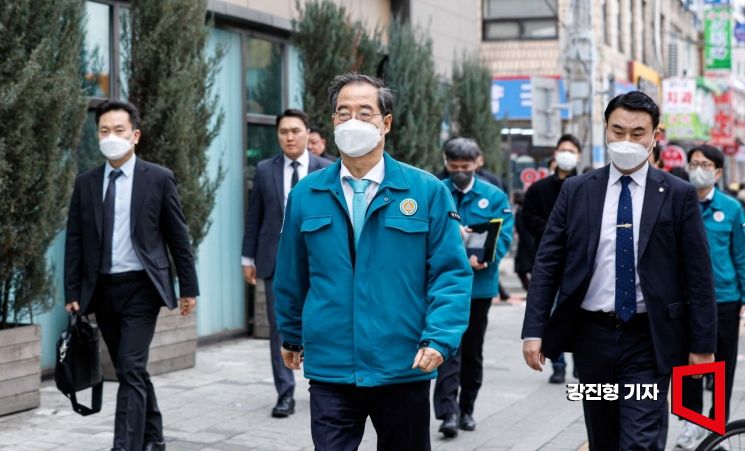 On the 11th, as collective actions by doctors centered around residents continue, Prime Minister Han Duck-soo is moving inside Myeongji St. Mary's Hospital, a secondary general hospital in Yeongdeungpo-gu, Seoul. Photo by Kang Jin-hyung aymsdream@
The government plans to elevate regional base hospitals such as national university hospitals to the level of the five major metropolitan hospitals. Along with this, it is also considering establishing a regional healthcare development fund to support manpower supply and other needs.
To secure essential regional medical personnel, the government has also proposed raising the 'medical school regional talent admission ratio'?which currently requires at least 40% of students to be from the local area?to 60% or more. To encourage doctors to work at regional medical institutions, the government is also promoting the introduction of a 'contract-based essential doctor system.'
Small-scale medical schools with quotas of 50 or fewer students are also likely to benefit. Among non-metropolitan medical schools, Konkuk University (Chungju), Daegu Catholic University, Eulji University, Ajou University, Ulsan University, and Dankook University have the smallest quotas at 40 students. Catholic Kwandong University, Dongguk University (Gyeongju), Konyang University, Dong-A University, and Inha University each have quotas of 49 students, also considered small-scale. In the metropolitan area, Sungkyunkwan University, Ajou University, CHA University, and Gachon University are 'mini medical schools' with quotas of 40 students.
In the metropolitan area, the increase is expected to focus more on Gyeonggi and Incheon regions rather than Seoul. The seven major regional national university medical schools are estimated to increase to around 200 students each. In this case, there will be regional medical schools larger than Seoul National University Medical School (135 students).
The government's allocation announcement is expected to intensify opposition from the medical community. The day before, the Korean Medical Association Emergency Committee warned in a statement, "If the quotas for each medical school are finalized and announced, it will effectively be like crossing a point of no return and simultaneously cutting off the last bridge to return, resulting in a catastrophic outcome." Currently, professors affiliated with the 'Big 5' hospitals and their associated universities have resolved to submit their resignations starting from the 25th.
© The Asia Business Daily(www.asiae.co.kr). All rights reserved.

















