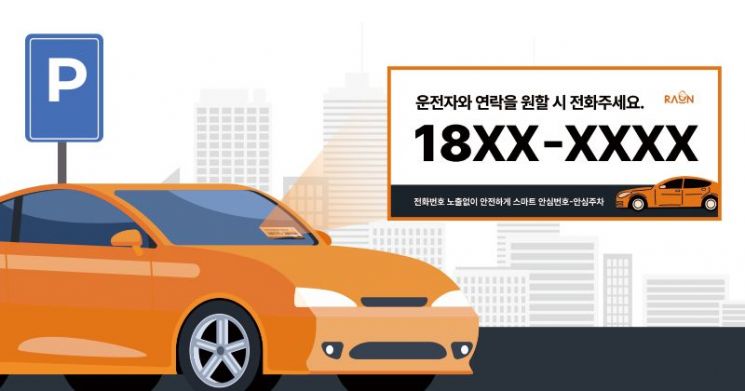
As attempts at 'smishing' crimes?where scammers impersonate mobile congratulatory or condolence notifications, parcel delivery tracking, and fine payments via text messages to steal money?are rapidly increasing, efforts to minimize personal information exposure are becoming crucial. In particular, there are numerous cases where personal contact information is randomly collected inside vehicles in parking lots and used for crimes, drawing attention to solutions that can preemptively block the exposure of personal contact details.
IT security and authentication platform company RaonSecure (CEO Lee Soon-hyung, Lee Jung-ah) detected a sharp rise in smishing targeting individuals through data analysis of its phishing prevention service 'Smart Anti-Phishing,' which is linked with financial institutions' abnormal financial detection systems. As a preventive measure, the company recommended using its virtual number call service for senders and receivers, the 'Smart Safe Number - Safe Parking' service.
Analyzing data on phishing crimes prevented by the Smart Anti-Phishing app, RaonSecure found that smishing cases in the second half of last year increased by more than 20% compared to the first half. Among all phishing prevention cases in the first half, smishing accounted for 46%, malicious apps 36%, and voice phishing 18%, with smishing attempts being the most frequent. In January this year, the number of smishing cases prevented by Smart Anti-Phishing surged approximately 56% compared to the same period last year.
The rapid increase in smishing crimes is due to the increasingly sophisticated smishing tactics. Victims across various age groups, including those in their 20s and 30s, are falling prey to numerous types of smishing such as impersonated condolence or wedding invitation links, high-value credit card payment notifications, and parcel receipt alerts. Additionally, new phishing methods like 'Qusing,' which installs malicious apps through QR codes, are also on the rise.
Accordingly, fundamental preventive efforts are needed to minimize the exposure of personal mobile phone numbers and eliminate the possibility of their use in crimes. Especially in parking lots of apartments or commercial buildings where many people come and go, virtual numbers inside vehicles are emerging as an alternative, enabling two-way safe number calls without exposing personal information.
Existing safe numbers convert only the recipient's number into a virtual number. Therefore, the sender's number is still displayed on the recipient's phone, and if the recipient replies to the sender, the recipient's contact is also exposed on the sender's phone.
RaonSecure's 'Smart Safe Number' allows both senders and receivers to communicate using virtual numbers, enabling two-way calls without exposing personal contact information. Compared to existing safe calls that convert only the recipient's number, this method offers greater protection against personal number exposure. Using the two-way Smart Safe Number, both parties can make and receive calls through a single virtual number, preventing the recipient's number from being exposed even when replying, and similarly protecting the sender's number.
The Smart Safe Number has limitless applications, including safe parking numbers, consultation calls between teachers and parents, and parcel delivery, and is expected to significantly reduce the risk of personal mobile number exposure across various fields, thereby contributing to the prevention of smishing crimes.
Jung Hyun-chul, Head of Service Division at RaonSecure, said, "To avoid smishing crimes, even if a text message appears to be from an acquaintance, it is important to be cautious rather than clicking on internet links without suspicion. In everyday life, such as parking, efforts to use safe numbers instead of directly exposing mobile phone numbers are necessary. Utilizing two-way safe numbers that provide stronger protection for personal mobile numbers will be more effective in preventing smishing."
© The Asia Business Daily(www.asiae.co.kr). All rights reserved.

















