Jensen Huang CEO Holds Press Conference
Expresses Expectation for Samsung Electronics HBM3E Supply
"HBM Technology and Value Are High... Like Logic"
"High Bandwidth Memory (HBM) technology is like a miracle. The upgrade cycles of Samsung Electronics and SK Hynix products are astonishing. We are testing Samsung Electronics products and expect to be able to use them soon."
Jensen Huang, CEO of NVIDIA, said this on the 19th (local time) at the Signia by Hilton Hotel in San Jose, USA. He made these remarks during a Q&A session with global media held during the GTC 2024 event when asked about HBM.
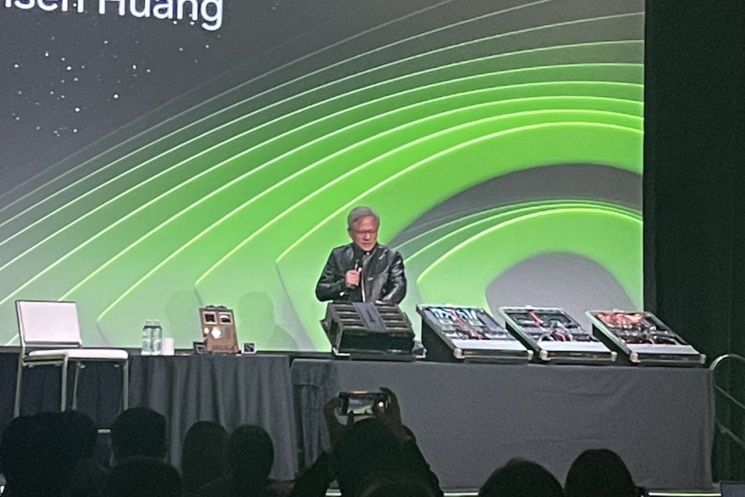 Jensen Huang, CEO of NVIDIA, holding a meeting on the 19th (local time) at Signia by Hilton Hotel in San Jose, USA / Photo by Kim Pyeonghwa
When asked, "Are you using Samsung Electronics and SK Hynix HBM?" Huang replied, "We are not yet using Samsung Electronics products," but expressed optimism by saying, "We are currently qualifying the products."
Huang’s comments appear to refer to the latest HBM product, HBM3E. Currently, NVIDIA receives the latest 5th generation 8-stack HBM3E from SK Hynix and the US-based Micron. Samsung Electronics recently developed a 12-stack HBM3E and is conducting tests.
Huang also highly praised the product’s technology level, saying, "We are investing heavily in HBM." He explained, "You should not think of HBM as just DDR5 DRAM," adding, "HBM memory is not simple DRAM but more like logic."
Regarding the importance of HBM, he emphasized, "Asking about TSMC excluding foundry (semiconductor contract manufacturing) or whether you like video work excluding GPUs is similar," and stressed, "HBM is very complex and a very high value-added memory."
He also highlighted a close relationship with the Taiwanese foundry company TSMC. He explained, "CPU and GPU dies and memory from Samsung Electronics, SK Hynix, and Micron must be assembled in Taiwan," adding, "Because the supply chain is not simple, coordination among large companies is necessary, and TSMC is doing that on our behalf."
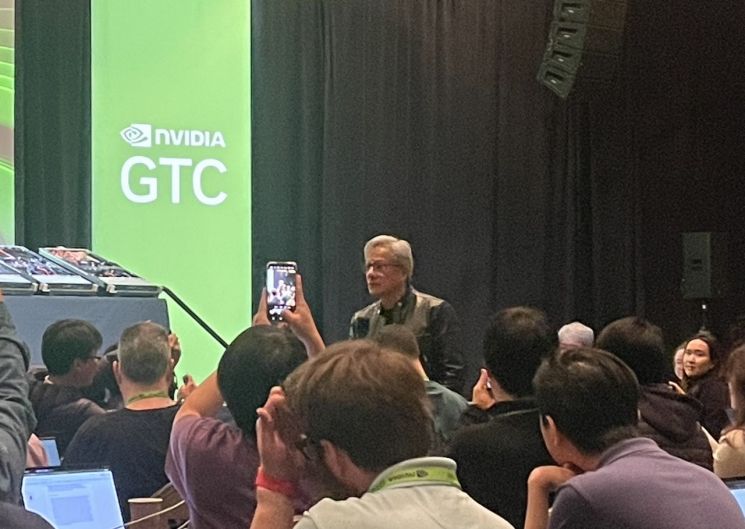 Jensen Huang, CEO of NVIDIA, approaches the reporter's seat during a briefing to take questions /
 Photo by Kim Pyeonghwa
Regarding the increasing risks in the Chinese market, he said, "We need to understand policies and enhance supply chain resilience." However, he added, "The world’s supply chains are quite complex," and expressed strong confidence that "the goal of countries is not to block [supply chains]." This reflects a negative stance on the emergence of closed national policies amid US-China conflicts.
In response to a reporter’s question about Japan’s AI capabilities expansion, he said, "Japan’s language and culture are very unique, and the data is specific," adding, "It is not reasonable for a third party to create AI using related data and then bring it to Japan; Japan must create it on its own." He further noted, "AI will be very important in terms of national and corporate productivity."
Regarding general artificial intelligence (AGI), which he has recently focused on, Huang explained that it could be introduced within five years as he has mentioned before. However, he believes the timing may vary depending on how AGI is defined.
Huang answered all the reporters’ questions, far exceeding the originally scheduled one hour. Toward the end of the event, he actively engaged by coming down from the stage to answer questions directly where the reporters were seated. Various media from different countries attended the event, demonstrating NVIDIA’s popularity.
© The Asia Business Daily(www.asiae.co.kr). All rights reserved.


















