Last year, Bangladesh was identified as the country with the most severe air pollution in the world. The concentration of fine particulate matter (PM2.5) in Bangladesh exceeded the World Health Organization (WHO) recommended guidelines by more than 15 times. South Korea ranked 50th among the surveyed countries in terms of poor air quality.
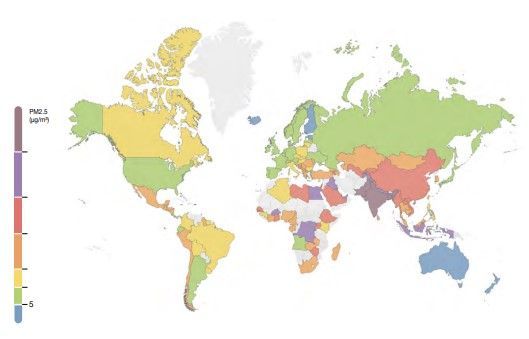
According to the "2023 World Air Quality Report" released by IQAir on the 18th (local time), the top five countries with the worst air quality were Bangladesh (79.9μg/m3), Pakistan (73.7μg/m3), India (54.4μg/m3), Tajikistan (49.0μg/m3), and Burkina Faso (46.6μg/m3). The average concentration of fine particulate matter in these countries exceeded the WHO guideline of 5μg/m3 by 9 to 15 times.
Among the 134 countries and regions and 7,812 cities included in this report, a staggering 92.5% failed to meet the recommended guidelines. On the other hand, countries identified as having healthy air quality included Finland, Estonia, Australia, New Zealand, Bermuda, Iceland, and Mauritius, totaling 10 countries.
IQAir stated, "The top 10 most polluted cities in the world are located in Central Asia and South Asia," adding, "India has four cities on the list." The most polluted major city in the world was Begusarai, India, and the capital with the worst air quality was New Delhi, India. Begusarai, a city with a population of 500,000 located in northern India, had a fine particulate matter concentration of 118.9μg/m3 last year, which is 23 times the WHO standard. Delhi also exceeded the standard significantly with 92.7μg/m3.
In South Korea, the average concentration last year was 19.2μg/m3, ranking 50th among the 134 surveyed countries. The capital, Seoul (19.7μg/m3), ranked 1,206th among 7,812 cities and 41st among 114 capitals. The report noted, "South Korea's air pollution mainly stems from manufacturing and industrial pollution, vehicle emissions within cities, and yellow dust," adding, "While facing pollution from its own industries and production activities, pollution from neighboring countries also has a significant impact."
Japan, adjacent to South Korea, recorded 9.6μg/m3, ranking 96th, while China ranked 19th with 32.5μg/m3. CNN highlighted that although pollution levels have increased across most parts of Asia, China's ranking has dropped from previously dominating the worst air quality lists.
In North America, Canada (10.3μg/m3, 93rd) was found to have worse air pollution than the United States (9.1μg/m3, 102nd) for the first time. This is interpreted as a result of large wildfires in Canada last year. These wildfires also affected northern U.S. regions such as Minneapolis and Detroit.
Such air quality is directly linked to health issues. Previously, the WHO announced that 6.7 million people die annually due to the complex effects related to air pollution. Frank Hams, CEO of IQAir Global, pointed out, "Air pollution affects every aspect of our lives," adding, "In some of the most polluted countries, it is highly likely that people's lifespans are shortened by 3 to 6 years due to this."
© The Asia Business Daily(www.asiae.co.kr). All rights reserved.












