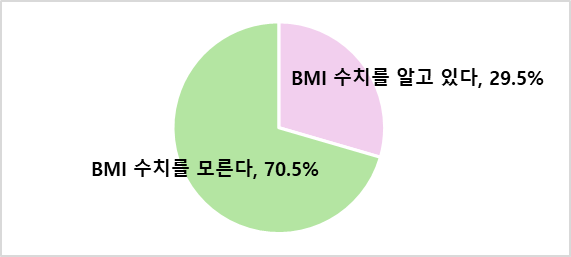
The most basic standard for obesity management is the Body Mass Index (BMI). However, according to a perception survey, 7 out of 10 Korean adults do not know their own BMI.

According to the 'Obesity and BMI Awareness Survey' conducted by Novo Nordisk and supervised by the Korean Society for the Study of Obesity, 70.5% of all respondents were unaware of their own BMI. Even among those classified as obese with a BMI of 25 (kg/㎡) or higher, 70.7% answered that they did not know their BMI. This awareness survey was conducted on 1,000 adult men and women aged 20 and over.
BMI is calculated by dividing one’s weight (kg) by the square of their height (㎡). The Korean Society for the Study of Obesity defines a BMI of 23?24.9 (kg/㎡) as the ‘pre-obesity stage’ and a BMI of 25 (kg/㎡) or higher as ‘obesity.’ Although evaluation based on the amount of fat accumulated in the body is the most accurate, indirect evaluation through BMI is widely used due to its difficulty. Among the survey participants, 26.3% were classified as obese, and 20.2% as pre-obese, meaning that 46.4% of all respondents were either obese or in the pre-obesity stage based on BMI criteria.
Despite this, the proportion of people who know their own BMI was found to be very low. Among those who responded that they knew their BMI, the largest group (34.9%) said they learned it through the national health screening. This rate increased with age, with 46.3% of people in their 50s and 47.7% of those in their 60s recognizing their BMI through the national health screening.
However, in contrast to the low BMI awareness rate, 88% of respondents agreed with the perception that ‘obesity is a disease that requires treatment,’ forming a consensus. This perception was high regardless of gender, age group, or BMI awareness. Awareness of the seriousness of comorbidities caused by obesity was also strong. In particular, more than 90% of respondents recognized type 2 diabetes, hypertension, hyperlipidemia, and coronary artery disease as serious conditions.
According to the Korean Society for the Study of Obesity, the prevalence of obesity among adults has continuously increased over the past 10 years without any decline. The obesity prevalence rate was 30.2% in 2012, rose to 33.3% in 2016, and jumped to 38.4% in 2021. Socioeconomic losses caused by obesity are also rapidly increasing. From about 5.1 trillion won in 2009, it surged to 13.8528 trillion won in 2019, more than doubling. Compared to other health risk factors such as drinking and smoking, the increase in socioeconomic costs due to obesity is considered the fastest.
Park Cheol-young, director of the Korean Society for the Study of Obesity, said, “This survey was planned to check the public’s awareness level of obesity and BMI amid the rapid increase in obesity prevalence and socioeconomic burden. The survey results show that fewer than 3 out of 10 people know their own BMI, so improving BMI awareness is urgent for efficient obesity treatment and management.”
This obesity and BMI awareness survey was conducted online through Macromill Embrain from January 19 to February 2, targeting 1,000 adults aged 20 and over. The sampling error is ±3.1% at a 95% confidence level.
© The Asia Business Daily(www.asiae.co.kr). All rights reserved.
![Clutching a Stolen Dior Bag, Saying "I Hate Being Poor but Real"... The Grotesque Con of a "Human Knockoff" [Slate]](https://cwcontent.asiae.co.kr/asiaresize/183/2026021902243444107_1771435474.jpg)

















