Organization Deciding Voting Rights at General Meeting
Does Not Disclose Vacancies or Reasons
Government: "Not a Good Thing, So No Need..."
The Stewardship Committee (Soochaekwi), which determines the voting direction of the National Pension Service, is operating with a reduced membership of eight instead of the full nine. Soochaekwi is a body that makes decisions on agenda items requiring in-depth discussion, such as treasury stock cancellation or director appointments.
A National Pension Service official said on the 19th, "Professor Kang Sung-jin of Korea University recently resigned due to his application as a proportional representative for the ruling party, so this shareholder meeting season will be operated with eight members instead of nine." He added, "It is difficult both procedurally and time-wise to immediately fill the vacancy." Professor Kang was appointed as a member last March through recommendations from expert organizations. The term of office is three years. Despite having much time left in his term, he resigned after only one year to enter politics. However, on the 18th, Professor Kang was not included in the proportional representative list announced by the People Power Party's satellite party for the general election, Kukmin Mirae.
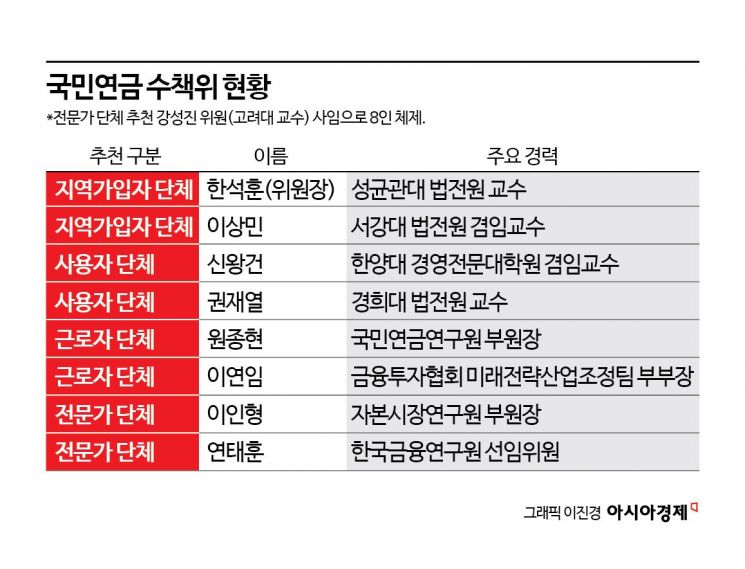
When the Ministry of Health and Welfare appointed three expert organization-recommended members, including Professor Kang, it stated it would "support professional and independent decision-making." This was in response to criticism that government influence might increase and undermine independence. Soochaekwi consists of nine members. The first Soochaekwi, active for three years from 2020, was composed of members recommended equally by user, worker, and regional subscriber groups, three each. The second Soochaekwi, which began activities last year, reduced the three seats allocated to subscriber groups (user, worker, regional subscriber) and filled the remaining seats with expert organization-recommended members.
The government has not disclosed either the fact or the reason for the vacancy in Soochaekwi. Even during the meeting on the 14th, which attracted attention over the approval or disapproval of the appointment of Posco Holdings Chairman candidate Jang In-hwa, it was only mentioned that eight members attended. This means the government kept quiet about changes in Soochaekwi, which handles socially important agenda items. A government official said, "It's not a good thing, so there's no need to talk about it." An investment banking (IB) industry insider pointed out, "They probably did not disclose it because the person who was supposed to maintain the 'independence' emphasized at the time of Soochaekwi's formation was trying to enter politics, which is the furthest from independence."
Soochaekwi basically aims for unanimous agreement. However, in cases of severe disagreement, decisions are made by a majority vote. Since the current 'eight-member system' is an even number, significant inconvenience arises when making decisions by majority vote. This is because a 4 to 4 tie can occur. Several shareholder meetings attracting attention to the National Pension Service's voting rights and direction are lined up. These include KT&G, where the largest shareholder, activist funds, and proxy advisory firms oppose the next CEO candidate; Hanmi Science, where a vote battle involving the owner family is anticipated; and Kumho Petrochemical, where activist funds and the company are engaged in a tense standoff over treasury stock cancellation.
© The Asia Business Daily(www.asiae.co.kr). All rights reserved.
![User Who Sold Erroneously Deposited Bitcoins to Repay Debt and Fund Entertainment... What Did the Supreme Court Decide in 2021? [Legal Issue Check]](https://cwcontent.asiae.co.kr/asiaresize/183/2026020910431234020_1770601391.png)
















