A technology for mass-producing solid electrolytes for next-generation all-solid-state batteries through a simple process has been developed by domestic researchers.
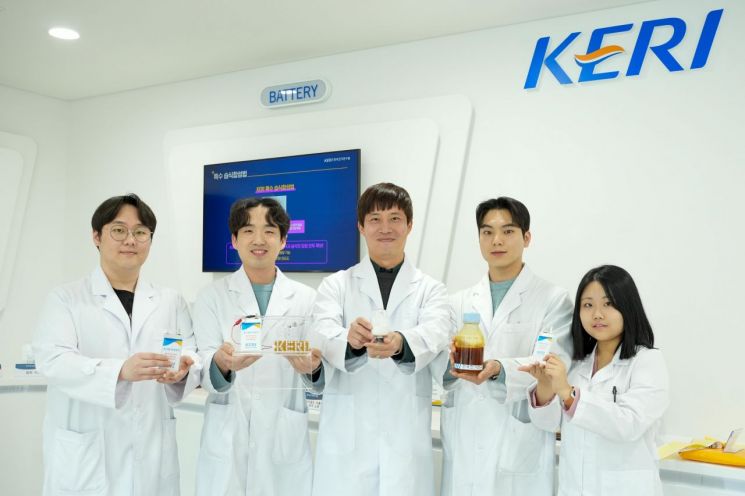 Dr. Junwoo Park (center) and his team at KERI are posing with a solid electrolyte manufactured through a wet synthesis process and a prototype all-solid-state battery utilizing it. Photo by Jeongi-yeon
The Korea Electrotechnology Research Institute (KERI) announced on the 18th that Dr. Park Jun-woo and researcher Sung Jeong-hwan (UST KERI campus student researcher) from the Next-Generation Battery Research Center have developed a technology for "particle size control and wet synthesis process of solid electrolytes (sulfide-based)."
All-solid-state batteries replace the electrolyte that transfers ions between the cathode and anode from a liquid to a solid, which has a lower risk of fire or explosion. For solid electrolytes to be used in all-solid-state batteries, the particle size must be very small, at the micrometer level, which is about 1/100th the thickness of a human hair.
The KERI research team succeeded in developing a technology to mass-produce solid electrolytes using only a simple process. Until now, solid electrolytes manufactured by domestic and international researchers using various methods had large particles, requiring additional processes such as mechanical grinding. These processes incurred time and physical costs, and performance degradation of the solid electrolyte caused by grinding was an obstacle to the commercialization of all-solid-state batteries.
Dr. Park Jun-woo’s team introduced fine raw materials such as lithium sulfide and controlled the nucleation rate generated by chemical reactions of each material to significantly reduce the particle size of the final product.
As a result, fine solid electrolytes can be manufactured through a simple wet synthesis process without complex procedures. Due to this successful chemical composition control, the ionic conductivity of the solid electrolyte was more than twice as high as that produced by conventional processes.
Dr. Park evaluated, "With this technology development, we can skip the complex and expensive processes previously required to miniaturize solid electrolytes."
The research results of Dr. Park Jun-woo’s team were published in the March issue of Energy Storage Materials, a prestigious international journal in the energy field.
This research was conducted through KERI’s basic project and the Ministry of Trade, Industry and Energy’s ‘Nano Convergence Innovative Product Technology Development Support Project.’
© The Asia Business Daily(www.asiae.co.kr). All rights reserved.
![Clutching a Stolen Dior Bag, Saying "I Hate Being Poor but Real"... The Grotesque Con of a "Human Knockoff" [Slate]](https://cwcontent.asiae.co.kr/asiaresize/183/2026021902243444107_1771435474.jpg)











