KCCI Holds Korea-US Trade Forum
Reviewing US Presidential Election Issues and Exploring Corporate Response Strategies
Korean and American economic experts predict that regardless of the outcome of the U.S. presidential election this November, there will be little change in the existing U.S. policy stance, including protectionism and the Inflation Reduction Act (IRA).
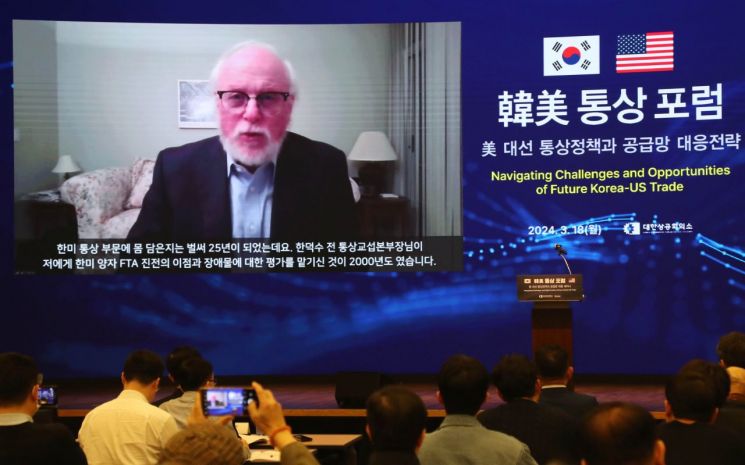 Jeffrey Schott, Senior Fellow at the Peterson Institute for International Economics (PIIE), is giving an online lecture on the topic of "Analysis and Prospects of Trade Policies of U.S. Presidential Candidates." Photo by Korea Chamber of Commerce and Industry
On the 18th, the Korea Chamber of Commerce and Industry held a Korea-U.S. Trade Forum at the Chamber of Commerce building in Jung-gu, Seoul, under the theme "U.S. Presidential Election Trade Policy and Supply Chain Response Strategy," reviewing U.S. election trade issues and exploring response strategies for Korean companies.
Jeffrey Schott, Senior Fellow at the Peterson Institute for International Economics (PIIE), said, "Regardless of who wins the election, the protectionist stance is expected to be maintained," adding, "Both candidates are likely to support policies based on economic security that affect third countries, and Korea, which has a Free Trade Agreement (FTA) with the U.S., will be no exception."
Kate Calutkevi, Managing Director of McLarty Associates, a trade consulting firm based in Washington D.C., stated, "From the U.S. perspective, Korean companies are important partners in trade and investment," and predicted, "Since the Korea-U.S. FTA was revised to satisfy American voters, there may be minor changes after the election, but no major issues."
She continued, "Investments and employment created by foreign companies investing in the U.S. receive bipartisan and regional support, so candidates will not want to weaken the IRA policy," adding, "Regardless of who wins, the priority will be blocking unfair competition related to supply chains."
In particular, many expressed the view that the risk related to supply chain restructuring is likely to continue, making it important to prepare countermeasures. Kim Sung-joong, attorney at Kim & Chang Law Office, emphasized, "The trend of intensifying geopolitical risks related to supply chain restructuring will continue for a considerable period," and added, "Actively seeking supply chain compliance beyond mere supply chain management is a matter of survival for companies."
Park Jung-hyun, attorney at Bae, Kim & Lee LLC, also forecasted, "U.S. economic security policies will be strengthened along with the expansion from individual policy tools such as import regulations and export controls to supply chain restructuring and industrial policies." Park Hyung-gon, partner at Deloitte Consulting, stated, "As the complexity of global supply chains increases and strategies among countries overlap, it is necessary to establish networks and a global control tower for timely risk identification, as well as secure decision-making systems to respond accordingly."
© The Asia Business Daily(www.asiae.co.kr). All rights reserved.

















