President Yoon Chairs Livelihood Economy Review Meeting
Immediate Injection of 150 Billion Won for Emergency Agricultural and Livestock Price Stabilization
Five Fruit Items Including Cherry and Kiwi Added to Tariff Reduction List
President Yoon Suk-yeol on the 18th instructed the government regarding measures on agricultural and livestock products and food prices, stating, "Each ministry, as the ultimate responsible party for prices, must ensure that tangible results are achieved in their respective areas that the public can feel."
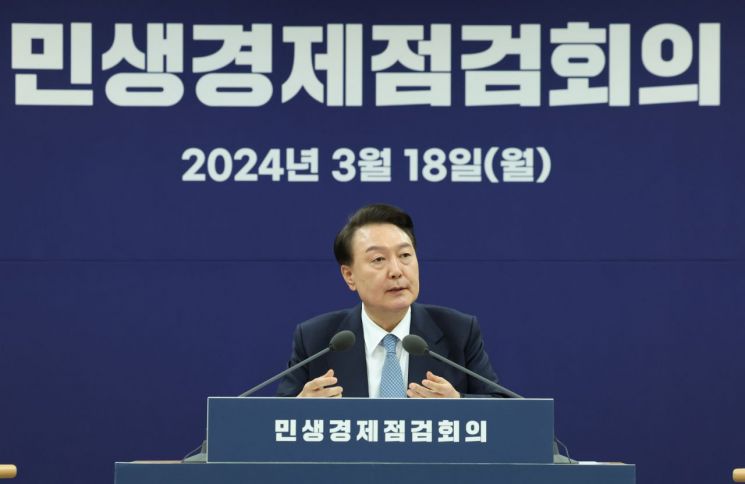
On the same day, President Yoon visited the Nonghyup Hanaro Mart Yangjae branch in Seocho-gu, Seoul, to check the prices of fruits, vegetables, and other grocery items. Afterward, he presided over a livelihood economy inspection meeting, saying, "Prices are the public's primary concern and the most fundamental measure by which policy achievements are immediately felt."
Despite five consecutive months of increasing export surpluses, record-high employment rates, and a commendable inflation rate in the 3% range, the inflation rate for daily necessities related to agricultural and livestock products and food remains high at 3.7%, due to rising international oil prices, poor fruit harvests last year, and adverse weather conditions in production areas in February.
At the meeting, President Yoon ordered extraordinary measures to reduce grocery prices. The government plans to fully implement delivery price and discount support without restrictions on period, item, or scale until agricultural product prices stabilize at average levels.
Regarding this, President Yoon explained, "We will provide more drastic support for apples and pears, which are expected to have a prolonged period of high prices due to cold damage, and spare no policy support to stabilize prices of substitute fruits such as strawberries and oriental melons. Additionally, discount channels centered on large supermarkets will be expanded to traditional markets and online shopping malls." He added, "We will immediately inject the 150 billion won emergency agricultural and livestock price stabilization fund prepared last Friday (the 15th) and expand the support scale if necessary."
Furthermore, President Yoon emphasized that the government will significantly expand the list of quota tax items for imported fruits, agricultural products, and processed foods that can substitute for apples and pears, and will release unlimited quantities.
As the first step, five items including cherries and kiwis, which have high market demand, will be added to the current 24 types of fruits with reduced tariffs. For items with rapidly rising prices, the Korea Agro-Fisheries & Food Trade Corporation (aT) will directly import and supply them to consumers at low prices without import margins. In addition to currently imported bananas and oranges, pineapples, mangoes, and cherries will be promptly added and supplied to the market.
The government also plans to actively respond to market disturbances and unfair practices. President Yoon stated, "We will thoroughly check and inspect the field to ensure that the government's price stabilization support is effective. If there are cases of excessive price increases, collusion, or unfair practices that exploit the market for excessive profits, we will respond strictly."
President Yoon also emphasized the importance of publicity, saying, "Above all, I hope the public always keeps in mind that there is virtually no policy they are unaware of. Each ministry must ensure that no one misses out on benefits such as government discount support due to lack of information."
At the livelihood economy inspection meeting, President Yoon received reports from relevant ministries on price trends and response measures. First, Choi Sang-mok, Deputy Prime Minister and Minister of Economy and Finance, reported on recent price trends; Song Mi-ryeong, Minister of Agriculture, Food and Rural Affairs, on agricultural and livestock product price trends and response measures; and Kang Do-hyung, Minister of Oceans and Fisheries, on seafood price trends and response measures.
During the subsequent discussion, various ideas and opinions were exchanged with representatives from the distribution industry, consumer groups, and merchant organizations regarding measures to stabilize perceived prices. Before the meeting, President Yoon visited the fruit, vegetable, seafood, and livestock product sales sections of Nonghyup Hanaro Mart, a representative agricultural and livestock product and food distribution company, to check supply and demand situations and price trends, and to listen to the opinions of consumers, producers, and sales staff.
Attending the meeting were Kang Jeong-hwa, Chairperson of the Korea Consumer Federation; Kwon Jang-hee, representative of Garak Market Seoul Wholesale Fruit and Vegetable Market; Yeom Ki-dong, CEO of Nonghyup Distribution; and Kim Ki-seong, Director of Economic Guidance at the National Federation of Fisheries Cooperatives. From the government, Prime Minister Han Duck-soo, Minister Choi, Ministers Song Mi-ryeong and Kang Do-hyung, Director of the Office for Government Policy Coordination Bang Ki-seon, and from the Presidential Office, Policy Chief Seong Tae-yoon and Senior Secretary for Economic Affairs Park Chun-seop were present.
© The Asia Business Daily(www.asiae.co.kr). All rights reserved.
![Clutching a Stolen Dior Bag, Saying "I Hate Being Poor but Real"... The Grotesque Con of a "Human Knockoff" [Slate]](https://cwcontent.asiae.co.kr/asiaresize/183/2026021902243444107_1771435474.jpg)
















