The 'Big Week' of interest rate decision meetings by major central banks, including those of the United States and Japan, has begun. Market attention is particularly focused on the Bank of Japan (BOJ), which is about to end its negative interest rate policy, and the U.S. Federal Reserve (Fed), which will release a new dot plot.
According to Bloomberg News on the 17th (local time), this week, countries including Pakistan, the United States, Japan, the United Kingdom, Australia, Morocco, Indonesia, Iceland, the Czech Republic, Brazil, Switzerland, Mexico, Russia, and Colombia are scheduled to make monetary policy decisions. This is the highest number of countries making rate decisions weekly this year, including six of the top 10 currencies by global trading volume.
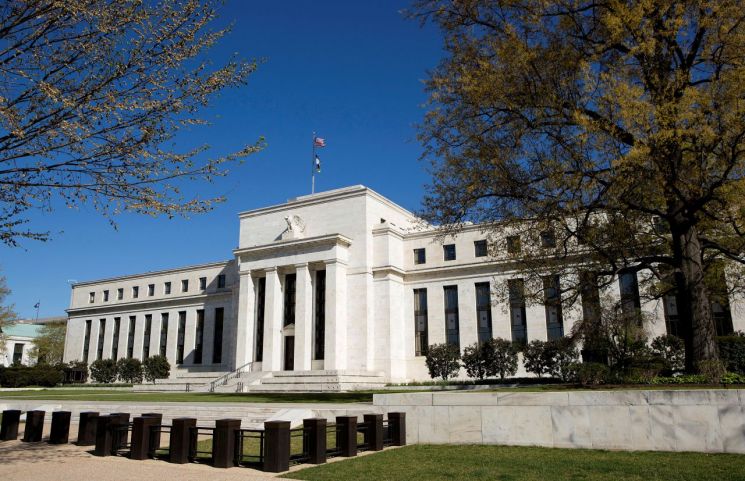
The Fed is the most closely watched. The Fed is expected to hold the federal funds rate steady at 5.25-5.5% at the Federal Open Market Committee (FOMC) meeting on March 19-20. According to the Chicago Mercantile Exchange (CME) FedWatch tool, the rate futures market currently prices in a 99% probability of a rate hold in March. Following recent inflation data exceeding expectations, the probability of a hold in May has also risen from around 70% a month ago to over 92%.
With some forecasts suggesting a rate cut as early as June, market focus is on the newly released dot plot. In December last year, the Fed’s dot plot projected year-end rates of 4.5-4.75%, implying a total rate cut of 0.75 percentage points this year. However, due to persistently high inflation, there are growing expectations that the new dot plot will show a reduced pace of cuts this year. Recently, Fed officials have repeatedly emphasized a cautious approach to rate cuts.
Investors are likely to seek hints about future monetary policy during the press conference of Fed Chair Jerome Powell immediately following the FOMC meeting. According to a Chicago Booth survey, more than two-thirds of economists expect only two rate cuts this year. This is somewhat more hawkish than the market consensus, which anticipates three cuts consistent with the Fed’s previous dot plot.
Jason Furman of Harvard University said, "The Fed wants to cut rates," but added, "The data will make that difficult. The last mile of inflation is likely to be quite stubborn." Evi Papa, a professor at Carlos III University of Madrid, also noted, "Recent figures show inflation rising, so central banks will not want to intervene too early," and advised, "It is better to wait until inflation approaches 2%."

Another key focus this week is Japan. The BOJ is expected to end its negative interest rate policy and possibly raise rates for the first time in 17 years at the two-day monetary policy meeting ending on the 19th. Japan currently remains the only country in the world maintaining negative interest rates.
Markets are watching closely because the BOJ’s precondition for raising rates?achieving a 2% inflation target accompanied by wage increases?has been met. Inflation has already exceeded the target, and wage increases are expected to surpass 5%. Last week, Rengo (Japanese Trade Union Confederation), Japan’s largest labor organization, announced that the average wage increase for regular employees in this year’s spring labor negotiations was 5.28%.
Along with ending negative rates, the yield curve control (YCC) policy is expected to be abolished, and new purchases of exchange-traded funds (ETFs) and real estate investment trusts (REITs) are likely to be halted. However, government bond purchases are expected to continue. Bloomberg reported, "The BOJ will decide whether to end negative rates immediately or wait until April." Taro Kimura, senior economist for Japan at Bloomberg Economics, suggested, "It might be judged too early to tighten."
On Monday the 18th, Pakistan will make its monetary policy decision, followed by Australia and Morocco on Tuesday the 19th. In Pakistan’s case, with an International Monetary Fund (IMF) management team visit imminent, the prevailing view is that the current rate will be maintained. The Reserve Bank of Australia is also expected to hold rates steady. Investors are focused on whether the meeting will signal the possibility of future cuts.
On the 20th, China, Indonesia, Iceland, the Czech Republic, and Brazil will set their rates. China will announce economic indicators such as retail sales, fixed asset investment, and industrial production for January and February ahead of its loan prime rate (LPR) decision, which effectively serves as the benchmark rate. Retail sales and industrial production growth have slowed this year, and real estate investment has declined by 8% year-on-year.
Additionally, on the 21st, Switzerland, Norway, the United Kingdom, Mexico, Paraguay, T?rkiye, and Taiwan will hold monetary policy meetings, followed by Russia and Colombia on Friday the 22nd. The Bank of England (BOE) officials have previously stated they will not rush to ease monetary policy, making this week’s inflation and economic data releases critical. Currently, rate holds are likely in Switzerland, Norway, and others.
Bloomberg noted, "There are noticeable differences in how central banks perceive inflation risks," adding, "While monetary policy decisions have generally been synchronized until now, we are now seeing a variety of policy dynamics in contrast."
© The Asia Business Daily(www.asiae.co.kr). All rights reserved.


















