Expanded to 186 Participating Universities
Inflation Burden Falls on Schools
With the start of the new semester, the line of students visiting the student cafeteria at Hankuk University of Foreign Studies is growing longer every morning. This is because the students' satisfaction has increased after the university newly joined the Ministry of Agriculture, Food and Rural Affairs (MAFRA) supported “1,000-Won Breakfast” program. During the first week of implementation, 200 meal tickets sold out in just 20 minutes.
Park Mijeong (23, Department of International Studies) said, “I heard that our school started the 1,000-Won Breakfast this year, so I have been coming to eat since the semester began. It’s hard to eat well when living alone, but coming here feels like eating homemade food, and the menu is diverse, which I like.” Kim Hyeongjun (20, Department of German Language Education) also said, “I usually eat school meals costing 4,000 or 5,000 won, but since this is a 1,000-won meal, I eat it more enthusiastically. I want to keep eating it regularly in the future.”
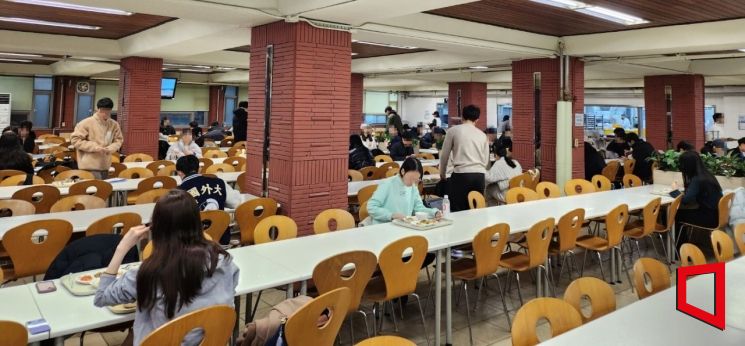 Students are having breakfast at the student cafeteria of Hankuk University of Foreign Studies in Dongdaemun-gu, Seoul. HUFS was selected for the first time this year as a participant in the "1,000 Won Breakfast" program operated by the Ministry of Agriculture, Food and Rural Affairs. The students' response was enthusiastic, with 200 meal tickets sold out within 20 minutes on the first day of implementation.
 [Photo by HUFS]
MAFRA has significantly increased support for the “1,000-Won Breakfast” program this year, enabling more students to have breakfast without financial burden. However, the rising costs of living and labor expenses remain a burden for the schools, raising concerns about the program’s sustainability.
According to MAFRA on the 18th, starting this year, the support amount for the “1,000-Won Breakfast” was increased from 1,000 won to 2,000 won per meal, and the number of participating universities expanded from 144 to 186. The “1,000-Won Breakfast” program provides healthy breakfasts at 1,000 won to young adults (university students) who have a high breakfast skipping rate of 59% (as of 2022). A survey conducted by MAFRA in 2023 among 5,711 students from 140 universities showed that 90.4% of respondents felt the importance of breakfast through this program, and 90.5% said it helped them develop healthy eating habits.
Following the second semester of last year, the student cafeteria at Myongji University, which also receives support from MAFRA for the “1,000-Won Breakfast,” was crowded with students from 8 a.m. Seo Jiha (22, Department of Chinese Language and Literature) said, “I used to just eat a piece of bread or corn soup for breakfast, but here the breakfast is served well like a hotel buffet, so I eat a hearty breakfast and have a light lunch.”
Kim, an employee at the student cafeteria, said, “Labor costs have increased and prices have risen a lot, so the situation is not easy, but with the support amount increased by 1,000 won this year, we try to provide a little more to the students.” A Myongji University official said, “With the increased support, we were able to raise the cost of the school meal composition and provide higher quality food.” He added, “We can serve up to 130 people a day, and on days when the number exceeds expectations, we cover the difference with school funds including donations so that no student misses out on a meal.”
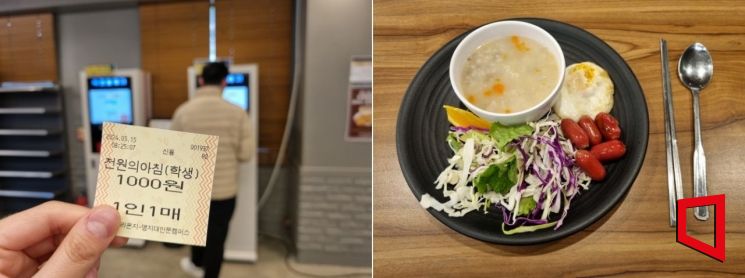 Meal ticket (left) for the '1,000 Won Breakfast' at the Myongji University Student Union cafeteria located in Seodaemun-gu, Seoul, and breakfast served on the morning of the 15th. The Ministry of Agriculture, Food and Rural Affairs supports this program with the purpose of 'promoting rice consumption,' so dishes containing rice must be included. On this day, porridge, salad, eggs, sausage, and oranges were served for breakfast.
 [Photo by Shim Seong-a]
Meanwhile, schools that rely on government subsidies to run the program still express concerns about its sustainability. Assuming the cost per meal for the “1,000-Won Breakfast” is 5,000 won, MAFRA covers 2,000 won, students pay 1,000 won, and the remaining amount is covered by local governments (1,000 won in the case of Seoul) and the schools. If the cost of ingredients or labor rises during the program period, the burden could be passed on to the schools or students.
A representative from Hankuk University of Foreign Studies started by saying, “This is also a case of the rich getting richer and the poor getting poorer.” The representative explained, “Government subsidies and student contributions are fixed, but the amount the school has to bear can fluctuate due to inflation and labor costs, and the school has to bear this fully. Since this is not a profit-making project but operated as a student welfare program, there is a joke that ‘the more you sell, the more you lose money.’” He expressed concern, adding, “If government support is one-time only, it will be difficult to sustain the program, so internal discussions within the school will be necessary to prepare for this.”
Soonchunhyang University, which newly joined the program this year, also expressed similar concerns. A Soonchunhyang University official said, “We couldn’t proceed earlier due to internal coordination issues, but after strong demands from the student council and students, we were able to start with difficulty. If government support decreases, it would be burdensome to run the program solely with the school’s own budget.”
In response, a MAFRA official explained, “We increased the support amount to allow schools with difficult financial conditions and low self-reliance to participate and provide benefits to more students. Although next year’s budget has not been finalized yet, we expect the program to be implemented steadily.”
A Seoul city official also said, “Since the program has a very positive response on the ground, we will strongly request the budget, but the budget office makes decisions by comprehensively considering tax revenue issues and university demand surveys, so it is difficult to answer about the possibility of implementation next year at this time.”
© The Asia Business Daily(www.asiae.co.kr). All rights reserved.


















