Seoul National University and Yonsei University Medical Professors' Emergency Committee Plan General Meeting on 18th
Medical Professors' Collective Action Expands... Resolution to Submit Resignation Letters on 25th
Private Practitioners Also Mobilizing: "We Cannot Remain Passive"
Ministry of Education Requests Universities to Keep Allocation Committee Meetings Confidential
Following the collective resignation announcement by residents, medical school professors have also signaled their intention to resign en masse. On the afternoon of the 18th, professors from Seoul National University College of Medicine and Yonsei University College of Medicine will hold general meetings to discuss the timing of their resignation submissions. As even private practitioners are showing signs of collective action, the disruption in the medical field is expected to worsen. The Ministry of Education has expressed its intention to meet with university officials to prevent student retention and class disruptions.
At a regular briefing at the Government Complex Sejong on the morning of the 18th, Ministry of Education spokesperson Koo Yeon-hee responded to questions about the collective movements of professors and medical students by stating, "The professors who have decided to resign are not those teaching at the medical schools but those involved in clinical treatment or supervision at hospitals," adding, "We understand that the schools themselves are operating well." However, she noted, "Even if the schools proceed with classes without issue, if the professors responsible for clinical training at hospitals leave, difficulties are expected."
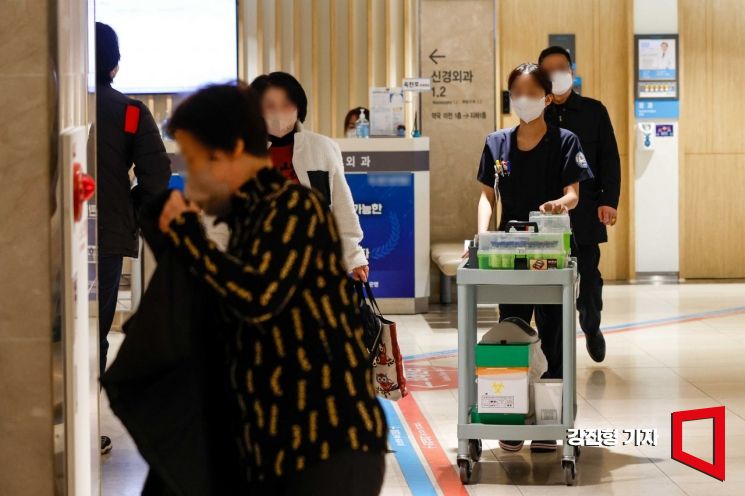 On the 11th, as collective actions by doctors, centered around residents, continue, a nurse is busy moving around at a secondary general hospital in Seoul. Photo by Jinhyung Kang aymsdream@
The Ministry of Education explained that officials, including department heads, are visiting 40 medical schools to meet with university representatives and urge them to prevent students from being held back. Regarding specific visit plans, they said, "We will inform you once they are finalized."
During the briefing, numerous questions were raised about the allocation procedures and schedule of the medical school quota allocation committee, but the Ministry of Education responded, "Since the process is being conducted strictly confidentially, we cannot disclose details."
According to the medical community, the Emergency Response Committees of the Seoul National University College of Medicine and Yonsei University College of Medicine professors will each hold meetings on the afternoon of the same day to assess the current situation and discuss future responses and detailed action plans.
The Emergency Response Committee of Seoul National University College of Medicine professors will hold a general meeting online, connecting Seoul National University Hospital, Bundang Seoul National University Hospital, and Boramae Hospital. The "National Emergency Response Committee of Medical School Professors," which includes the Seoul National University College of Medicine Emergency Response Committee, agreed at a meeting on the 15th to submit resignation letters on the 25th. Considering that Professor Bang Jae-seung, chairman of the Seoul National University College of Medicine Emergency Response Committee, also serves as the chairman of the national medical school professors' emergency committee, it is highly likely that the resignation submission timing of the Seoul National University College of Medicine Emergency Response Committee will align with this schedule.
The Yonsei University College of Medicine professors' Emergency Response Committee is also expected to hold a meeting with approximately 1,300 clinical and attending professors to discuss future response plans. It is reported that the meeting will review the results of an internal survey and the committee's activities.
The collective action movement among medical school professors is spreading further. At the national medical school professors' emergency committee meeting on the 15th, 20 medical schools participated, with 16 agreeing to submit resignation letters. Although they have stated that they will remain by patients' sides until their resignations are accepted, the fact that professors have joined residents in collective action is increasing public anxiety. It takes about a month for professors' resignation letters, which have been filling the vacancies left by residents, to be processed.
A bigger issue is that private practitioners are also showing signs of collective action. The Korean Association of Private Practitioners, a group of doctors who run local clinics and hospitals, shared at an academic seminar the previous day that, regarding recent medical issues, "Following residents and medical school professors leaving hospitals, there is an atmosphere that we cannot remain passive." This suggests that they may also respond by reducing working hours in opposition to the government's medical school expansion.
Voices urging restraint from further collective action for public safety continue to emerge. At an emergency press conference the previous day, Joo Young-soo, director of the National Medical Center, criticized, "Taking collective action at the expense of patients' health and lives is no different from holding them hostage," and added, "It is a desperate situation when medical school professors, who are at the pinnacle among doctors, say this." Park Min-soo, the second vice minister of the Ministry of Health and Welfare, also stated, "The government does not negotiate with specific professions over quota issues. This applies equally to lawyers, accountants, pharmacists, and nurses," and emphasized, "We cannot accept proposals suggesting that patients' lives will be endangered if negotiations do not occur."
© The Asia Business Daily(www.asiae.co.kr). All rights reserved.

















