Situations Threatening National Survival and Well-being
Breaking the Chain Continued Since the Separation of Dispensing and Prescribing
On the 18th, the Presidential Office rebutted the Korea Intern Resident Association's (Daejeonhyeop) submission of an urgent intervention request letter to the International Labour Organization (ILO), claiming that the work commencement order violates the prohibition of forced labor, stating that "this is not forced labor." The rationale is that the case falls under the ILO's exception to the prohibition of forced labor, which applies when the survival and well-being of the nation are at risk, and thus does not constitute forced labor.
Jang Sang-yoon, Senior Secretary for Social Affairs at the Presidential Office, appeared on CBS Radio that morning and responded to the host's question, "If the ILO intervenes in the government's work commencement order for doctors, what is the government's position?" with this statement.
The position is that the ILO cannot intervene in the current work commencement order for doctors. Jang said, "First, the host used the term 'intervention,' but according to ILO regulations, the term is Intervention (request for opinion)," and "there is a misunderstanding that the ILO intervenes to enforce coercion, but in reality, it is merely a procedure to request or convey the government's opinion when requested by labor-management organizations."
He continued, "I understand that the ILO is reviewing whether the Intern Resident Association qualifies as a labor-management organization or not," and added, "Even if they qualify, according to many labor law experts, the work commencement order for interns and residents falls under the exceptions of ILO Convention No. 29 on forced labor."
ILO Convention No. 29 defines forced labor as all work or services exacted under the threat of penalty and not voluntarily offered, and states that illegal coercion of such labor should be punishable as a criminal offense. It was adopted in 1930, ratified by South Korea in 2021, and came into effect in 2022.
However, Article 2 of Convention No. 29 stipulates that labor such as military service under conscription laws, normal civic obligations, labor required by court order, or labor exacted in cases of war, epidemic, or disasters threatening the survival or well-being of the whole or part of the population, is not considered forced labor. Jang explained that the doctors' collective action falls under a situation or concern that threatens the survival or well-being of the nation.
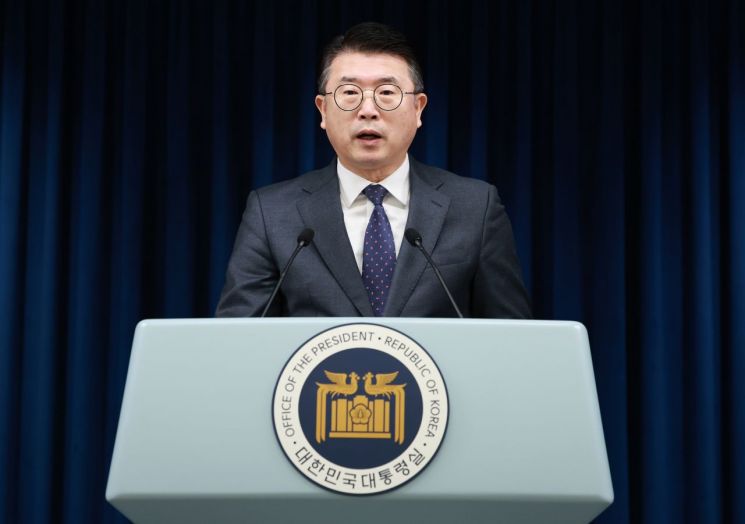
He reaffirmed the government's position of no compromise regarding the doctors' collective action opposing the increase in medical school quotas. Jang emphasized, "During the 2000 separation of prescribing and dispensing of medicines and the 2020 quota increase attempt, the phenomenon of collective actions escalating in the order of interns, residents, and professors has repeatedly occurred," and added, "This time, we must break the chain of collective actions."
When asked whether the government would respond similarly if medical school professors submit their resignations, as the interns have done, he explained, "Medical school professors hold two statuses: university professors and hospital doctors," and "From the perspective of their doctor status, collective action violates the Medical Service Act, and if they leave the clinical field, we have no choice but to respond according to law and principles."
Regarding the medical community's demand for a compromise on increasing quotas by 350 or 500 students, Jang countered, "I would like them to present the basis for why 350 or 500," and "the decision on manpower supply is not something to be made by saying '500 is excessive, so 300 will do.'"
Addressing concerns that increasing medical school quotas by 2,000 may not resolve the concentration of doctors in the metropolitan area, he stated, "Training requires patient cases," and "If essential medical services are performed centered on regional base medical schools and patients come, a natural ecosystem for training will be formed."
Regarding the rising negative public opinion on the government's response in polls, he said, "The government's top priority is to eliminate the anxiety of the public and patients and ensure that medical care is not disrupted," but also mentioned, "We will act according to law and principles against those who unilaterally abandon their public duties."
© The Asia Business Daily(www.asiae.co.kr). All rights reserved.