Seoul National University College of Medicine and Yonsei University College of Medicine Professors' Emergency Committee Plan General Meeting on 18th
Expansion of Medical Professors' Collective Action... Resolution to Submit Resignation Letters on 25th
Private Practitioners Also Mobilizing: "We Cannot Remain Idle"
Following the collective resignation threat from residents, medical school professors at Seoul National University College of Medicine and Yonsei University College of Medicine will hold general meetings on the afternoon of the 18th to discuss the timing of resignation submissions. With even private practitioners showing signs of collective action, the confusion in the medical field is expected to worsen.
According to sources in the medical community, the Emergency Response Committees of the Seoul National University College of Medicine and Yonsei University College of Medicine Professors' Associations will each review opinions on the current situation and future responses and establish detailed countermeasures this afternoon.
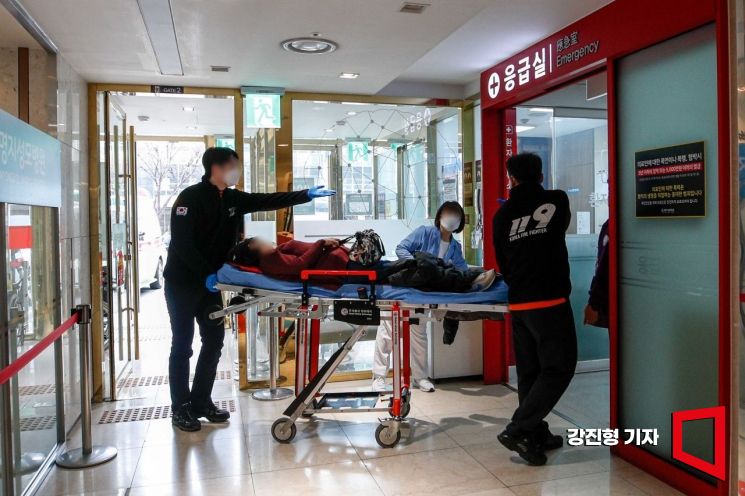 On the 11th, as collective actions by doctors, mainly residents, continue, a patient is entering the emergency room at a secondary general hospital in Seoul. Photo by Jinhyung Kang aymsdream@
The Emergency Response Committee of the Seoul National University College of Medicine Professors' Association will hold a general meeting online connecting Seoul National University Hospital, Bundang Seoul National University Hospital, and Boramae Hospital. The "National Medical School Professors Emergency Response Committee," which includes the Seoul National University College of Medicine Professors' Emergency Response Committee, agreed at a meeting on the 15th to set the resignation submission date as the 25th. Considering that Professor Bang Jae-seung, chairman of the Seoul National University College of Medicine Professors' Emergency Response Committee, also serves as the chairman of the National Medical School Professors Emergency Response Committee, it is highly likely that the resignation submission timing of the Seoul National University College of Medicine Professors' Emergency Response Committee will align with this date.
The Yonsei University College of Medicine Professors' Emergency Response Committee is also reported to hold meetings with about 1,300 clinical and attending professors to discuss future countermeasures. At this meeting, they are expected to review the results of their own surveys and the activities of the emergency response committee.
The collective action movement among medical school professors is spreading further. At the National Medical School Professors Emergency Response Committee meeting on the 15th, 20 medical schools participated, and 16 of them resolved to submit resignation letters. Although they stated that they would stay by patients' sides until their resignations are accepted, the fact that professors have joined the collective action following residents is increasing public anxiety. It takes about a month for the resignation letters of professors, who have been filling the vacancies left by residents, to be accepted.
A bigger issue is that private practitioners are also showing signs of collective action. The Korean Association of Private Practitioners, a group of doctors who open and operate local clinics, shared at an academic seminar the day before that there is an internal atmosphere of "since residents and medical school professors are saying they will leave hospitals, we cannot remain idle." This is interpreted as their possible response to reduce working hours in opposition to the government's medical school enrollment expansion.
Voices urging restraint from further collective action for public safety are also continuing. Joo Young-soo, director of the National Medical Center, pointed out at an emergency press conference the day before, "This is no different from holding patients' health and lives hostage through collective action," and added, "It is a desperate situation when medical school professors, who are at the pinnacle among doctors, say this." Park Min-soo, the second vice minister of the Ministry of Health and Welfare, also stated, "The government does not negotiate with specific professions over quota issues. This applies equally to lawyers, accountants, pharmacists, and nurses," and emphasized, "We cannot accept proposals that imply patient lives will be endangered if negotiations do not occur."
© The Asia Business Daily(www.asiae.co.kr). All rights reserved.
![User Who Sold Erroneously Deposited Bitcoins to Repay Debt and Fund Entertainment... What Did the Supreme Court Decide in 2021? [Legal Issue Check]](https://cwcontent.asiae.co.kr/asiaresize/183/2026020910431234020_1770601391.png)















