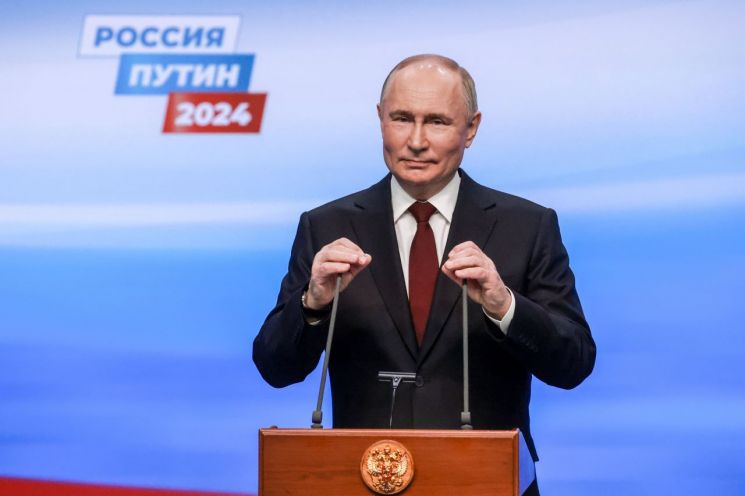
Russian President Vladimir Putin's landslide victory in the presidential election was a result anticipated well in advance. With opposition figures barred from running and pro-Putin forces merely playing a supporting role, the election held from the 15th to the 17th (local time) was less about whether he would succeed in securing another term and more about the 'vote percentage.'
For President Putin, who seeks to justify the invasion of Ukraine (special military operation), this election was essentially a referendum on public approval. The Wall Street Journal (WSJ) reported, "The vote was a formality, and President Putin is set to follow a path comparable to Joseph Stalin, the former Soviet Communist Party secretary who ruled for 29 years," adding, "For Putin, who desires victory in the broad confrontation with Ukraine and the West, it was necessary to appear as if he had won a large victory in the election to maintain discretionary power."
The Ukraine War Likely to Worsen
Having laid the foundation for long-term rule with a historic high vote share in the 87% range, President Putin now believes he has secured strong domestic support for the war justification, making it highly likely that he will expand offensives against Ukraine. This reduces the chances of finding a peace solution through negotiations. Angela Stent, senior advisor at the U.S. Institute of Peace, assessed, "All signals from President Putin indicate that the war will continue," adding, "At this point, he feels that time is on his side." Even on the last day of the presidential vote, air raids continued in border areas.
The confrontation between the West and Russia is also expected to intensify further. Ahead of the election, President Putin issued so-called nuclear warnings, stating, "If our sovereignty is threatened, Russia is ready to use nuclear weapons at any time." He is also likely to strengthen anti-Western alliances in response to NATO's eastward expansion. The WSJ noted, "The more important election will be the U.S. presidential election this coming November," and "President Putin will wait for the election results in Europe and the U.S. amid signs of cracks in the West over support for Ukraine."
Particularly, the close ties between Russia and North Korea raise security concerns on the Korean Peninsula. As the war in Ukraine prolongs, Russia is showcasing a closer relationship by receiving ammunition supplies from North Korea. Following a meeting with North Korean State Affairs Commission Chairman Kim Jong-un in Russia last September, President Putin is expected to visit North Korea soon. Russia has also confirmed its intention to strengthen strategic cooperation with China. The close ties among North Korea, China, and Russia deepen the new Cold War dynamics and inevitably impact the situation on the Korean Peninsula.
Why Did Russia Choose Putin?
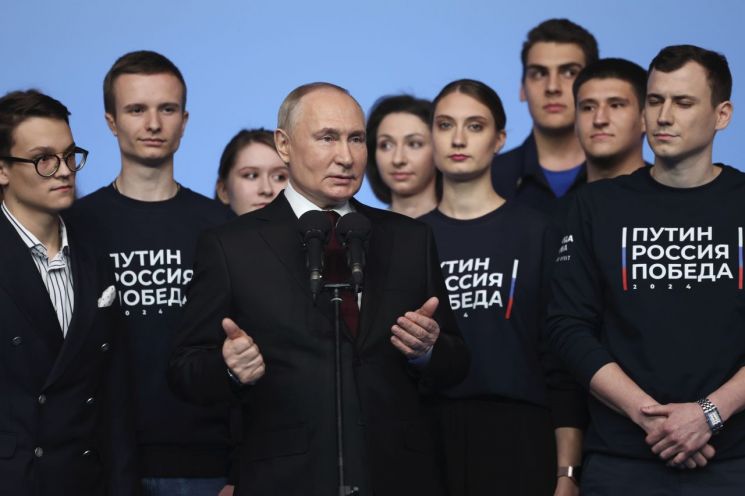
The primary reason Russian citizens chose President Putin again despite the prolonged war, massive Western economic sanctions, and criticism of authoritarianism is his 'irreplaceable leadership.' The New York Times (NYT) reported, "Many Russian voters say they have sufficient reasons to support President Putin," explaining that they believe Putin, who emphasized a 'strong Russia,' led the country from the hardships following the collapse of communism in the 1990s to a period of economic prosperity. According to a survey by the Russian independent polling agency Levada Center, Putin's approval rating remained above 80% throughout last year.
There is also analysis that the prolonged war and Western sanctions have provided a patriotic rationale that unites Russians. Moreover, there is no suitable leader domestically to rally anti-government sentiment. The 'opponent' Alexei Navalny suddenly died in custody last month. Most other opposition figures facing threats to their lives are currently exiled abroad.
However, as the Ukraine war and Western sanctions drag on, the fatigue felt by Russians is inevitably increasing. Analysts interpret President Putin's announcements ahead of this election, including raising the minimum wage, tax reforms, and infrastructure reconstruction, as efforts to appease the public.
The growing voices criticizing the government following Navalny's death also represent a variable. On the last day of the election, at noon, so-called 'Navalny protests' took place in Russia and around the world, expressing opposition to President Putin. Yulia Navalnaya, Navalny's wife who participated in the protests, revealed that she wrote her husband's name on the ballot.
Meanwhile, President Putin spoke to reporters for the first time about Navalny's death, calling it a "sad event." He referred to Navalny as "Mr. Navalny" and acknowledged the claim by Navalny's associates that he could have been released through a prisoner exchange shortly before his death.
© The Asia Business Daily(www.asiae.co.kr). All rights reserved.


















