Korea University of Technology and Education Proposes Establishment of 'College of Industrial Medicine'
Calls for Training Research-Focused Physician-Scientists
Seoul National University Receives 50 Applications for New Department of Medical Science
As the government has announced plans to increase the number of medical school admissions by 2030, attention is being drawn to calls for establishing a new type of medical school that responds to specific demands rather than simply training general physicians.
According to the education sector on the 18th, Korea University of Technology and Education (KOREATECH) is discussing the establishment of an 'Industrial Medical School' to train specialists in occupational medicine. President Yu Gil-sang of KOREATECH revealed this plan, explaining that the demand for occupational medicine specialists has surged due to the need to respond to industrial accident patients and a shortage of personnel. While the lack of training hospitals is cited as a problem in establishing new medical schools, KOREATECH noted that it can utilize 10 industrial accident hospitals nationwide under the Ministry of Employment and Labor as training hospitals.
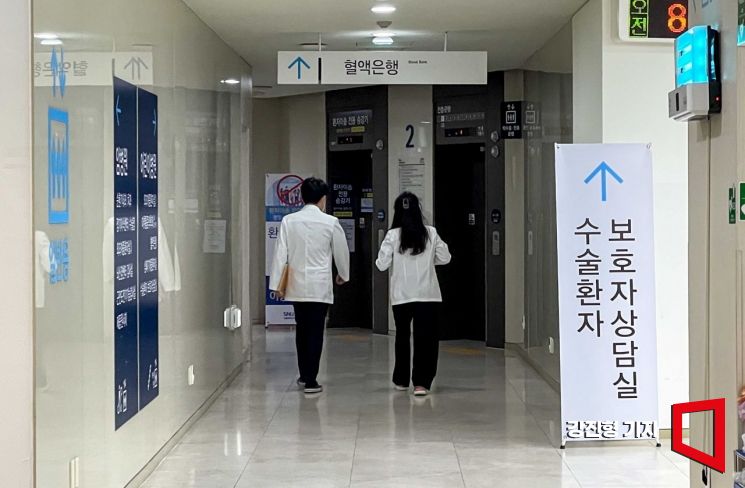 Medical staff are moving at a large hospital in Seoul on the 29th of last month. Photo by Jinhyung Kang aymsdream@
Previously, Changwon National University, a national university, had been promoting the establishment of an industrial medical school since the 1990s. Changwon National University prepared a plan and submitted it to the Ministry of Education and even conducted a signature campaign, but it did not come to fruition. It is currently known that Changwon National University has shifted its focus from an industrial medical school to establishing a general medical school.
There are also voices advocating not merely increasing medical school admissions but establishing a graduate school of science and technology medicine (GSTM) or a medical science department focused on training research-oriented 'physician-scientists.' Physician-scientists gained attention during the 2020 COVID-19 pandemic for their significant achievements such as vaccine development, but the domestic situation remains challenging. Over the past three years until last year, physician-scientists accounted for only about 1.6% of annual medical school graduates.
The government also recognizes the need to train physician-scientists. At the first Biohealth Innovation Committee meeting chaired by Prime Minister Han Duck-soo in December last year, it was decided to invest 49.5 billion KRW in increasing the number of physician-scientists and to improve the military service system. The Ministry of Science and ICT also announced plans this year to establish GSTMs at four major science and technology institutes, including the Korea Advanced Institute of Science and Technology (KAIST), aiming to train physician-scientists.
Universities and local governments have also jumped into training physician-scientists. Seoul National University College of Medicine has allocated 50 spots for establishing a 'Medical Science Department' in 2025, separate from its application to the Ministry of Education for increasing medical school admissions by 15 students in the existing pre-medical program that trains physicians who directly treat patients. Gyeongsangbuk-do Province requested the Ministry of Health and Welfare and the Ministry of Education on the 14th to establish a 'POSTECH Medical School' for training physician-scientists.
© The Asia Business Daily(www.asiae.co.kr). All rights reserved.
![User Who Sold Erroneously Deposited Bitcoins to Repay Debt and Fund Entertainment... What Did the Supreme Court Decide in 2021? [Legal Issue Check]](https://cwcontent.asiae.co.kr/asiaresize/183/2026020910431234020_1770601391.png)















