[Trump Risk①]
If a second term for Donald Trump becomes a reality, there are prospects that he will play the card of raising automobile tariffs, similar to the steel Section 232 export restrictions. Concerns are growing that if second-term Trump imposes 'bomb tariffs' on automobiles to revive the declining industrial area of the U.S. Midwest known as the 'Rust Belt' and restore manufacturing, South Korea will not be able to escape the scope of these measures.
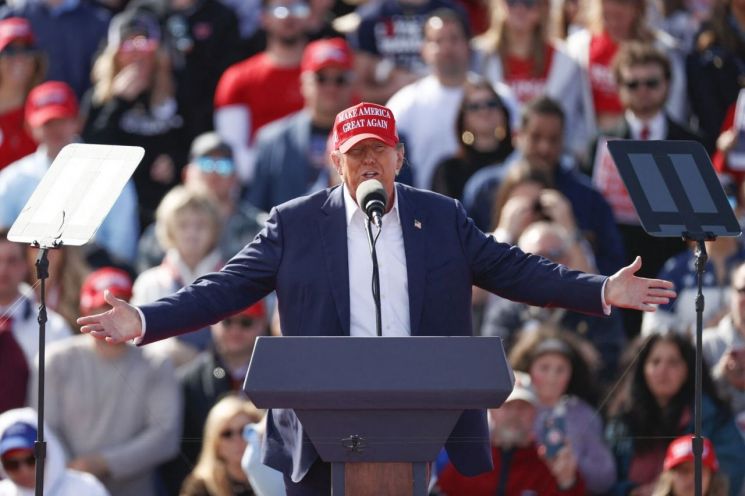
According to the book "No Trade Is Free," published last year by Robert Lighthizer, former U.S. Trade Representative (USTR) and considered a key figure in Trump's trade policy, the U.S. automobile industry accounts for 11.4% of total U.S. manufacturing output and creates value worth about $1.1 trillion, approximately 5.5% of the U.S. Gross Domestic Product (GDP).
Former Representative Lighthizer is a person designing the blueprint for second-term Trump's trade policy. Since former President Trump pledged to revive the automobile manufacturing industry, there is growing weight to the expectation that if second-term Trump takes office, he will first pull out the card of raising automobile tariffs. Previously, the Trump administration imposed a 25% tariff on steel in its first year in 2017 and considered raising tariffs on automobiles and auto parts, but this did not lead to actual tariff imposition.
Former President Trump already announced in his pledge book "Agenda 47" that he would save the U.S. automobile industry through tariffs. South Korea was mentioned several times in particular in the pledge book. He pointed out, "The biggest cause of the U.S. trade deficit, which approached $1 trillion in 2022, is automobiles and auto parts from Europe, Japan, Mexico, Canada, and South Korea," adding, "Cheap imports from Japan and South Korea have destroyed the U.S. automobile industry, and entire towns and cities in the heartland of America have been devastated."
Accordingly, if former President Trump wins the presidential election this November, there are prospects that South Korean companies could suffer damage due to increased automobile tariffs. While China is likely to be the main target, South Korea also appears unlikely to avoid tariff increases.
Former Representative Lighthizer has already suggested that South Korea could be a subject of automobile tariff negotiations. In his book, he pointed out that the U.S. trade deficit with South Korea was $17.2 billion as of 2020, and the largest contributor to the trade deficit was transportation equipment. Specifically, he directly stated that the trade deficit with South Korea amounted to $13.7 billion in automobiles and $5.4 billion in auto parts. This is a point where negotiations on the automobile sector are expected to be demanded from a second-term Trump administration.
© The Asia Business Daily(www.asiae.co.kr). All rights reserved.
![User Who Sold Erroneously Deposited Bitcoins to Repay Debt and Fund Entertainment... What Did the Supreme Court Decide in 2021? [Legal Issue Check]](https://cwcontent.asiae.co.kr/asiaresize/183/2026020910431234020_1770601391.png)















