On the final day of the Russian presidential election, the 17th (local time), so-called 'Navalny protests' took place across various locations at exactly 12 noon. These protests were held by supporters of anti-government activist Alexei Navalny, who died in prison last month, to express their opposition to Russian President Vladimir Putin. Yulia Navalnaya, Navalny's wife who participated in the protests, revealed that she wrote her husband's name on the ballot paper.
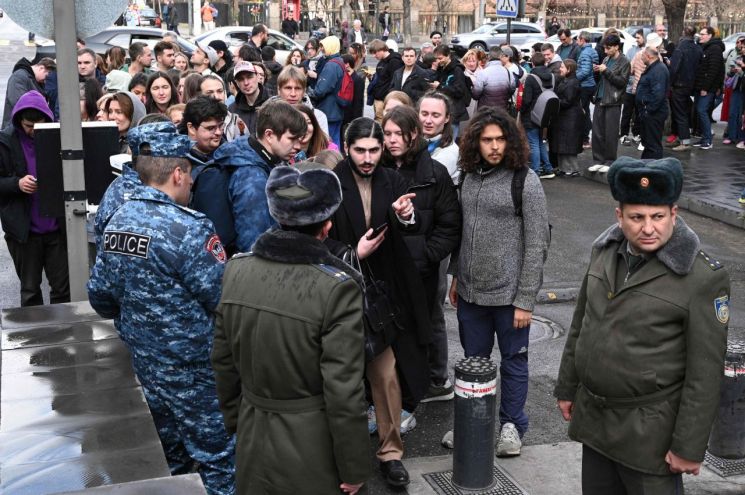
According to major foreign media including The Washington Post (WP), voters lined up outside polling stations in major cities such as Moscow, Saint Petersburg, Yekaterinburg, Chelyabinsk, Tomsk, and Novosibirsk for a noon protest against President Putin. This form of protest was previously encouraged by Navalny during his lifetime as a "completely legal and safe political action."
Although many polling stations in Moscow were quiet earlier in the day, WP reported that long lines appeared precisely at noon. Most participants were citizens in their 20s and 30s, with police cars and patrol vehicles nearby. A woman named Elizaveta told WP, "I came here to cast a vote against Putin." Nikolai said, "I came to express my position and show that there are still different opinions in this country," adding, "It is important to demonstrate this." Voters also posted photos of their ballots with protest slogans such as "Navalny is my president," "No to war, no to Putin," and "Putin is a murderer."
WP noted that this election was the first in history to be held over three days, stating, "The sudden surge of voters at noon on Sunday makes it even clearer that this was no coincidence." However, it added that any form of protest in Russia is difficult due to the authorities' ruthless crackdown on activists and gatherings.
The Russian human rights organization OVD-Info reported that at least 74 people were detained in 17 cities in connection with the election on this day. Among them was a couple arrested for wearing Orwell scarves, reminiscent of George Orwell's dystopian novel 1984, symbolizing a totalitarian state. Reports also emerged from Russian-occupied areas of Ukraine that authorities, accompanied by soldiers and pointing guns at people, forced them to vote.
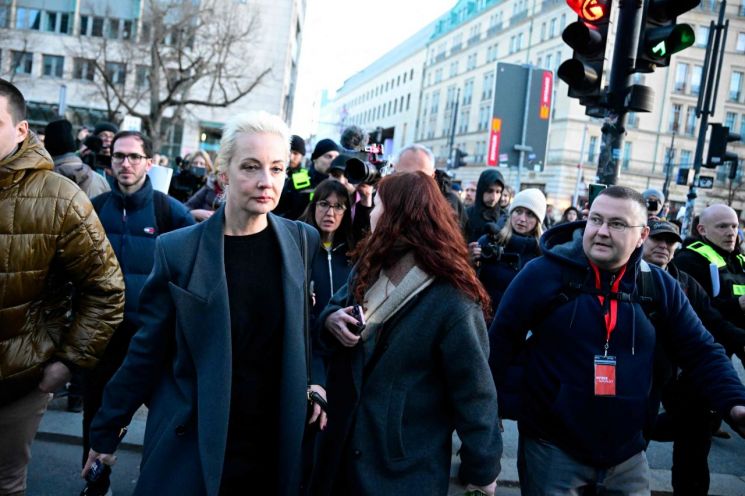
The noon protests against President Putin were more prominent in countries with large populations of Russians who left after the invasion of Ukraine. Armenia, Kazakhstan, Kyrgyzstan, Germany, China, Portugal, and the United Kingdom were representative examples. WP stated that it was impossible to estimate how many people participated in the protests in Russia and worldwide on this day, but photos and videos released publicly showed hundreds of voters lining up at many polling stations. Even pro-Kremlin analyst Sergey Markov described the protests as "excellent from a political technology perspective."
Navalny's wife, Navalnaya, also appeared at the Russian Embassy in Berlin, Germany, at noon on this day. While Navalnaya waited in line in front of the embassy, supporters cheered and chanted her name. Afterwards, Navalnaya came out of the polling station and told the gathered reporters and supporters, "Thank you to everyone who came and stood in line," adding, "Of course, I wrote Navalny's name." When asked about her message to President Putin, she replied, "Please stop asking about the message," and said, "He is a murderer and a thug, so there can be no negotiations or anything with him."
President Putin, often called the 'modern-day czar,' secured an overwhelming victory in the Russian presidential election held from the 15th to this day, effectively confirming his fifth term. According to the Russian Public Opinion Research Center VTsIOM, exit polls showed Putin's vote share at 87%. The Russian Central Election Commission also announced that with 40% of the votes counted, Putin's vote share was 87.634%.
The winner of this election was practically decided well in advance. Anti-government figures such as Boris Nadezhdin were denied candidate registration ahead of this year's election. The three candidates who were registered were pro-Putin figures with minimal presence, leading to criticism that they were merely "window dressing." With this election victory, President Putin will extend his rule until 2030, effectively paving the way for lifelong governance.
© The Asia Business Daily(www.asiae.co.kr). All rights reserved.


















