Over 20 Years, Wage Increase Rates in Korean Large Corporations Surpass Japan
Wage Gap Between Large and Small-Medium Enterprises More Than Doubles
Wage levels in Korea have surpassed those in Japan for the first time in 20 years. The wage gap between large corporations and small and medium-sized enterprises (SMEs) has been found to be wider in Korea than in Japan.
According to the "Trends and International Comparison of Korea-Japan Wage Status and Implications" released by the Korea Employers Federation on the 17th, the total monthly wage of regular workers in Korea in 2022 was 3,998,000 KRW, exceeding Japan's 385,500 JPY (approximately 3,791,000 KRW).
When comparing the total monthly wages of regular workers employed at companies with 10 or more employees in both Korea and Japan, Korea's wage was 1,798,000 KRW in 2002, which was less than half of Japan's total wage of 385,600 JPY (about 3,854,000 KRW). However, the situation reversed after 20 years.

In particular, the wage gap between large corporations and SMEs more than doubled, increasing from 676,000 KRW in 2002 to 1,450,000 KRW in 2022. When setting the wages of large corporations in Korea and Japan as "100" in 2022, the wage level of SMEs was 57.7 in Korea and 73.7 in Japan.
This is analyzed to be because Korea's large corporation wage increase rate (157.6%) from 2002 to 2022 was higher than the SME wage increase rate (111.4%). During the same period in Japan, wages at large corporations decreased by 6.8%, while SME wages increased by 7%, resulting in a reduced wage gap.
The wage increase rate adjusted for economic growth was also higher for Korean large corporations compared to Japan. From 2002 to 2022, the hourly wage increase rate for Korean large corporations was 183.1%, surpassing the nominal GDP per capita growth rate of 154.2%. In contrast, in Japan during the same period, nominal GDP per capita increased by 8.8%, while hourly wages at large corporations fell by 9.7%, and the total monthly wage increase rate showed a similar trend.
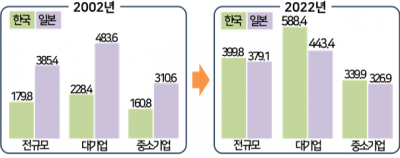 Changes in Monthly Wage Levels by Scale of Korean and Japanese Companies (Businesses) from 2002 to 2022
 [Image Source: Provided by Korea Employers Federation]
The Korea Employers Federation analyzed that considering changes in working hours between Korea and Japan over 20 years, the difference in wage increase rates between the two countries is even greater. In Korea, monthly working hours decreased by 13.8% over 20 years (excluding overtime), while total monthly wages (excluding overtime pay) increased by 122.3%. Korea's hourly wage rose from 9,954 KRW in 2002 to 25,661 KRW in 2022, an increase of 157.8%.
In contrast, in Japan, working hours and wages hardly changed during the same period. Hourly wages in 2022 were similar to those in 2002. For Japanese large corporations, hourly wages decreased by 9.7%.
Ha Sang-woo, head of the Economic Research Department at the Korea Employers Federation, stated, "The accumulated high wage increases in large corporations in Korea have caused wage disparities and a deepening dual structure, leading to various social conflicts. High-wage large corporations should restrain wage increases as much as possible and focus on expanding youth employment and improving the management conditions of small and medium-sized partner companies."
© The Asia Business Daily(www.asiae.co.kr). All rights reserved.



















