'Maintaining Quality in Severe Weather' Automotive Camera Module Mass Production This Year
Equipped with Water-Repellent and Heating Functions... World's First Vehicle Aperture Installed
Samsung Electro-Mechanics will mass-produce automotive camera modules that maintain quality even in severe weather conditions this year. These products maintain image quality even when water is on the camera and in temperatures ranging from -40 to 50 degrees Celsius. After developing an industry-leading 8-megapixel automotive camera module, the company plans to deliver it to complete vehicle customers and launch it in the market this year.
On the 17th, Samsung Electro-Mechanics announced plans to mass-produce all-season, all-weather automotive camera modules equipped with market-leading water-repellent coating and heating functions within this year. These camera modules operate stably even under weather variables such as snow, frost, and fog.
The water contact angle was maximized to minimize the area where water droplets touch the lens. The design allows water droplets on the camera to fly off as quickly as possible. This helps drivers avoid interference when changing lanes or detecting surrounding movements on rainy days. Water-repellent coatings wear down when exposed to sunlight or ultraviolet rays. Samsung Electro-Mechanics solved this problem by coating the lens with a self-developed material technology. Hyungchan Kwak, Executive Director of the Automotive Optics Team at Samsung Electro-Mechanics, explained, "The lifespan is about six times longer and the wear resistance performance is about 1.5 times stronger than existing market products."
The camera is heated to prevent fogging or frost from forming on cold days, significantly reducing accident risks. If snow or frost accumulates on the camera module, it melts within one minute. The heating operation maintains a constant temperature, minimizing current consumption. Executive Director Kwak said, "While existing products melt foreign substances in 8 to 10 minutes, Samsung Electro-Mechanics' product melts them within one minute."
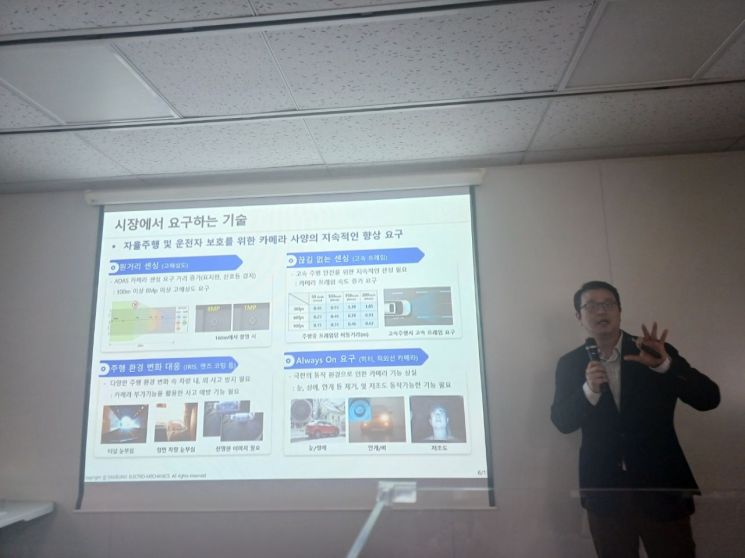 Kwak Hyung-chan, Executive Director and Head of the Automotive Optics Team at Samsung Electro-Mechanics, explaining Samsung Electro-Mechanics' automotive camera module.
 [Photo by Moon Chae-seok]
Samsung Electro-Mechanics developed 'hybrid lens' technology that utilizes the advantages of both glass and plastic lenses. Glass lenses transmit light well and are heat-resistant but are heavy and vulnerable to impact. They also have a higher product cost. Plastic lenses are more cost-competitive but have significant performance degradation depending on temperature, making them unsuitable for automotive lenses that must maintain stability in extreme environments. Samsung Electro-Mechanics plans to equip hybrid lenses in vehicle cameras such as rear and surround view monitoring systems.
The company developed the world's first camera module equipped with an aperture. The aperture is a component that controls the amount of light, functioning like the iris in the human eye. Automotive camera module apertures must operate flawlessly in temperatures ranging from -40 to 50 degrees Celsius to be recognized as high-quality products. Executive Director Kwak stated, "Samsung Electro-Mechanics' product is the first automotive camera module to adopt an aperture."
Samsung Electro-Mechanics plans to deliver the 8-megapixel automotive camera module to customers soon after development. The product is likely to be released as early as the first half of the year or at the latest within this year. While mobile camera modules reach up to 200 megapixels, securing 8 megapixels is crucial for automotive applications. Executive Director Kwak said, "A 5-megapixel camera module can recognize up to 150 meters ahead, while an 8-megapixel module can recognize over 300 meters. Development is already complete, and once customer vehicle products are released, we will be able to showcase Samsung Electro-Mechanics' products."
 Executive Director Kwak introducing Samsung Electro-Mechanics' automotive camera module.
 [Photo by Samsung Electro-Mechanics]
Samsung Electro-Mechanics stated that the automotive camera module market has high growth potential. The number of camera modules per vehicle is expected to increase from the current 4 to 5 units to 20 units in the future. According to global market research firm Consegic Business Intelligence, the automotive camera module market size is projected to grow from $3.1 billion (approximately 4.15 trillion KRW) in 2023 to $8.5 billion (approximately 11.3 trillion KRW) in 2030, with an average annual growth rate of about 13.8%.
Last year, Samsung Electro-Mechanics' Optical Communication Solutions Division, which handles smartphone and automotive camera modules and communication modules, recorded sales of 3.289 trillion KRW, accounting for 36.92% of the company's total revenue. Industry experts expect the proportion of automotive camera sales relative to Samsung Electro-Mechanics' total sales to increase from the low 10% range last year to 24% next year. Samsung Electro-Mechanics said, "Based on Samsung Electro-Mechanics' IT camera module technologies such as sensors, variable apertures, and folded zoom, we are fully prepared to become a key player in the automotive camera module market as well."
© The Asia Business Daily(www.asiae.co.kr). All rights reserved.
![Clutching a Stolen Dior Bag, Saying "I Hate Being Poor but Real"... The Grotesque Con of a "Human Knockoff" [Slate]](https://cwcontent.asiae.co.kr/asiaresize/183/2026021902243444107_1771435474.jpg)

















