A new biomarker for early diagnosis and treatment support of Alzheimer's disease has been discovered by our research team.
The Korea Brain Research Institute announced on the 18th that the research team led by Senior Researcher Yoon Jong-hyuk from the Degenerative Brain Disease Research Group identified a new biomarker for early diagnosis of Alzheimer's disease through integrated Omics-AI research. Omics is a study that comprehensively reveals the structure and function of biomolecules such as genomes and proteomes. Biomarkers are indicators that can detect changes inside the body using cells, blood vessels, proteins, DNA, and other components.
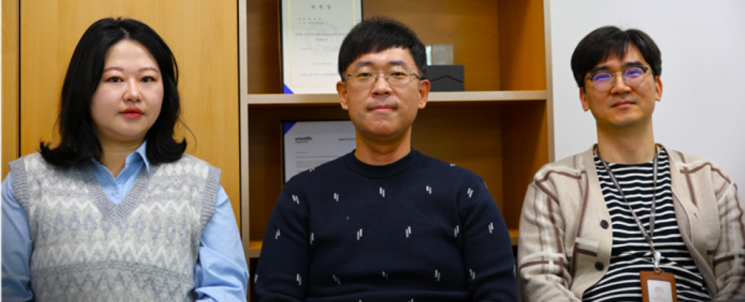 (From left) Dr. Seul-Ah Lee, Postdoctoral Researcher; Jonghyuk Yoon, Senior Researcher; Chanhee Lee, Principal Researcher
Alzheimer's disease affects more than 60% of dementia patients in South Korea, but since treatment effectiveness is limited to the early stages, early diagnosis is extremely important. However, clinical tests and brain imaging methods currently used for Alzheimer's diagnosis are effective mainly in the middle or late stages, and early diagnostic technologies remain insufficient.
Dr. Yoon Jong-hyuk's research team utilized proteomic analysis technology specialized for brain research to obtain multi-proteome information related to Alzheimer's disease, then applied artificial intelligence (AI) technology to discover new signal modules for early Alzheimer's and develop a combined biomarker for early diagnosis.
To understand the pathological mechanisms of early Alzheimer's disease, the team analyzed proteomic information from the hippocampus, cerebral cortex, and plasma extracellular vesicles of Alzheimer's model mice aged 3 and 6 months. As the pathology of Alzheimer's progressed, they observed significant changes in specific proteomic information, including the phosphatidylinositol 3-kinase/protein kinase B enzyme signal module, in the hippocampus and cerebral cortex of the model mice.
The team identified potential biomarker candidates from the multi-proteome data and confirmed the diagnostic potential for early Alzheimer's disease. They selected 125 individuals aged 60 and above, categorized as normal, early-stage, and late-stage Alzheimer's patients through the Mini-Mental State Examination (MMSE), and validated the potential biomarker candidates in their plasma extracellular vesicles. As a result, 12 biomarkers were confirmed to be effective.
Regarding the multi-proteome data and biomarkers, Dr. Lee Chan-hee's cognitive science research team utilized support vector machine (SVM) analysis, a machine learning technique, to discover the optimal combination of biomarkers. The combined biomarker identified by the Brain Research Institute was able to distinguish between normal and early Alzheimer's patient groups with a high accuracy of 78%. The research team has filed an international (PCT) patent for the discovered early diagnostic biomarker for Alzheimer's disease.
Senior Researcher Yoon Jong-hyuk stated, "We expect that the use of omics information and AI technology to develop new diagnostic and therapeutic methods for brain diseases will become more active in the future," adding, "We will focus on the practical application and industrialization of early diagnostic biomarkers for Alzheimer's disease." He also expressed optimism that the biomarkers would have relatively high success rates in clinical trials and could be immediately utilized in future diagnostic technology development. The team has completed international (PCT) and Korean patent applications for the early diagnostic biomarker combination and is exploring technology transfer opportunities.
This study involved Dr. Lee Seul-ah, a postdoctoral researcher at the Korea Brain Research Institute, as the first author, and Dr. Lee Chan-hee as a co-author. The findings were published in the latest issue of the international journal Aging Cell (IF: 7.8).
© The Asia Business Daily(www.asiae.co.kr). All rights reserved.
![Clutching a Stolen Dior Bag, Saying "I Hate Being Poor but Real"... The Grotesque Con of a "Human Knockoff" [Slate]](https://cwcontent.asiae.co.kr/asiaresize/183/2026021902243444107_1771435474.jpg)
















