67.9% of Consumers Say Buffet Restaurant Prices Are Too High
Buffet Usage Declines Due to Price Burden
Some Say Prices Are Reasonable Considering Dessert Costs
Recently, amid prolonged high inflation, the preference for buffet-style restaurants has declined compared to before as dining-out costs have soared. Buffets are generally more expensive than regular restaurants, making them a consumption choice that does not align well with the current economic situation. However, there is also a considerable opinion that buffets are rather reasonable because they allow customers to enjoy a variety of dishes in ample quantities.
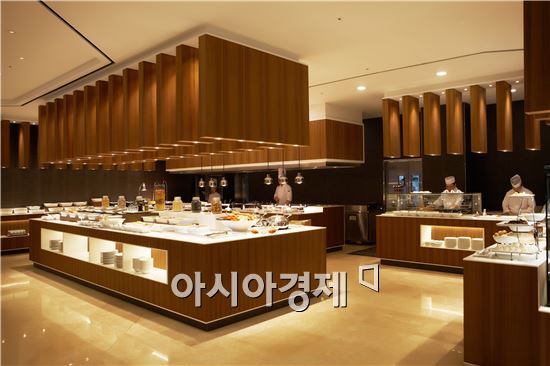
On the 16th, market research firm Embrain conducted the "2023 Buffet Restaurant Related U&A Survey" targeting 1,000 adults aged 19 to 59 nationwide who have experience using buffet-style restaurants. The results showed that 67.9% of respondents felt that buffet prices have risen too much due to inflation, indicating a high level of psychological resistance to the price aspect.
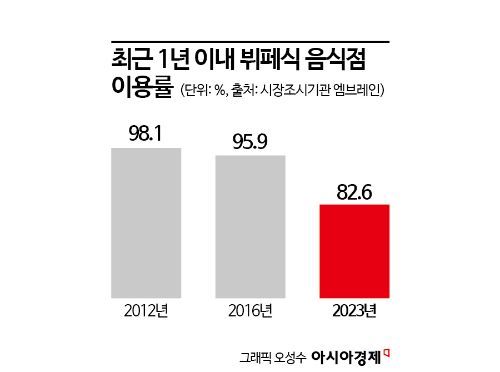
Respondents generally viewed buffet-style restaurants as a type of consumption that does not fit the economic conditions of high inflation and recession. 61.1% of all respondents said they felt it was a waste because they could not eat as much as the price when going to a buffet restaurant. They also showed an attitude that eating mainly high-priced menu items to get their money's worth (57.6%) was the way to break even. As a result, the usage rate of buffet-style restaurants has also declined. In 2012, 98.1% of respondents said they had used a buffet restaurant within the past year, but last year, this dropped to 82.6%.
However, about half of the respondents (49.2%) answered that considering the cost of desserts such as coffee after meals, buffet-style restaurants could actually be a "cost-effective (performance relative to price)" option. Additionally, 40.3% of respondents said that with recent dining-out prices rising so much, buffet restaurants actually feel inexpensive, and 45.2% agreed that it is good to be able to eat as much as they want at a relatively low price. This shows that public attitudes toward buffet-style restaurants coexist with both dissatisfaction and satisfaction regarding price.
Among types of buffet-style restaurants, family restaurant salad buffets were the most visited (77.3%, multiple responses allowed), followed by hotel buffets (71.5%) and Korean food buffets (70.2%). Notably, the usage rate of hotel buffets increased significantly from 55.3% in 2016 to 71.5% last year, confirming that as high inflation and economic downturn continue, interest in cost-effective products is rising, while consumption polarization persists with people opening their wallets for special experiences.
This trend is also clearly reflected in the reasons for visiting buffet-style restaurants. For family restaurant salad buffets, the main reasons cited were being able to enjoy a variety of desired menu items (40.6%) and being able to eat as much as they want (34.4%), indicating a high appreciation for the ability to taste "various menus relative to price." In contrast, for hotels, the highest response (36.0%) was that it is suitable for a special meal, followed by a luxurious atmosphere (34.6%) and visiting because the company is enjoyable (27.3%), showing a difference in motivations.
© The Asia Business Daily(www.asiae.co.kr). All rights reserved.
![Clutching a Stolen Dior Bag, Saying "I Hate Being Poor but Real"... The Grotesque Con of a "Human Knockoff" [Slate]](https://cwcontent.asiae.co.kr/asiaresize/183/2026021902243444107_1771435474.jpg)











