Criticism at Kyungpook National University Special Lecture
Lee Cheol-woo, Governor of Gyeongbuk Province, delivered a special invited lecture titled "Challenges of 21st Century Korea and Globalization Strategies" on the 14th at the audiovisual room of the Gyeongbuk National University Museum in downtown Daegu. The lecture was attended by Lee In-jung, Vice President of Gyeongbuk National University, and other officials related to the Eurasian Silk Road Humanities Advanced Course.
This special lecture was arranged at the special request of Governor Lee by Park Cheon-soo, Director of the Gyeongbuk National University Museum, who judged that in the era of 21st-century globalization, communication and coexistence among political, economic, and cultural experts equipped with humanistic wisdom and insight are necessary, based on domestic and international Silk Road research achievements.
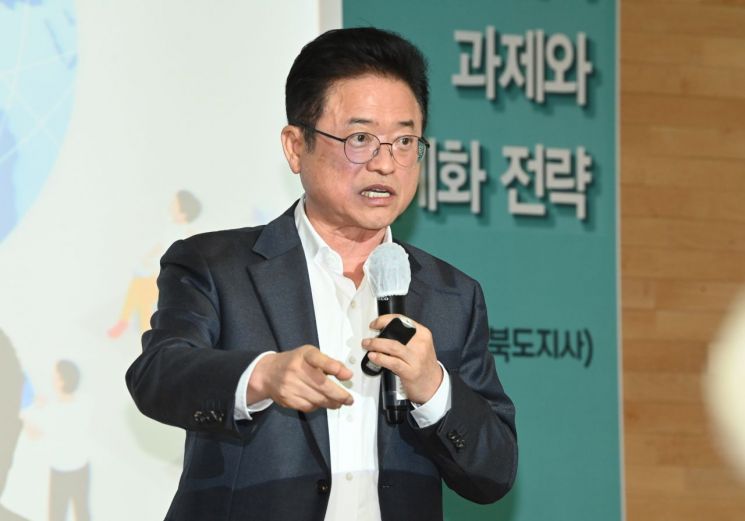 Lee Cheol-woo, Governor of Gyeongbuk Province, giving a special lecture at Kyungpook National University.
On that day, Governor Lee emphasized that Korea was once the poorest country in the world but achieved overwhelming results such as a 386-fold increase in GDP compared to the 1960s and ranking 6th in global exports through a half-century miracle, making it a proud nation.
He shared his usual philosophy that "the country thrives when the regions thrive," stating, "Since the 1970s and 1980s, Gyeongbuk Province has been at the center of Korea's economic growth," and suggested the importance of creating an opportunity for a new leap forward through the humanistic spirit of Gyeongbuk.
He also mentioned the recent crisis Korea faces with ultra-low birth rates, saying, "The fate of the nation depends on how we solve this problem," and emphasized the need to strengthen the authority of local governments as a countermeasure to overcome it.
Governor Lee further diagnosed that Korea's chronic problems of low birth rates and polarization stem from the "Seoul metropolitan area disease," and strongly advocated for solving housing issues and implementing comprehensive care policies to encourage young people to settle in local areas.
The Eurasian Silk Road Humanities Advanced Course at Gyeongbuk National University runs for a total of 16 weeks from March to June and is composed of a variety of Silk Road enjoyment programs including lectures, field trips, and exhibitions.
Governor Lee said, "In the era of the 4th Industrial Revolution, including robots and AI, science, technology, and industry are rapidly developing, making the role of the humanities even more important," and added, "We must develop Korea's culture, tourism, and services into future core industries based on the humanities."
© The Asia Business Daily(www.asiae.co.kr). All rights reserved.

















