Possibility of Establishing a National Medical School in Jeonnam
"It Will Be Easier for Local Students to Enter Medical School"
The government is currently working on allocating the increased 2,000 medical school admission quotas for 2025 to each medical school, reportedly promoting a plan to distribute 20% of the increased quotas to the metropolitan area and 80% to non-metropolitan areas. Additionally, President Yoon Seok-yeol has personally expressed willingness to establish new regional medical schools. As the number of regional medical school quotas is expected to expand further than the original government plan, concerns are being raised that the scale might be increased without proper measures.
On the 15th, Lim Seong-ho, CEO of Jongno Academy, said in a phone interview with this paper regarding the question about the "impact of distributing 20% to the metropolitan area and 80% to non-metropolitan areas," "The gap between universities will widen significantly," and added, "In a situation where the number of students is already decreasing, if the total admission quota increases, the gap between metropolitan and non-metropolitan areas, as well as among universities within regions, will widen considerably." He further criticized, "The distribution of science students in non-metropolitan areas must be considered," and warned, "Some medical schools might not be able to recruit high-scoring students at all." This points out that if the admission quotas are significantly increased without analyzing the demand for science students in non-metropolitan areas, there could be a shortage of demand or a widening score gap among medical schools.
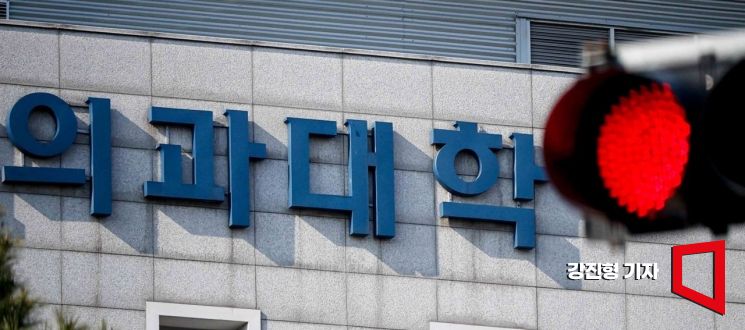 On the 16th of last month, the traffic light near a medical college in Seoul was showing a red light. Photo by Jinhyung Kang aymsdream@
Earlier, the Ministry of Health and Welfare announced a plan to increase medical school quotas by 2,000, stating that more than 60% would be filled through regional talent selection. However, as a more concrete plan was revealed the day before that the government would allocate more than 80% of the increased quotas to non-metropolitan areas, the scale of regional quota increases is expected to grow further. Regarding President Yoon Seok-yeol’s mention of the "establishment of a national medical school in Jeonnam" at a public discussion on livelihood held in Jeonnam the previous day, there is also a possibility that if a national medical school is established in the provinces in the future, the quota increase could exceed 2,000.
If the quotas for non-metropolitan medical schools increase significantly, it is expected to affect students’ admission strategies as well. Nam Yoon-gon, director of the Megastudy Admission Strategy Research Institute, analyzed, "If 80% is allocated to non-metropolitan areas, it means increasing the metropolitan medical school quota from the current 1,000 to 1,400, and increasing the provincial medical school quota from 2,000 to 3,600," adding, "If 60% of the 3,600 are selected as regional talents, that alone exceeds 2,000. So, for students in the regions, getting into medical school will become very easy."
However, medical schools in non-metropolitan areas, which are the targets of the quota increase, welcomed the current government policy. Lee Hae-woo, president of Dong-A University in Busan, said in a phone interview that day, "For small medical schools like ours with fewer than 50 students, if quotas are preferentially allocated, the capacity to operate the medical school will improve," adding, "Currently, with about 49 students, it is difficult to secure residents."
© The Asia Business Daily(www.asiae.co.kr). All rights reserved.
!["The Woman Who Threw Herself into the Water Clutching a Stolen Dior Bag"...A Grotesque Success Story That Shakes the Korean Psyche [Slate]](https://cwcontent.asiae.co.kr/asiaresize/183/2026021902243444107_1771435474.jpg)
















