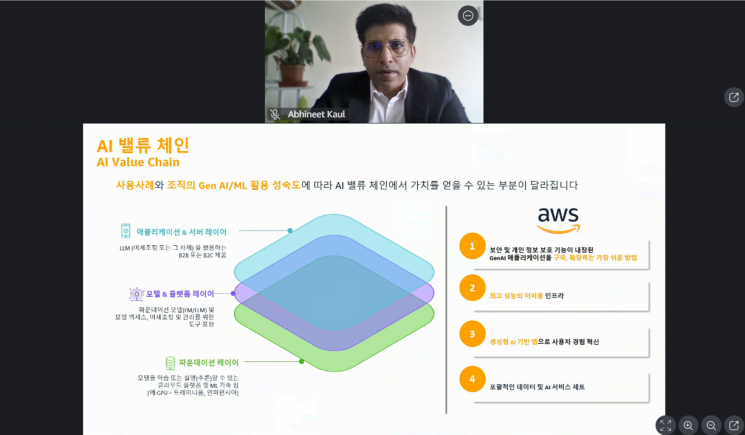
 Abhinit Kaul, Access Partnership Economic Strategy Director, is giving a presentation on "Accelerating AI Capabilities: Preparing the Future Jobs of Asia-Pacific Workers."
 [Photo by Amazon Web Services]
A study has revealed that domestic workers equipped with artificial intelligence (AI) capabilities and expertise could see their annual salaries increase by more than 18%.
Amazon Web Services (AWS) held the 'AWS AI Digital Skills Media Briefing' on the 14th at the AWS Korea office in Gangnam-gu, Seoul. During the briefing, Abhinit Kaul, Director of Access Partnership Economic Strategy, explained the research findings under the theme 'Accelerating AI Capabilities: Preparing Asia-Pacific Workers for the Future of Jobs.'
The survey included in the study showed that domestic employers expect workers in IT and research and development (R&D) fields to enjoy wage increases of 29% and 28%, respectively. Sales & marketing and business operations were estimated at 24%, while finance and legal & regulatory sectors were identified at 23% and 20%, respectively.
Furthermore, 85% of domestic employers anticipated their companies would transform into AI-based organizations by 2028. They expected the IT department to be the biggest beneficiary. Business operations, R&D, finance, legal, sales & marketing, and human resources departments were also expected to generate value.
Employers projected that AI capabilities would automate repetitive tasks (51%), enhance communication (47%), and encourage new skill learning (43%), leading to a 38% increase in productivity. Workers also believed AI would boost efficiency by up to 41%.
Additionally, 87% of workers expected AI capabilities to help improve work efficiency and job satisfaction beyond just salary increases. Sixty-eight percent expressed interest in developing AI skills to accelerate their careers, a trend seen across various generations. Sixty-nine percent of Generation Z and Generation X, 66% of Millennials, and 77% of Baby Boomers said they would enroll in AI skills enhancement programs if offered.
However, more than 64% of Korean companies prioritize hiring AI-skilled talent, but 88% of them reported difficulty finding the necessary personnel. Moreover, 76% of companies responded that they do not know how to operate AI workforce training programs, revealing a gap in educational awareness. Seventy-two percent of workers were uncertain about which jobs would effectively utilize AI capabilities.
The survey involved 15,000 workers and 5,000 employers from nine countries, including Korea, Australia, India, Indonesia, and Japan. In Korea, over 1,600 workers and 500 employers participated.
Director Kaul emphasized, "According to this study, society as a whole will benefit from productivity improvements, leading to salary increases for skilled workers. More organizations are expected to expand the use of AI solutions and tools, with AI-driven innovation continuously advancing."
He added, "Employers and governments need to cultivate skilled personnel who can lead current and future AI developments."
© The Asia Business Daily(www.asiae.co.kr). All rights reserved.
![Clutching a Stolen Dior Bag, Saying "I Hate Being Poor but Real"... The Grotesque Con of a "Human Knockoff" [Slate]](https://cwcontent.asiae.co.kr/asiaresize/183/2026021902243444107_1771435474.jpg)
















