UNIST Professor Jang Sung-yeon’s Team Develops Quantum Dot Junction in Tin-Lead Mixed Metal Perovskite
Joint Research with Korea University Professor Kwak Sang-gyu’s Team Published in Advanced Energy Materials
A technology that maximizes the efficiency of perovskite solar cells has emerged, attracting global attention.
UNIST (President Yong-Hoon Lee) announced on the 14th that Professor Sung-Yeon Jang’s team from the Department of Energy and Chemical Engineering, in collaboration with Professor Sang-Kyu Kwak’s team from Korea University, developed a technology that significantly improves the efficiency of solar cell devices by combining a tin-lead halide perovskite photoactive layer with a quantum dot layer.
This research result utilizes the thin film layer formed by bonding the combined materials to greatly increase the efficiency of the cell. The generated junction layer enhances the internal electric field and significantly reduces defects at the interface, thereby increasing the charge extraction efficiency by extending the charge transport distance.
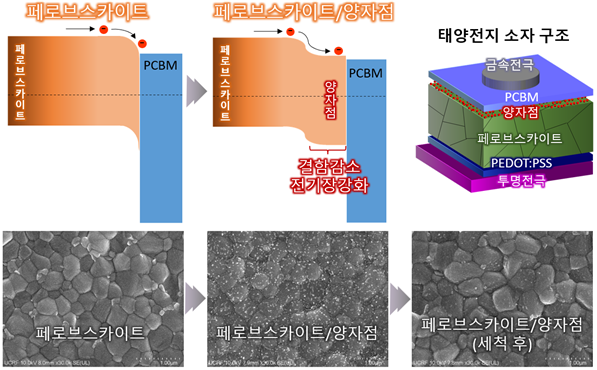
Tin-lead halide compounds are known to have a small energy gap difference between bands. Although they have excellent ability to absorb light in the near-infrared region, they contain many internal defects and have a short charge transport distance, making stable charge extraction difficult.
The research team improved this chronic issue by covering the tin-lead perovskite layer with a thin film of perovskite quantum dots.
According to the study, when the quantum dot material is applied to the surface of the tin-lead halide perovskite thin film, the ‘oleyl ligand’ present on the quantum dot surface significantly improves the defect sites on the perovskite surface, confirming enhanced stability of the thin film.
Thanks to the characteristic differences arising from the different materials, the energy levels align to facilitate electron extraction, enabling efficient charge collection. This means more charges generated by sunlight can be extracted.
The device fabricated using the developed technology achieved a record-high power conversion efficiency of 23.74% for tin-lead halide perovskite solar cells reported to date. This represents about a 20% performance improvement compared to the 19% efficiency observed with conventional fabrication methods.
 (Back row from left) Sanghak Lee, Jinha Hwang researcher, (Front row from left) Professor Seongyeon Jang, first author Muhibullah Al Mubarok researcher.

Professor Sung-Yeon Jang stated, “The convergence of quantum dot technology, a core area of next-generation solar cells, and perovskite solar cell technology has presented a new direction toward high-efficiency solar cells,” adding, “This discovery is a very appropriate research example utilizing the characteristic changes caused by the quantization of materials.”
This research involved Dr. Muhibullah Al Mubarok and integrated MS-PhD course researcher Yujin Kim as first authors. The research results were published online on February 20 in Advanced Energy Materials. The research was supported by the National Research Foundation (NRF) of Korea under the Ministry of Science and ICT.
© The Asia Business Daily(www.asiae.co.kr). All rights reserved.
![Clutching a Stolen Dior Bag, Saying "I Hate Being Poor but Real"... The Grotesque Con of a "Human Knockoff" [Slate]](https://cwcontent.asiae.co.kr/asiaresize/183/2026021902243444107_1771435474.jpg)


















