Fire Caused by Cooking Oil Overheating Due to Safety Device Failure
Receiver Alarm, Factory Staff Forced Shutdown
"Information Not Accurately Communicated to Rescue Workers"
It has been confirmed that in the fire accident at a food processing factory in Mungyeong, Gyeongbuk, last January, where two firefighters died in the line of duty, a factory official had turned off the fire alarm bell, delaying the discovery of the fire. The background of the fatal accident was analyzed to include inadequate information delivery to on-site personnel about the cause of ignition, 'heated cooking oil,' and the factory being constructed with sandwich panels vulnerable to fire. The National Fire Agency has decided to revise on-site procedures focusing on 'firefighter safety' to prevent recurrence.
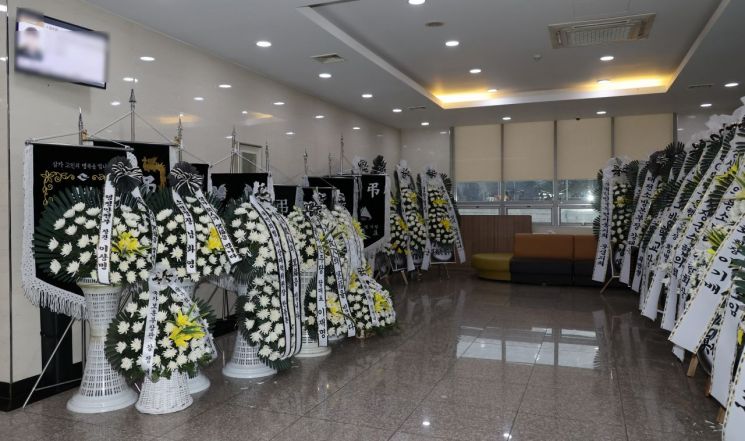
On the 13th, the National Fire Agency held a briefing at the Government Complex Sejong to announce the joint investigation results and recurrence prevention measures related to the fatal accident at the Mungyeong factory fire site in Gyeongbuk. Immediately after the accident on January 31, the National Fire Agency formed a joint investigation committee consisting of 25 members, including the Planning and Coordination Officer, external experts, and on-site personnel, and analyzed the circumstances of the fatal accident over 30 days from February 5 to March 5 to prepare recurrence prevention measures.
"Fire alarm turned off, delayed detection... No information on 'cooking oil' etc."
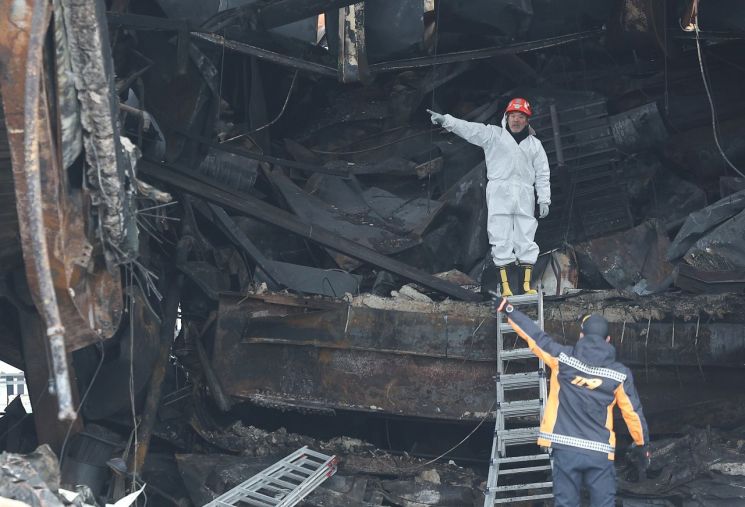
The investigation revealed that the fire started at around 7:35 p.m., 12 minutes before the 119 call was received at 7:47 p.m., from an electric fryer on the third floor of the factory and spread to a cooking oil storage tank (982ℓ). The fire then rapidly spread to the ceiling and interior. The reason the cooking oil was heated beyond its ignition point is presumed to be a malfunction of the temperature controller, a safety device. Additionally, two days before the accident, a factory official forcibly stopped the fire alarm bell, and the 119 call was made only after the fire spread to the third floor. During the briefing, Bae Deok-gon, Planning and Coordination Officer of the National Fire Agency, explained, "According to the official's statement, since the factory processes food using cooking oil, high-temperature conditions sometimes occur. Therefore, the detector occasionally activates, so they stopped the alarm bell."
Inaccurate information delivery appears to have influenced the deaths of the rescue personnel. It was not confirmed whether five factory officials inside the building at the time of the fire had evacuated, so arriving personnel entered the building from both directions. The investigation committee estimated that the combustible gases trapped inside exploded as air flowed in through the door opened by four rescue personnel who entered the third floor to search for people. In this situation, two rescue personnel were trapped by the sudden surge of intense heat, dense smoke, and collapsed ceiling debris, and other personnel could not re-enter to rescue them due to flames and heat.
Kim Jo-il, Deputy Commissioner of the National Fire Agency, stated, "The fire outbreak and spread were due to inaccurate information delivery about the main combustible material, presumed to be cooking oil, and insufficient sharing of on-site activity information such as water application." The factory officials did not provide prior information that cooking oil was inside the factory, and on-site personnel were unaware of this when conducting rescue operations. The factory was also constructed with sandwich panels vulnerable to fire, which caused rapid fire spread and difficulties in fire suppression.
Rapid transmission of essential on-site information... Complete revision of disaster site standard procedures
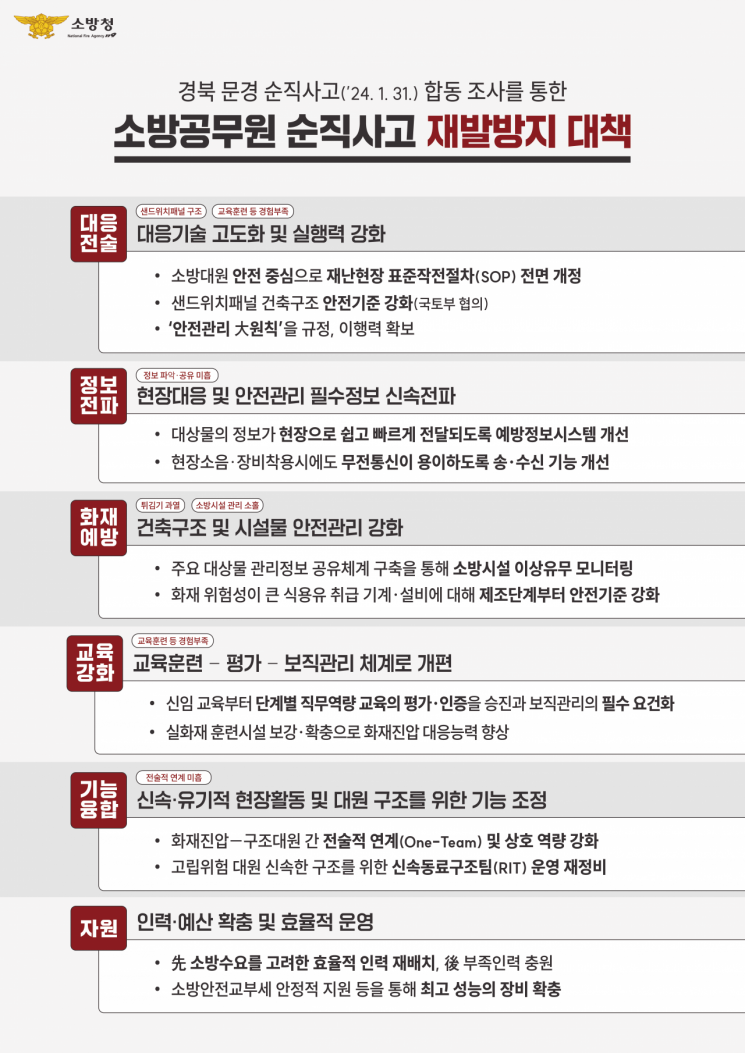
Based on the analysis results, the National Fire Agency prepared recurrence prevention measures divided into short-term and mid-to-long-term tasks.
First, to enhance response technology and execution capability, the disaster site standard procedures (SOP) will be completely revised focusing on firefighter safety. Additionally, the 'Safety Management Principles' that firefighters must strictly follow on-site will be clearly defined to ensure compliance.
Essential information for on-site response and safety management will be prioritized for rapid transmission. To this end, the prevention information system will be improved, including mobile transmission, so that information on the structure of the target object, risk factors, and maintenance of firefighting facilities can be easily and quickly delivered to the site. Transmission and reception functions will also be improved to facilitate radio communication even amid on-site noise and while wearing equipment.
The National Fire Agency will also strengthen safety management of building structures and facilities. For sandwich panel buildings, which have been identified as a major cause of fire spread, safety standards such as fire resistance time and fire compartments will be reinforced in consultation with the Ministry of Land, Infrastructure and Transport. A management information sharing system for major target objects will be established to monitor abnormalities, and safety standards for machines and equipment handling cooking oil with high fire risk will be strengthened from the manufacturing stage in cooperation with the National Institute of Technology and Standards.
From initial training to stepwise job competency education for firefighters, evaluation and certification will be made mandatory, and only those with competencies will be assigned positions such as fire station chiefs. To this end, live fire training will be expanded, and training infrastructure will be strengthened. Originally, eight live fire training facilities were planned to be added by 2026, but this has increased to nine new facilities and six reinforcements.
Furthermore, the National Fire Agency will ensure that Rapid Intervention Teams (RIT) can be immediately deployed in case of firefighter disappearance or entrapment by simultaneously organizing separate RIT teams. For manpower and budget expansion and efficient operation, the principle is to prioritize efficient personnel redistribution considering firefighting demand, and specific reinforcement plans will be prepared for any remaining shortages.
© The Asia Business Daily(www.asiae.co.kr). All rights reserved.
![Clutching a Stolen Dior Bag, Saying "I Hate Being Poor but Real"... The Grotesque Con of a "Human Knockoff" [Slate]](https://cwcontent.asiae.co.kr/asiaresize/183/2026021902243444107_1771435474.jpg)


















