Prime Minister Han Duck-soo expressed his anticipation for the period after next month's general election, stating that if the current 'minority ruling party, majority opposition' political landscape changes, he intends to actively push forward medical reform, labor reform, and pension reform. Regarding the 'postponement of medical school quota expansion' proposed by Seoul National University College of Medicine professors, he responded that "it should not be delayed."
At a press briefing held on the 12th at the Prime Minister's official residence in Sejong City, Prime Minister Han said, "As everyone knows, the coming years will require truly painful reforms."
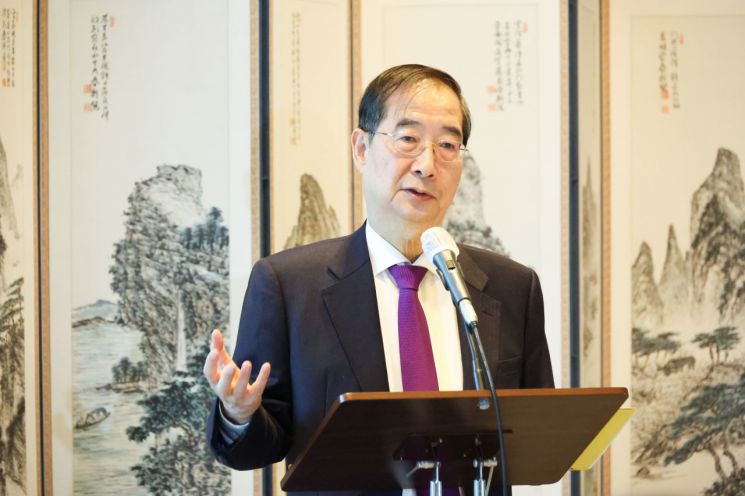
He stated, "In addition to responses in pensions, education, and labor, there will need to be very painful measures for medical normalization reforms and climate change, and especially, there must be tremendous reforms on how to reverse the declining population trend. In that regard, I am truly looking forward to the election on April 10."
Although the government's reform policies have repeatedly been thwarted by the strong opposition of the major opposition party in the current 'minority ruling party, majority opposition' situation, this statement is interpreted to mean that if the political landscape changes after the general election, there will be more room to advance government reform policies.
Prime Minister Han argued, "The political environment will improve somewhat, and through that, a situation similar to when the U.S. Congress met for nearly a year during the Great Depression to take necessary measures and create new systems will probably come to us as well. Otherwise, we will continue to be a country that debates whether the potential growth rate has risen or fallen by a few percentage points."
Regarding the priority of reform tasks the government will pursue if the political landscape between the ruling and opposition parties changes after the general election, he cited improving the dual structure of the labor market, and reforms in education, pensions, and healthcare. Prime Minister Han said, "Improving the dual structure of the labor market, education reform and pension reform related to nurturing people?all of these are important," adding, "Regarding healthcare, the issue of increasing quotas can be handled through government procedures, but many other matters require legislation, so those should be done quickly as well."
He also emphasized youth support and regulatory innovation. Prime Minister Han said, "In the housing sector, it is important whether young people can buy homes suitable to their ability with mortgages over 30 to 40 years based on their income," adding, "Another factor is total factor productivity (an invisible factor of productivity increase). Our society needs to become more transparent and escape unnecessary regulations, and there are many legislative tasks to be done in those areas."
Regarding the proposal by Seoul National University College of Medicine professors to postpone the quota expansion for one year, he said, "Since January last year, the government has started talking about medical reform and has met 130 times with patients, medical staff, hospital employees, nurses, and experts. We have met separately with the Korean Medical Association (KMA) 28 times. However, the KMA has continuously insisted from beginning to end that 'no increase in quota is necessary.' Now, they say there is no scientific basis and want to create new evidence and negotiate step by step? If we do not increase now, it will be delayed by another year."
The government expects a shortage of 15,000 doctors by 2035. Prime Minister Han emphasized, "If we do not do this now and keep postponing, who will suffer the damage? Isn't it the people? I consider postponing this to be a dereliction of government duty."
In response to criticism that increasing the medical school quota by 2,000 at once would not allow proper education, he said, "The average quota per medical school in our country is 77 students, while in the U.S. it is 146, in Germany 243, and in the U.K. 221. This means there is still room to increase," adding, "Legally, one professor can educate up to 8 students, but currently, the average in our medical schools is 1.6 students per professor. There is sufficient capacity to educate good talent."
Regarding the controversy over Minister Lee Jong-seop’s appointment as ambassador to Australia while under investigation by the High-ranking Officials’ Crime Investigation Division (HID) for alleged interference in the investigation of the death of Chae Sang-byung, Prime Minister Han responded, "When I was Deputy Prime Minister for Economic Affairs, some of our staff were also reported and investigated in such cases, but I appointed them as attach?s. However, I promised that if the investigative agencies needed them, they would return at any time to cooperate with the investigation. It is unthinkable for a public official under investigation in our country to be posted abroad as an ambassador and not return."
© The Asia Business Daily(www.asiae.co.kr). All rights reserved.
![User Who Sold Erroneously Deposited Bitcoins to Repay Debt and Fund Entertainment... What Did the Supreme Court Decide in 2021? [Legal Issue Check]](https://cwcontent.asiae.co.kr/asiaresize/183/2026020910431234020_1770601391.png)















