KF-Ministry of Foreign Affairs Publish '2023 Global Hallyu Status'
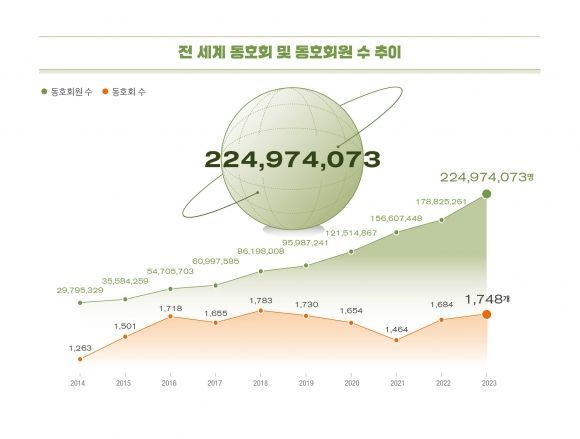
The number of Hallyu fans worldwide has surpassed 200 million. This is the highest number recorded since the counting of Hallyu fans began, and the country with the largest increase in Hallyu fans last year was Mexico.
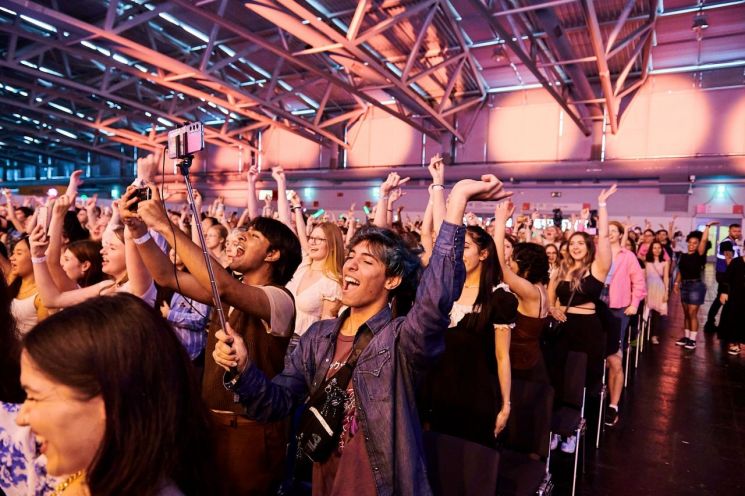 At the '2023 Frankfurt Hallyu Expo' held in Frankfurt, Germany, the audience is enjoying the opening performance.
 [Image source=Yonhap News]
On the 12th, the Korea Foundation (KF), together with the Ministry of Foreign Affairs, announced the "2023 Global Hallyu Status," which captures the current state of Hallyu in 119 countries around the world.
The Hallyu status report compiles data from 172 overseas diplomatic missions in 119 countries on various fields including broadcasting, film, K-pop, Korean cuisine, Korean language, beauty, sports, and e-content. It includes data on Hallyu fans (club members) collected by 161 missions and reasons why locals in each country like Korean culture.
The number of Hallyu fans worldwide was estimated at approximately 225 million as of December last year. This is about 24 times the 9.26 million fans recorded in 2012 when the first Hallyu status report was published, and an increase of 46 million (25.8%) compared to the previous year. Additionally, the number of Hallyu clubs worldwide reached 1,748, about 2.3 times the 757 clubs in 2012, and 64 more than the previous year.
The region with the largest number of Hallyu clubs and fans is Asia and Oceania, accounting for 66% of all Hallyu fans. In particular, China resumed broadcasting Hallyu dramas in 2022, and the number of Hallyu fans there reached 100 million last year. Thailand had the highest number of Hallyu fan clubs, with 123 clubs.
The continent with the largest increase in fan club members last year was the Americas, where the number of Hallyu fans increased by 80% compared to the previous year. Mexico especially led the growth rate of Hallyu fans.
A KF official explained, "During the COVID-19 pandemic, Hallyu fans in the Americas were the second largest consumers of Hallyu content worldwide, which laid the foundation for the evolution into Hallyu 4.0 centered on lifestyle Hallyu, where content consumption led to learning the Korean language." The basis of the Hallyu craze was found to be K-pop and dramas. About 68% of the Hallyu clubs surveyed last year were K-pop clubs, and about 10% were K-drama clubs. KF analyzed, "Korean culture based on Korean narratives and content dealing with hope, love, and family resonated with people and gave them hope."
© The Asia Business Daily(www.asiae.co.kr). All rights reserved.
![Clutching a Stolen Dior Bag, Saying "I Hate Being Poor but Real"... The Grotesque Con of a "Human Knockoff" [Slate]](https://cwcontent.asiae.co.kr/asiaresize/183/2026021902243444107_1771435474.jpg)

















