Search for the Lowest Price of the Same Product via Image Search
"CS Sacrificed for Low-Price Offensive... There Are Risks"
The 'photo search' feature of the Chinese e-commerce application AliExpress is attracting attention from netizens. By simply pasting an image of the desired product into the search bar, it finds similar or identical products and shows them at the lowest price. For some products, the price difference compared to domestic apps is nearly 15 times or more.
Recently, a 'tip' about using AliExpress was posted on an online community, drawing the interest of netizens. The author claimed, "If you capture a photo of the item you need from a domestic e-commerce app and use AliExpress's photo search feature, you can purchase the same product at a cheaper price."
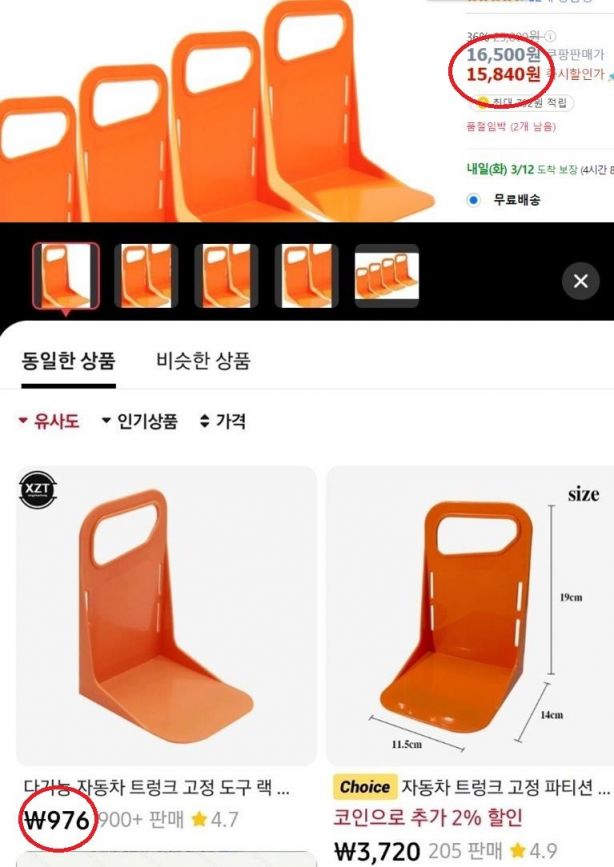 You can purchase the same or similar products much cheaper using the photo search feature on the Chinese e-commerce site AliExpress.
 [Image source=Online Community Archive]
According to the photo posted by the author, a product priced around 15,000 KRW on a domestic app is available for as low as 976 KRW on AliExpress. That is almost a 15-fold difference. The author added, "(Domestic apps) are only good as a source for photos."
Netizens who saw the price difference between AliExpress and Coupang criticized so-called Coupang middlemen who sell low-priced overseas products on Coupang with a markup. They reacted with comments like, "How much profit are they making to price the same product like that?" and "AliExpress is smart. It seems the photo feature was made to be used like this." Some also shared their experiences of purchasing the same umbrellas sold on domestic apps at cheaper prices through Chinese apps.

In fact, Chinese apps are making significant inroads into the domestic market by leveraging aggressive low-price strategies. Representative examples include AliExpress and Temu. According to data on 'Chinese online commerce apps' analyzed last month by Macromill Embrain Panel Big Data, the number of AliExpress installers as of January this year increased by 97.8% compared to the same period last year?almost doubling.
Temu has shown rapid growth since entering the domestic market in July last year. Its growth rate reached 1020.5% in January this year. Both Chinese apps are visibly standing out by ranking within the top tiers of the domestic e-commerce market.
However, users note that the low-price offensive of Chinese apps comes with 'risks.' One netizen said, "It’s impossible to beat China on price. But the reason domestic apps charge more is because customer service is different. Product certification, consultations, and same-day fast delivery are only possible through domestic infrastructure, so the costs are higher."
Another netizen commented, "When buying fragile products from Chinese apps, there is an element of 'luck.' Sometimes items arrive completely broken. Although returns are possible, it’s true that when you urgently need a product, you hesitate to use Chinese apps."
© The Asia Business Daily(www.asiae.co.kr). All rights reserved.
!["The Woman Who Threw Herself into the Water Clutching a Stolen Dior Bag"...A Grotesque Success Story That Shakes the Korean Psyche [Slate]](https://cwcontent.asiae.co.kr/asiaresize/183/2026021902243444107_1771435474.jpg)

















