At the State Council Meeting: "Illegal Collective Actions, Deep Regret"
"Must Reduce Avoidance of Essential Medical Services and Concentration in Big 5 Hospitals"
"Mercury Capital Increased from 15 Trillion to 25 Trillion Won"
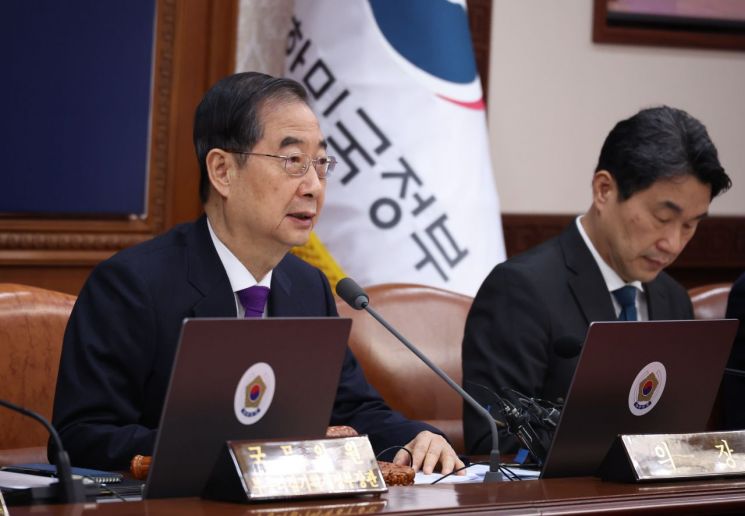 Prime Minister Han Duck-soo is speaking at the Cabinet meeting held at the Government Seoul Office in Jongno-gu, Seoul, on the morning of the 12th. [Image source=Yonhap News]
Prime Minister Han Duck-soo stated on the 12th, "We will establish a system where small but strong specialized hospitals with the expertise of tertiary general hospitals that treat severe patients can receive appropriate compensation based on their capabilities." The aim is to reduce the avoidance of essential medical fields through support for specialized hospitals and to lower the patient concentration at the so-called Big 5 hospitals (Seoul National University Hospital, Severance Hospital, Seoul Asan Hospital, Samsung Seoul Hospital, and Seoul St. Mary’s Hospital).
At the cabinet meeting held at the Government Complex Seoul that morning, Prime Minister Han said, "The government will support the emergence of more small but strong specialized hospitals by creating a system where hospitals at all levels receive appropriate compensation based on their capabilities rather than their size."
As residents have entered their fourth week of leaving medical sites, Prime Minister Han expressed, "I deeply regret the illegal collective actions that ignore the earnest appeals of the public and the government," and reiterated, "Expanding medical school quotas is an unavoidable task." The medical community had argued 20 years ago that there was no shortage of doctors and even demanded a reduction in medical school quotas. It is pointed out that if proactive measures had been taken then, the current reality where patients wander hospitals without doctors in emergencies would not have occurred.
Prime Minister Han strongly indicated that there is no change in his determination to push forward medical reform, saying, "If we neglect the current reality, which has reached a crisis of collapse in essential and regional medical care, the future we face will be even more desperate." Considering that the hospitalization days of those aged 65 and older are 11 times higher than those in their 30s and 40s, it is predicted that by 2035, the hospitalization days of the public will increase by about 45% compared to now.
The day before, Prime Minister Han visited Myongji St. Mary’s Hospital, a cerebrovascular specialty hospital, to respond to the doctors’ collective action. He emphasized the need to resolve the contradiction where essential and regional medical care have collapsed, causing all citizens to go to the Big 5 hospitals, and to ensure that everyone can trust and visit their "local Big 5." Accordingly, the Ministry of Health and Welfare plans to review support measures based on expertise and performance so that specialized hospitals with the expertise of tertiary general hospitals treating severe patients can receive appropriate compensation, not just based on hospital size.
Currently, fee support is applied based on hospital size, with tertiary general hospitals receiving a 15% additional rate, general hospitals 10%, hospitals 5%, and clinics 0%. Because of this, specialized hospitals have been receiving lower fees than tertiary general hospitals despite providing the same treatment and high medical expertise, which has been criticized as unreasonable.
At the cabinet meeting that day, measures to support companies to enhance South Korea’s economic growth potential were also discussed. Prime Minister Han said, "The agenda to increase the Export-Import Bank’s statutory capital from 15 trillion won to 25 trillion won, to timely support export financing necessary for the mega-scale and long-term export and order projects, will be implemented following today’s cabinet meeting," adding, "The government will continue to provide necessary support so that our companies can enter overseas markets more dynamically and extensively."
Meanwhile, Bang Jae-seung, emergency committee chairman of the Seoul National University College of Medicine Professors’ Association, held a press conference at the National Assembly Communication Hall that morning and announced, "If the government does not actively come up with reasonable solutions to resolve the situation, we have decided to voluntarily submit resignation letters starting from the 18th." In response, the government expressed deep concern, stating, "This is very serious as it threatens patients’ lives and health," and urged the professors to stay by the patients’ side.
© The Asia Business Daily(www.asiae.co.kr). All rights reserved.
![Clutching a Stolen Dior Bag, Saying "I Hate Being Poor but Real"... The Grotesque Con of a "Human Knockoff" [Slate]](https://cwcontent.asiae.co.kr/asiaresize/183/2026021902243444107_1771435474.jpg)
















