No Impact of Radiation Exposure on DNA
Thirty-eight years after the Chernobyl nuclear power plant accident, there are claims that a new type of worm unaffected by radioactive contamination has been discovered in the area, drawing significant attention.
On the 9th (local time), the British newspaper The Independent cited research results from a team at New York University, reporting that "an analysis of worms living around the Chernobyl Exclusion Zone (CEZ) revealed nematodes with immunity to radioactive substances." The study was published in the international scientific journal Proceedings of the National Academy of Sciences of the United States of America.
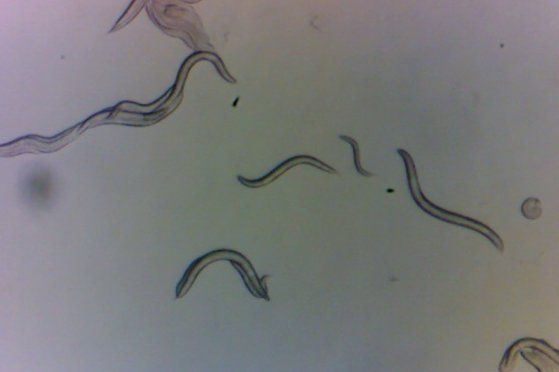 Nematodes found in the Chernobyl exclusion zone. Their DNA does not change due to radiation.
 [Image source=New York University website]
The Chernobyl nuclear accident occurred on April 26, 1986, when Reactor 4 at the Chernobyl nuclear power plant in the northwest region of the former Soviet Union exploded. This caused radioactive materials to spread to the surrounding environment, severely damaging the ecosystem and resulting in hundreds of thousands of casualties due to radiation exposure.
After the accident, a 30 km radius around Chernobyl was designated as the Exclusion Zone (CEZ). However, with no human intervention, various flora and fauna have flourished in the area. The NYU research team analyzed samples from some animals living in the CEZ.
In particular, the team focused on nematodes, worms with relatively simple genomes and rapid reproduction. This allows for easier generational turnover due to new mutations. Genetic analysis of nematodes collected from the CEZ revealed that the genes of certain nematodes were completely undamaged by radiation.
Matthew Rockman, a biology professor and lead author of the study, explained the radiation resistance observed in nematodes: "These worms live everywhere and have short lifespans, so they have undergone dozens of generations of evolution before typical vertebrates mature."
However, he added, "These results do not indicate that the Chernobyl area is safe from radiation," and emphasized, "In some nematodes, strong resilience and the ability to endure extreme conditions are evident."
© The Asia Business Daily(www.asiae.co.kr). All rights reserved.
![Clutching a Stolen Dior Bag, Saying "I Hate Being Poor but Real"... The Grotesque Con of a "Human Knockoff" [Slate]](https://cwcontent.asiae.co.kr/asiaresize/183/2026021902243444107_1771435474.jpg)











