U.S. intelligence agencies have assessed that North Korean Supreme Leader Kim Jong-un almost certainly views nuclear weapons as a tool for regime security and has no intention of engaging in nuclear negotiations. It is analyzed that North Korea seeks international recognition as a nuclear power through military closeness with Russia.
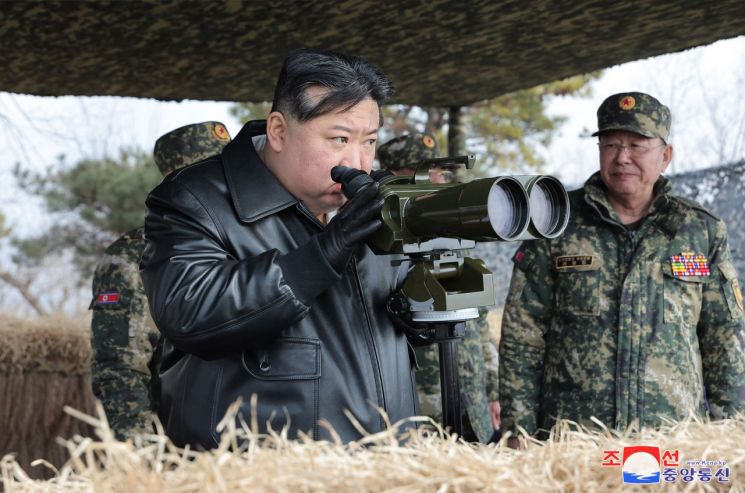
The Office of the Director of National Intelligence (DNI), which oversees U.S. intelligence agencies, stated in its annual threat assessment report released on the 11th (local time), "It is almost certain that Kim Jong-un has no intention of negotiating the dismantlement of the nuclear program." The report noted, "Kim Jong-un perceives nuclear weapons as a tool to guarantee regime security and national pride," and predicted that "he will continue to pursue nuclear and conventional military capabilities that threaten the United States and its allies."
The report also mentioned North Korea's strengthening relations with Russia and China, stating, "Kim Jong-un may seek to leverage a close military relationship with Russia to achieve his goal of gaining international recognition as a nuclear power." It further diagnosed that North Korea is demonstrating through missile launches and nuclear threats in response to the strengthening of U.S.-South Korea-Japan cooperation.
Regarding North Korea's weapons of mass destruction systems, the report said, "Kim Jong-un strongly maintains an expansionist stance on nuclear weapons," and assessed that "North Korea has been preparing to resume nuclear tests at the Punggye-ri nuclear test site since mid-2022." It added, "North Korea maintains biochemical warfare capabilities and may use them in armed conflicts or for unconventional and covert attacks."
The report analyzed, "North Korea is improving its conventional weapon capabilities, but the pace is slower compared to missile development, testing, and deployment," attributing this to resource constraints and prioritization. It also emphasized, "Kim Jong-un will prioritize building more powerful missile systems ranging from cruise missiles to intercontinental ballistic missiles (ICBMs) and hypersonic vehicles," noting that "these are designed to evade U.S. and regional missile defense systems and involve importing dual-use goods from China and Russia in violation of UN sanctions."
Regarding North Korea's cyber threats, the report stated, "North Korea's cyber capabilities are mature and fully capable of carrying out various strategic objectives targeting a wide range of targets, including the United States and South Korea." It predicted, "North Korea will continue cybercrimes such as virtual asset theft, acquiring cash through virtual assets, using them for money laundering, and employing IT workers overseas as an additional source of income."
Furthermore, the report noted, "While North Korea is trying to overcome the aftermath of the pandemic and extreme isolation, in the long term it will need to find a balance between total control policies and economic well-being," suggesting that living conditions for North Korean residents may have deteriorated under Kim Jong-un's regime.
Additionally, the report predicted that China may engage in more aggressive and unpredictable behavior globally due to demographic and economic issues. The Taiwan issue was specifically mentioned as a powder keg that could escalate U.S.-China tensions. Russia, which is prolonging its invasion of Ukraine, and Iran were also assessed as major threats to the international order.
© The Asia Business Daily(www.asiae.co.kr). All rights reserved.
![A Woman Who Jumps Holding a Stolen Dior Bag... The Mind-Shaking, Bizarre Con of a "Human Knockoff" [Slate]](https://cwcontent.asiae.co.kr/asiaresize/183/2026021902243444107_1771435474.jpg)
















