Ministry of Industry Holds Public-Private Joint Battery Alliance Meeting
This year, domestic battery companies in Korea plan to invest more than 9 trillion won in the development of next-generation and mass-market batteries, mineral refining, and recycling. The government has decided to invest 117.2 billion won over the next five years in the development of promising batteries such as all-solid-state, lithium metal, and lithium sulfur by 2028.
The Ministry of Trade, Industry and Energy announced that on the 11th, it held a public-private joint Battery Alliance meeting attended by Minister An Deok-geun to review key tasks for this year and discuss future response plans. At the meeting, the three major battery companies and others expressed their agreement on the necessity of the public-private joint next-generation technology development project and indicated their intention to participate, according to the ministry.
Next-generation batteries refer to secondary batteries that use materials different from conventional ones to dramatically improve battery performance and safety. The government plans to invest a total of 117.2 billion won from this year through 2028 to develop three promising batteries: all-solid-state, lithium metal, and lithium sulfur. A ministry official stated, "In Korea, development is currently underway at the individual company level centered on the three major battery companies, but through this project, it is expected that a next-generation battery ecosystem including domestic parts, materials, equipment, cells, and finished car companies will be established."
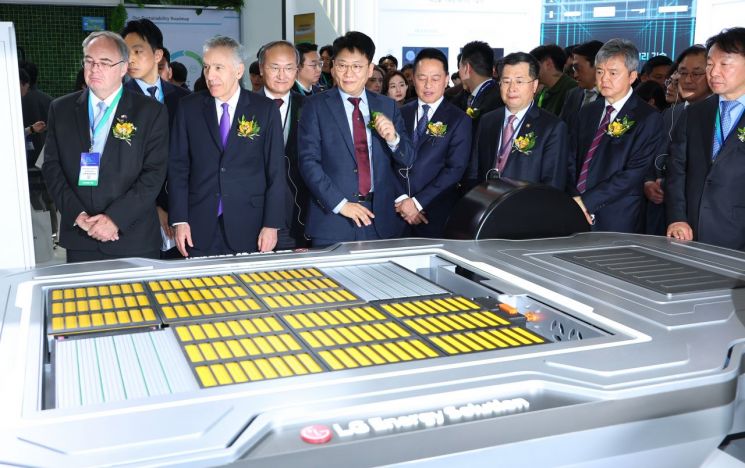 On the 6th, at COEX in Gangnam-gu, Seoul, after the opening ceremony of the 2024 InterBattery, Kang Kyung-sung, the 1st Vice Minister of the Ministry of Trade, Industry and Energy, Kim Dong-myung, CEO of LG Energy Solution and Chairman of the Korea Battery Industry Association, Lee Seok-hee, President of SK On, Choi Yoon-ho, CEO of Samsung SDI, and other battery company representatives visited the LG Energy Solution booth to examine a vehicle platform equipped with batteries based on the Cell To Pack concept.
 [Photo by Yonhap News]
All-solid-state batteries use solid electrolytes to significantly reduce the risk of fire, earning them the nickname "dream batteries," and are expected to be utilized in many fields including electric vehicles. Lithium metal batteries are secondary batteries that improve energy density and lifespan by using lithium metal instead of graphite as the anode material. Since graphite is not used, it is expected to contribute to supply chain stabilization. Lithium sulfur batteries use sulfur instead of lithium in the cathode material, making them lighter than conventional batteries. They are expected to be used in urban air mobility (UAM), where weight is critical.
The ministry plans to announce next-generation battery technology development tasks next month and start the project in the second half of the year.
The ministry also announced plans to support private sector technology acquisition by promoting a sodium-ion battery technology development project this year, following last year's lithium iron phosphate (LFP) battery project. The sodium-ion battery development project will receive 28.2 billion won over four years from this year through 2027.
The three major domestic battery companies began LFP development last year, and material companies such as Ecopro and L&F are also developing cathode materials for LFP. Samsung SDI, Ecopro BM, Kyonggi University, Sogang University, the Ceramic Technology Institute, the Mechanical, Electrical and Electronics Testing Institute, and the Korea Research Institute of Chemical Technology are participating in the government's LFP battery development project. The project period is four years from 2023 to 2026, with a total investment of 23.3 billion won.
According to the ministry, battery companies plan to invest more than 9 trillion won in facilities and research and development (R&D) domestically this year. Of this, a total of 7.1 trillion won is expected to be invested in facility investments.
Major facilities include a 4680 cylindrical battery production plant (Cheongju, scheduled for mass production in August 2024), an all-solid-state battery pilot line (Daejeon), an artificial graphite production plant (Pohang, scheduled to start construction in the second half of 2024), a high-nickel cathode material production plant (Gwangyang, targeted for completion in the first half of 2025), an LFP cathode material production plant (Ulsan, scheduled to start construction in the first half of 2024), a pretreatment plant producing black mass from used batteries (Hwaseong), and a post-processing plant extracting metal minerals (Saemangeum, targeted for completion in the first half of 2024).
At the meeting, Minister An Deok-geun proposed five major tasks for the public and private sectors to solve together this year: ▲ next-generation battery technology development ▲ development of mass-market products ▲ response to trade issues such as the Inflation Reduction Act (IRA) ▲ supply chain self-reliance through domestic investment ▲ establishment of a full-cycle battery circulation system.
The event was attended by battery cell companies including LG Energy Solution, Samsung SDI, and SK On, as well as Hyundai Motor Company, Ecopro, L&F, POSCO Future M, Enchem, Korea Zinc, LS MnM, PM Grow, Korea Mining and Resources Corporation, and the Battery Industry Association.
© The Asia Business Daily(www.asiae.co.kr). All rights reserved.


















