KAIST (President Kwang Hyung Lee) announced on the 11th that the research team led by Professor Jaewook Ahn of the Department of Physics, in collaboration with Professor Klaus MØlmer's research team at the University of Copenhagen, successfully implemented the extreme characteristics of quantum magnets using a Rydberg atom quantum computer, which is currently the most prominent quantum computer platform for performing quantum simulations.
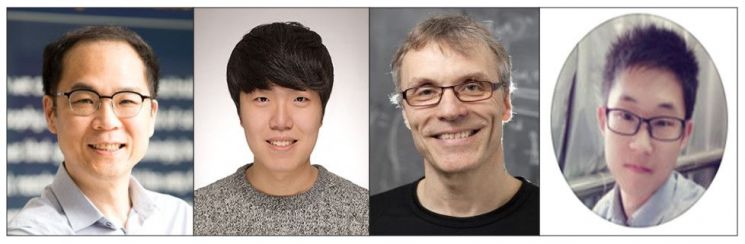 (From left) Professor Jae-Wook Ahn, Department of Physics, KAIST; Kang-Heun Kim, Graduate Student, Department of Physics; Professor Klaus Mølmer, University of Copenhagen; Dr. Fan Yang, Postdoctoral Researcher, Aarhus University, Denmark
Magnetic materials are core elements of modern technology, used in electronic devices such as hard disks and in power generation. Recently, research on quantum magnetic properties at ultra-low temperatures, where quantum characteristics become prominent beyond room-temperature magnets, has been actively conducted. Material analysis and measurement studies performed at ultra-low temperatures are expected not only to be applied in medical devices such as MRI but also to trigger next-generation ultra-precise control and measurement engineering.
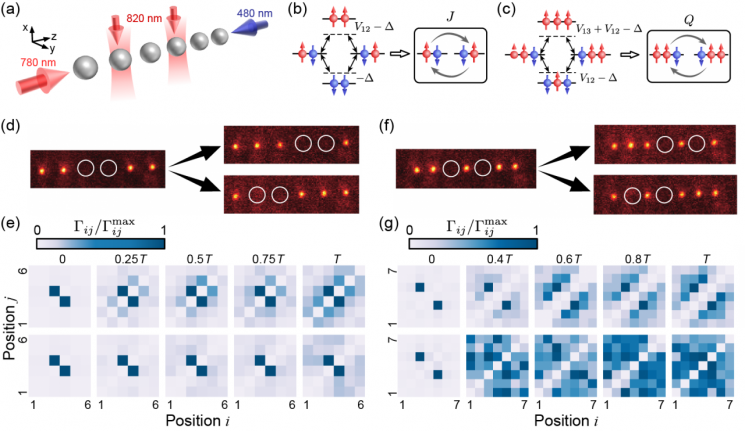 This is the experimental result confirming the time evolution of the Heisenberg model with extreme anisotropy, along with a schematic diagram of the experimental equipment and a schematic diagram showing the propagation of spin.
In this study, the global collaborative research team simulated and implemented the Heisenberg model, one of the models describing quantum magnets, on a quantum computer using Rydberg atoms. Unlike previous implementations of the Heisenberg model, this research succeeded in realizing extreme anisotropy?where interactions in a specific direction in 3D are more than 1000 times stronger than in other directions?by utilizing the strong interactions of Rydberg atoms, thereby opening a new research area.
Professor Jaewook Ahn of KAIST’s Department of Physics, who led the research, stated, “This study demonstrated that new quantum properties can be investigated using Rydberg quantum computers,” and expressed expectations that “material research using quantum computers will become more active.”
Graduate researcher Kangheun Kim from KAIST’s Department of Physics and postdoctoral researcher Fan Yang from Aarhus University in Denmark participated in this study, which was published in the 14th volume of the international journal Physical Review X in February. (Paper title: Realization of an Extremely Anisotropic Heisenberg Magnet in Rydberg Atom Arrays). This research was supported by the Samsung Future Technology Foundation and the National Research Foundation of Korea.
© The Asia Business Daily(www.asiae.co.kr). All rights reserved.


















