"Government Medical School Expansion, Deliberate Violation of Higher Education Act
Is a Criminal Act and Admission Manipulation"
The Council of Professors from 33 Medical Schools Nationwide (Jeonui Gyohyeop) claimed that the government's plan to increase medical school admissions for the 2025 academic year deliberately violates the current Higher Education Act. They rebutted the government's explanation that the increase falls under the exception of 'university structural reform' in the Higher Education Act, stating that for this exception to apply, the policy must aim at a 'reduction' rather than an increase in admissions quotas.
Lee Byung-chul, a lawyer representing the council (from Law Firm Chanjong), announced on the 11th that he submitted a second written statement containing these arguments to the Seoul Administrative Court Administrative Division 11 (Presiding Judge Kim Jun-young), which is hearing the request for suspension of the medical school admission increase. Earlier, on the 5th, the council filed a cancellation lawsuit against the Minister of Health and Welfare and the Minister of Education regarding the increase of 2,000 medical school admissions for the 2025 academic year and applied for a suspension of execution.
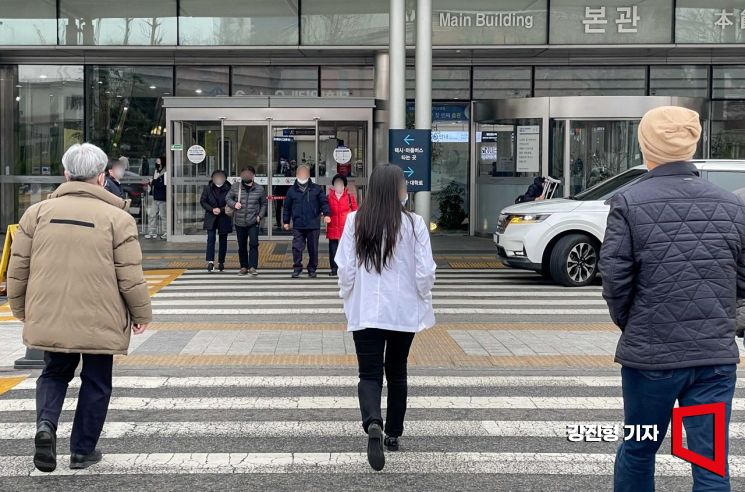 Amid the ongoing strong confrontation between the government and the medical community over the increase in medical school admissions, medical staff are moving at a large hospital in Seoul on the 29th, the government's deadline for residents who left the hospital to return. Photo by Kang Jin-hyung aymsdream@
The council rebutted the government's position that the increase in medical school admissions does not violate the Higher Education Act. On the 8th, the government released reference materials stating, "Although the principle is to announce the university entrance examination implementation plan 1 year and 10 months before the admission year, the increase in medical school admissions falls under the exception in Article 33 of the Enforcement Decree of the Higher Education Act, specifically 'when there is an adjustment of quotas for university structural reform,' allowing changes to the entrance examination implementation plan."
In their written statement that day, the council said, "University structural reform refers to a series of policies conducted by the Ministry of Education in response to environmental changes where university admissions quotas exceed the number of high school graduates due to a sharp decline in the school-age population. These policies aim at the consolidation, restructuring, and 'reduction' of admissions quotas at national and private universities. It is clear that the government's sudden push to increase medical school admissions has nothing to do with 'university structural reform.'"
Furthermore, the council stated, "The purpose of the Enforcement Decree of the Higher Education Act mandating the announcement of the university entrance examination implementation plan at least 1 year and 10 months before the admission year and prohibiting changes thereafter is to provide examinees with information in advance so they can prepare for exams stably and ensure predictable and fair admissions. This is a mandatory regulation, and the deliberate violation of this by the Ministry of Education, Ministry of Health and Welfare, and Ministry of the Interior and Safety constitutes a criminal act of admissions manipulation."
Lawyer Lee predicted, "Jeonui Gyohyeop will soon file a constitutional complaint and injunction related to the medical school admission increase with the Constitutional Court and will criminally accuse the Minister of Education and others at the Corruption Investigation Office for High-ranking Officials for abuse of authority and obstruction of the exercise of rights."
© The Asia Business Daily(www.asiae.co.kr). All rights reserved.

















