Resident Attrition and Emergency Care Response Funded by Contingency and Health Insurance
Health Insurance Expenditure Hits 96 Trillion Won This Year... Deficit Expected from 2026
Health Insurance Financial Stability Possible Based on 'Cumulative Balance'
5th Year of 1st and 2nd Health Insurance Plans, Maintaining Cumulative '28 Trillion'
The government has decided to inject 188.2 billion KRW monthly from the National Health Insurance (NHI) fund starting from the 11th as a countermeasure against the medical service gap caused by the resignation of resident doctors, raising concerns about the soundness of the NHI finances again. The NHI finances are expected to turn into a current account deficit from 2026, and total expenditures are projected to exceed 100 trillion KRW starting next year.
In addition, President Yoon Suk-yeol announced last month a 10 trillion KRW investment over five years for the four essential medical service packages, and with an additional monthly expenditure of 188.2 billion KRW to respond to the medical service gap, concerns are growing that the burden on the NHI finances will increase further. However, the government believes that based on the ‘accumulated balance’ (reserve fund), not the current account balance, the NHI finances can handle this within its scope.
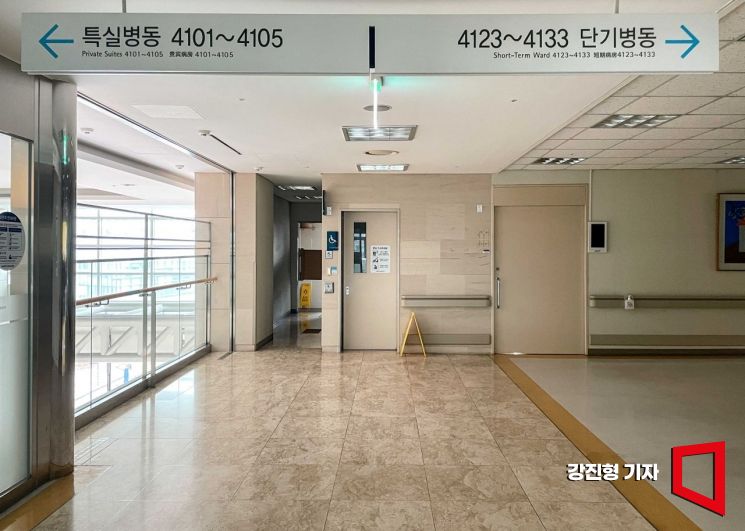 A ward of a university hospital that was closed on the 7th as large hospitals began downsizing operations by reducing the number of beds and staff is empty. Photo by Jinhyung Kang aymsdream@
According to the Ministry of Health and Welfare’s ‘2nd Comprehensive Plan for National Health Insurance (2024?2028)’ announced last month, this year’s NHI expenditure is 96.2553 trillion KRW. On average, this amounts to about 8.0212 trillion KRW per month, so the additional 188.2 billion KRW represents about 2.3% of the monthly expenditure. The government plans to use this cost for strengthening personnel in preparation for prolonged emergency medical systems and compensating deficits in tertiary medical institutions.
The government has not yet finalized the detailed expenditure items for the 188.2 billion KRW. However, it plans to allocate 100 billion KRW for ‘post-compensation to institutions treating severe patients.’ This money will partially cover the deficits incurred when maintaining and actually providing care for severe patients at training hospitals that have lost specialists. The remainder will be used for additional compensation for the transfer of mild patients, establishing policy support funds for specialists such as professors treating critically ill patients, and strengthening compensation for rapid response teams.
Regarding the government’s urgent injection into the NHI finances, concerns have been raised that it will accelerate the already ongoing deterioration of financial soundness. The Movement Headquarters for Blocking Medical Privatization and Realizing Free Medical Care (Free Medical Movement Headquarters) opposed this in a statement, saying, “This is an attempt to cover the revenue decline of large private hospitals caused by doctor departures with the NHI finances.”
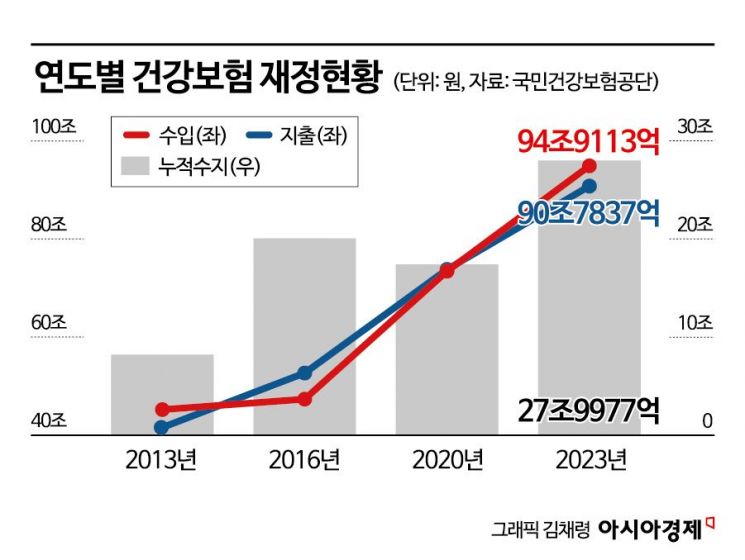
NHI expenditures have more than doubled over the past decade. According to the National Health Insurance Service’s ‘Annual Status of National Health Insurance Finances,’ benefit expenditures, which were 41.5287 trillion KRW in 2013, exceeded 50 trillion KRW in 2016 and reached 90.7837 trillion KRW last year, increasing by 118% over ten years. Next year, it is expected to reach 104 trillion KRW. According to the 2nd comprehensive plan, the NHI finances will turn into a current account deficit from 2026. In this situation, an additional monthly expenditure of 188.2 billion KRW will deepen the deficit trend.
The 188.2 billion KRW to be injected this month has already been approved by the subcommittee of the Health Insurance Policy Deliberation Committee (HIPDC), but the Ministry of Health and Welfare reported to the HIPDC that if the medical service gap is not resolved within a month, the financial injection may be extended. A ministry official said, “Since the NHI financial injection is on a ‘monthly’ basis, if the emergency medical situation prolongs, it will be extended month by month,” adding, “The goal is to prevent the situation from becoming prolonged.”
The government explains that the urgently allocated 188.2 billion KRW can be managed within the NHI finances. The basis is the ‘accumulated balance,’ not the ‘current account balance.’ The stability of the NHI finances is judged by the accumulated balance, and the Ministry of Health and Welfare analyzes that this level of financial injection is not a big problem given the operational policy to maintain a similar accumulated balance at the end of the 1st comprehensive plan (2023) and the 2nd comprehensive plan (2028). The accumulated balance of the NHI finances recorded a surplus of 27.9977 trillion KRW last year. It increased to 30.6 trillion KRW this year and is expected to decrease to 28.4209 trillion KRW in 2028.
Lee Jung-kyu, Director of the Health Insurance Policy Bureau at the Ministry of Health and Welfare, said, “The goal is to maintain an accumulated balance surplus at a level similar to the last year of the previous project in the 5th year, which is the final year of the NHI comprehensive plan,” adding, “The current account balance may be in surplus or deficit in the short term, but since the accumulated balance maintains a surplus of around 28 to 30 trillion KRW, we can stably maintain the accumulated balance even if we spend an additional 188.2 billion KRW monthly for the time being.”
© The Asia Business Daily(www.asiae.co.kr). All rights reserved.


















