Shin Ramyun 'Hot Topic' Sold in Japan
Nongshim "Due to Different Food Cultures"
There is a controversy over claims that the quality of Shin Ramyun sold in Japan differs from that sold in Korea.
Recently, on various SNS and communities, public opinion is spreading that "instead of eating Japanese cup noodles in Japan, it is better to spend that money on Shin Ramyun."
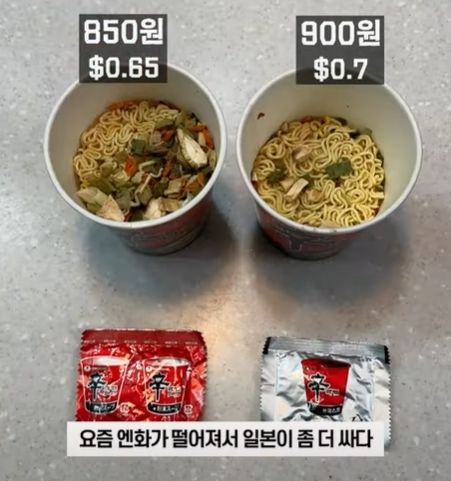
A person identified as A, currently residing in Japan, directly compared Shin Ramyun cup noodle products sold in Korea and Japan, finding that the Japanese version contained significantly more dried ingredients such as green onions, chili peppers, and mushrooms. Moreover, due to the depreciation of the yen, the Japanese product is cheaper, leading to dissatisfaction among domestic consumers. A said, "(Japanese Shin Ramyun) has a generous amount of dried ingredients. Honestly, the Japanese version of Shin Ramyun tastes the best," recommending it. The video has become a major topic, surpassing 6 million views as of that day.
Another YouTube channel, Jjapjoreum Doctor, also uploaded a video comparing Japanese and Korean Shin Ramyun. However, Jjapjoreum Doctor evaluated that "the Japanese product overwhelmingly has more dried ingredients," while rating the taste of the noodles and broth as better in the Korean Shin Ramyun.
Currently, the price of a small cup of Shin Ramyun at convenience stores in Korea is 1,150 won, and at discount marts, a pack of six costs between 850 and 920 won per cup. In Japan, it is about 150 yen (approximately 1,341 won) at convenience stores and 100 to 130 yen (approximately 894 to 1,162 won) at discount marts.
This is not the first time that Shin Ramyun has caused controversy for producing different products depending on the country. In 2010, it was revealed that the amount of noodles differed in the Chinese version (65g), Japanese version (61g), and Korean version (44g), and that only the Japanese dried soup contained seasoned egg, sparking controversy. Some even argued that "only domestic consumers are being exploited" and called for a boycott of Shin Ramyun.
At that time, Nongshim explained, "Food cultures differ by country," and asked consumers to "consider the price differences, which can be nearly double."
© The Asia Business Daily(www.asiae.co.kr). All rights reserved.

















