BBC Seoul Correspondent's Speech at Women's Day Commemoration Event
On the occasion of International Women's Day on March 8, Jin Mackenzie, BBC Seoul correspondent, who gave a lecture, said, "What Korean women who have gone on a 'birth strike' truly want is a change in social awareness and flexible working hours." Mackenzie recently attracted attention with an article titled "Why Korean Women Are Not Having Children."
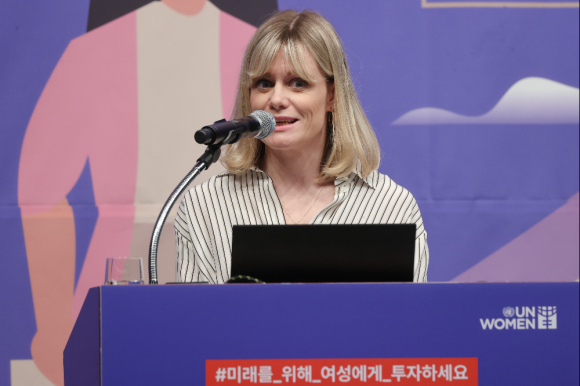 Jin McKinsey, BBC News Seoul correspondent, is giving a lecture at the International Women's Day commemorative event on the 8th.
 [Photo by Yonhap News]
On the 8th, Yonhap News and others reported that Jin Mackenzie, BBC Seoul correspondent, attended as a speaker at the International Women's Day commemorative event hosted by the UN Women Gender Equality Center, diagnosing the causes of Korea's low birthrate issue through cases of Korean women she personally met. Mackenzie said, "When I first came to Seoul two years ago, someone told me that 'Korean women are on a birth strike,'" adding, "Since then, various policies have been introduced, but the birthrate has continued to decline." She continued, "Korea's total fertility rate in the fourth quarter of last year fell to the 0.6 level for the first time in history," emphasizing, "Especially in Seoul, it is almost as if nearly all women have chosen not to have children."
Mackenzie revealed that she traveled across the country to meet many women in order to understand the reasons for the declining birthrate. She first shared the case of a woman who gave up on childbirth. She said, "A woman who leaves work at 8 p.m. and receives IV drips on weekends to prepare for Monday's work said she has no time to raise a child," adding, "Many were particularly worried that having children would mean leaving their jobs."
She also shared stories of women struggling with childcare. She said, "A working mom confessed that contrary to what she learned in the past?that men and women are equal?her husband did not help with childcare and housework, so she had to do 'childcare alone,'" pointing out, "If it were not for such situations, many women would have willingly chosen pregnancy and childcare."
She went on to emphasize that Korean women "give up childbirth because they know what it means to become a mother in Korea and understand the reality," adding, "If knowing the reality prevents childbirth, then the reality itself must change." She pointed out, "Ultimately, long working hours and unfair childcare sharing make women reluctant to have children." Mackenzie said, "Now Korean women do not want to choose only one between family and work," adding, "What they want is a change in social awareness and flexible working hours." She also added, "Korean society needs to consider the fact that pouring huge amounts of finances is not effective in solving the low birthrate problem."
About 200 people from government, diplomatic circles, business, and academia attended the event held by UN Women that day. Tamara Mohyani, Canadian Ambassador to Korea, who attended as a speaker, said, "Gender equality is not a 'zero-sum game' but a 'win-win game,'" emphasizing, "Men's participation is necessary to achieve this transformation." She stressed, "Gender equality does not mean taking away someone's rights but empowering women without depriving men of their rights," adding, "It does not mean sacrificing or excluding men."
© The Asia Business Daily(www.asiae.co.kr). All rights reserved.

















