"Discovered While Building Residential Structure"
Seventeenth-Century Plague Victims Likely Buried
A mass burial site containing over 1,000 corpses has been discovered in the center of Nuremberg, Germany. Local cultural authorities believe it to be a burial ground for victims of past epidemics.
On the 6th (local time), CNN cited a statement from the Nuremberg Cultural Heritage Preservation Department, reporting, "While investigating to build new residential buildings in the city center, a mass burial site containing more than 1,000 skeletal remains was found."
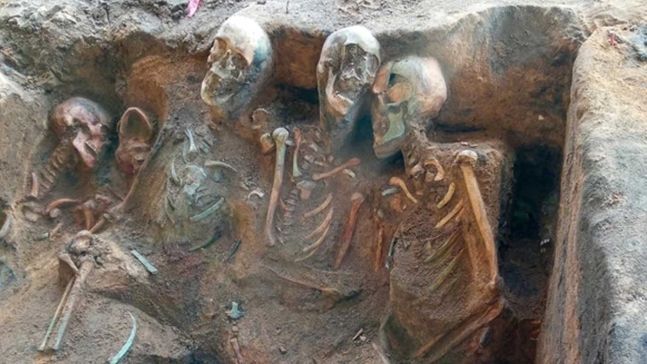 Large mass burial site discovered in Nuremberg, Germany [Image source: Terra Veritas, archaeological excavation company website]
According to the German cultural authorities, the burial site is divided into eight pits, each containing skeletal remains. The number of remains discovered so far exceeds 1,000, and it is estimated that an additional 500 remains will be found. Melanie Langbein, spokesperson for the Cultural Heritage Preservation Department, speculated, "It is highly likely that this is a burial site for people who died from epidemics such as the plague in the 17th century." She explained, "Fragments of pottery and coins presumed to be from the 17th century were found within the burial site."
The plague is an infectious disease transmitted to humans by fleas that parasitize black rats, spreading across the Eurasian continent roughly from the 14th century to the early 19th century. In particular, the 14th-century plague outbreak is estimated to have caused the deaths of over 100 million people at the time. The plague outbreak sacrificed 30% to 60% of the European population, profoundly impacting religion, social structure, culture, and industry. Langbein added, "We found records related to an epidemic from 1632 to 1633 at the burial site," and "The outbreak claimed about 15,000 lives."
Authorities are currently proceeding with the excavation of the burial site. The research team that began the work told CNN, "The graves include representative samples of the society at the time, which will be used to investigate the characteristics of the population then," and added, "We plan to continue analyzing the epidemic bacteria and examining parasite eggs in the soil in cooperation with various institutions."
© The Asia Business Daily(www.asiae.co.kr). All rights reserved.

















