US Senate Says "Interest Rates Restrictive... Higher Than Neutral Rate"
S&P 500 Index Hits Record High... Treasury Prices Rise
Jerome Powell, Chairman of the U.S. Federal Reserve (Fed), stated that while the Fed will not cut interest rates immediately, the time to gain the necessary confidence for a rate cut is not far off. The market interpreted this as a more dovish stance (favoring monetary easing) compared to his remarks the previous day, which suggested a rate cut within the year. The New York stock market rose across the board, with the Standard & Poor's (S&P) 500 index hitting an all-time high, and bond prices also increased.
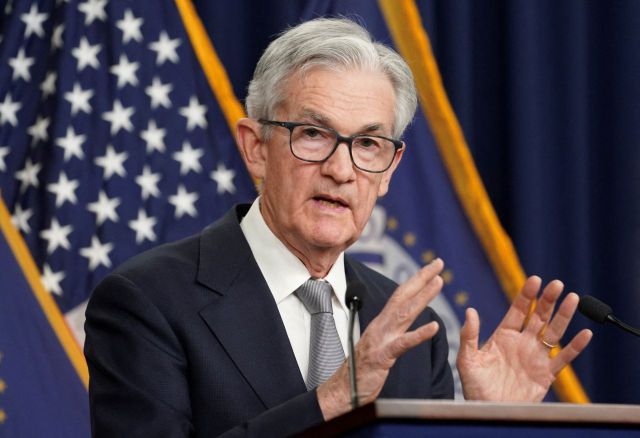
On the 7th (local time), Powell appeared before the U.S. Senate Banking Committee and said, "We believe we are in an appropriate position," adding, "It will be appropriate to reverse the current restrictive level of interest rates to avoid a recession when we gain more confidence that inflation is sustainably declining to 2%." He further stated, "We're not far from that point."
He also assessed that the current interest rates are higher than the 'neutral rate.' Powell said, "Rates have now entered a restrictive territory," and "They are above the neutral rate and now far from it."
The neutral rate is a theoretical interest rate level that allows the economy to achieve its potential growth rate without overheating or recession. Despite the Fed raising the benchmark interest rate to around 5.25-5.5%, the U.S. economy has maintained solid growth, leading academics to suggest that the neutral rate itself has risen. The central bank's main task is to bring the benchmark rate close to the neutral rate. Powell's statement that the current rate is above the neutral rate implies that the rate level is restrictive and that a rate cut is likely to follow soon.
Regarding the Personal Consumption Expenditures (PCE) price index, the inflation indicator most closely watched by the Fed, Powell said, "It has sharply slowed since mid-last year," and "significant progress has been made." The January PCE price index and core PCE price index rose 2.8% and 2.4% year-on-year, respectively, marking increases in the 2% range.
In response to concerns that the cumulative tightening effect could worsen the labor market, Powell acknowledged, "We are well aware of that risk," but reaffirmed the existing stance that the inflation slowdown must continue.
When asked by Senator Sherrod Brown, a Democrat, why the Fed is not cutting rates sooner to prevent worker layoffs, Powell said, "If strong growth, a robust labor market, and continued progress in slowing inflation persist, I expect the process of cautiously removing restrictive monetary policy will begin sometime this year." According to the U.S. Department of Labor's announcement that day, the number of continuing unemployment claims for at least two weeks was 1,906,000 for the week of February 18-24, an increase of 8,000 from the previous week.
Powell's remarks that day were a continuation of the cautious approach to early rate cuts emphasized since the January Federal Open Market Committee (FOMC) meeting. However, by mentioning that the timing for a cut is near, he delivered a more dovish message than his previous day's statement, which anticipated a cut within the year.
Adam Turnquist, Chief Technical Strategist at LPL Financial, analyzed, "The market has been expecting this, and finally heard it from a Fed official," adding, "(Powell is) increasing confidence in the market that rate cuts are approaching."
The market expects the Fed to make its first rate cut in June. According to the Chicago Mercantile Exchange (CME) FedWatch tool, the federal funds futures market on that day priced in nearly a 74% probability that the Fed will cut rates by at least 0.25 percentage points in June, up from 69% the previous day.
The financial market welcomed Powell's remarks. On the New York Stock Exchange (NYSE) that day, the large-cap-focused S&P 500 index closed at 5,157.36, up 52.6 points (1.03%), marking a record high. The blue-chip Dow Jones Industrial Average rose 130.3 points (0.34%) to 38,791.35, and the tech-heavy Nasdaq index gained 241.83 points (1.51%) to close at 16,273.38. Bond prices rose on expectations of rate cuts (bond yields fell). The 2-year Treasury yield, sensitive to monetary policy, dropped 5 basis points (1bp = 0.01 percentage points) to 4.5%, and the U.S. 10-year Treasury yield, a global bond benchmark, fell 4 basis points to around 4.08%.
© The Asia Business Daily(www.asiae.co.kr). All rights reserved.

















