Ministry of Land, Infrastructure and Transport Announces Statistics on the 'Real Estate Service Industry'
Total Businesses 277,939... Licensed Real Estate Agencies Account for 40%
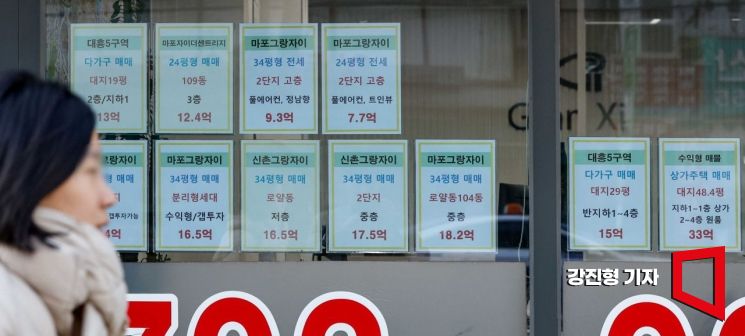 As the government announced that it will freeze the actualization rate of publicly announced real estate prices at the 2020 level, on the 21st, sale and jeonse prices are posted at an apartment complex in Seoul. Photo by Kang Jin-hyung aymsdream@
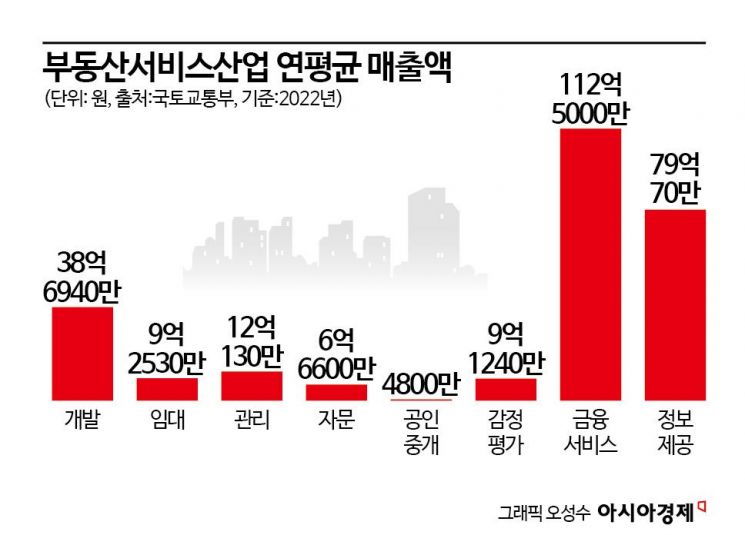
Annual Sales '11.2 Billion KRW vs. 48 Million KRW'
The real estate service industry also showed a 'rich get richer, poor get poorer' divide depending on the business sector. While real estate financial services such as REITs recorded average annual sales exceeding 10 billion KRW, the average annual sales of licensed real estate agents were found to be less than 50 million KRW.
On the 8th, the Ministry of Land, Infrastructure and Transport (MOLIT) announced the results of the "2022 Real Estate Service Industry Survey at a Glance," which included these findings. MOLIT surveyed 4,000 companies nationwide engaged in the real estate service industry, dividing them into eight business sectors (development, leasing, management, consulting, licensed real estate brokerage, appraisal, financial services, and information provision) to assess management status and business conditions. This is the first survey result released since it was designated as a national approved statistic in October last year.
The total sales of the real estate service industry were estimated at 254 trillion KRW. Development, including project implementation companies, accounted for the largest share at 55.4% (approximately 140 trillion KRW). Looking at average sales by industry, real estate financial services such as REITs had the highest average sales at 11.25 billion KRW.
REITs refer to real estate indirect investment vehicles that collect funds from investors to invest in real estate and then return dividend income to the investors. Due to high interest rates, they showed weakness over the past two years but have recently been recovering. Rental income from real estate tends to be maintained regardless of the economy or interest rates, making it relatively profitable during downturns.
On the other hand, the average annual sales of licensed real estate brokerage services were the lowest at about 48 million KRW. A MOLIT official explained, "There are many small-scale brokerage offices nationwide, and overall sales decrease during real estate downturns."
Among the total 277,939 real estate service industry businesses, licensed real estate brokerage services accounted for the largest portion at 40.1% (111,516 businesses). Following that, real estate leasing, referring to private rental businesses, accounted for 27% (75,043 businesses). Financial services numbered only 556 businesses.
About 46.3% (128,686 businesses), nearly half of all businesses, evaluated their "business performance as worse" compared to the previous year. In particular, negative evaluations were highest in licensed real estate brokerage services at 64.8%, while financial services had the lowest negative evaluation at 12.9%.
The total number of workers in the real estate industry was approximately 783,210. Real estate management accounted for the largest share at 37.6% (294,834 people), followed by licensed real estate brokerage services at 21.7% (170,160 people). Workers in financial services accounted for only 0.6% (4,682 people).
By gender, male workers accounted for 65.7% (514,569 people), significantly more than female workers. Among workers, 71.9% (563,128 people) were aged 50 or older. Except for appraisal, financial services, and information provision sectors, the majority of workers in other businesses were aged 50 or older. Workers in their 20s and 30s accounted for only 11.4% (89,286 people).
© The Asia Business Daily(www.asiae.co.kr). All rights reserved.


















